Overview
Property is one of the highest-stakes B2B and B2C categories in existence. Whether a potential client is considering placing £50,000 with a buy-to-let investment company, sourcing £10 million in development finance from a capital advisory firm, or evaluating a PropTech platform that will underpin their portfolio management — the decision involves significant financial commitment and genuine personal risk. The website is doing active work in that decision. It is either building the conditions under which a high-stakes financial decision feels safe to make, or it is failing to do so.
Most property company websites fail at this. They look acceptable. They present the service. They have a contact form. They do not build the specific combination of authority, transparency, and commercial clarity that property buyers and investors need to feel confident enough to make contact. The gap between a property website that generates qualified enquiries and one that merely occupies a URL is almost always a gap in strategic thinking, not visual design.
This guide covers everything a property company needs to know about building a website that performs commercially — from investment advisories and property developers to PropTech platforms serving the UK market.
In this guide:
- The trust problem that defines property web design
- The property sector is not one market — and your website cannot treat it as one
- What property investors and clients expect from a website
- Design principles that build credibility in property
- Platform choice for property companies
- CRM integration and lead generation architecture
- Content strategy for property websites
- What a property website project involves
- How much does a property website cost?
- Property sectors we work in
- Frequently asked questions
Find out more about our property web design service.
1. The trust problem that defines property web design
Every sector has a trust challenge. Property's is acute. The sums of money involved are large. The decisions are long-term and often irreversible. The market has a well-documented history of poor actors, failed developments, and investment schemes that did not deliver. Buyers and investors carry this awareness into every website visit, consciously or not.
A property company website that fails to address the trust question directly — through specific, verifiable evidence of track record, through transparent communication of risk and process, through visible credentials and named client relationships — will lose visitors who would have been excellent clients. They simply will not make contact. You never know they were there.
What trust looks like in practice
- Named track record. Not 'we have arranged over £500 million in funding' buried in an about page, but surfaced prominently as a credibility anchor on the homepage. Numbers are only credible if they are specific and visible.
- Named clients and named deals. Where confidentiality allows, the names of clients, the sectors they operate in, and the outcomes achieved are far more persuasive than aggregate statistics or unnamed testimonials.
- Team visibility. In property, relationships matter. Named individuals with backgrounds, experience, and photographs communicate that there are real, qualified people behind the business. An anonymous corporate website in a sector built on personal relationships is a contradiction.
- Regulatory and compliance transparency. FCA authorisation, RICS membership, FSCS protection status — any credentials that a client would look for during due diligence should be findable within two clicks, not buried in footer text.
- Process transparency. What happens after someone makes contact? A clearly explained process — in steps, with timescales, with an honest description of what the client will be asked to provide — reduces the anxiety that prevents enquiry. Most property websites skip this entirely.
| The invisible shortlist |
| A sophisticated property investor evaluating three investment companies does most of their due diligence online before making contact with any of them. If your website does not communicate the credibility signals they are looking for, you are removed from the shortlist before your team ever gets a call. The shortlisting happens invisibly. The only way to be on it is to build a website that earns it. |
2. The property sector is not one market — and your website cannot treat it as one
Property is a broad commercial category encompassing fundamentally different business models, buyer types, and website requirements. A website built for a capital advisory firm needs to communicate very differently from one built for a PropTech SaaS platform or a residential property investment company. The mistake many property companies make is treating 'property' as a sufficient brief and applying generic property aesthetics — dark blues, architectural photography, aspirational copy — regardless of what the business actually does and who its buyers are.
Property investment companies
Serve investors seeking returns from residential or commercial property. Buyers range from first-time buy-to-let investors to experienced landlords managing portfolios. Often serve international investors as well as domestic ones. The website needs to serve these audiences simultaneously: accessible enough for new investors, credible and data-led enough for experienced ones. Key design challenges: communicating the investment thesis clearly, explaining the risk-return profile honestly, and supporting both UK and international buyers through culturally appropriate content and journeys.
See our guide to property investment website design.
Property development companies
Build and sell residential or commercial developments. Buyers are typically owner-occupiers or investors purchasing off-plan. The website sells something that does not yet exist: the quality of what is being built, the credibility of the developer, and the desirability of the location. Key design challenges: presenting CGIs and specifications compellingly, communicating the developer's track record across previous schemes, and managing the off-plan sales process from interest registration to reservation.
See our guide to property developer website design.
Property investment and capital markets
Provide debt and equity financing, transactional advice, or capital structuring for commercial and residential property. Clients are typically professional developers, institutional investors, or high-net-worth individuals. The website serves a sophisticated audience that is evaluating expertise, network, and track record. Key design challenges: communicating authority without arrogance, making a complex service offering navigable, and supporting digital marketing campaigns that drive qualified enquiries.
See our guide to property investment website design.
PropTech platforms
Technology businesses whose product sits within the property ecosystem: investment platforms, company formation tools, property management software, mortgage technology, and more. Often B2B SaaS or consumer fintech with property as the vertical. The website serves both an investor acquisition function (find the right buyers for the platform) and an investor education function (explain a new or complex concept clearly). Key design challenges: making a technical product feel accessible, converting multiple audience segments with distinct onboarding paths, and supporting a fast-moving product roadmap.
See our guide to PropTech website design.
3. What property investors and clients expect from a website
The specific expectations of property buyers and investors are shaped by the financial stakes involved and by the sector's trust history. Meeting them is not optional if lead generation is the objective.
Immediate authority signals
A property professional or investor arriving on a website is assessing within seconds: does this company operate at the level my situation requires? The signals they look for in the first scroll: AUM or deal volume with specific numbers, years of operation, names of clients or investment partners in recognisable sectors, and team credentials. Generic claims of expertise do not register. Specific, verifiable evidence does.
Clear service explanation
Property services are often complex, nuanced, and specific. What exactly does the company do, for whom, and what does the client experience look like? Most property websites answer the first question superficially and skip the second and third entirely. A buyer who cannot understand what working with you actually looks like will not make contact to find out.
Evidence of outcomes
Case studies in property are among the highest-converting content on a well-built property website. Not generic testimonials, but specific outcomes: the deal that was structured, the development that was funded, the portfolio that was grown. Where client confidentiality allows named references, they should be named. Where it does not, deals should be described with enough specificity to communicate real capability.
Friction-free enquiry
Property enquiries are considered decisions. The buyer has typically done significant research before reaching the contact point. When they are ready to make contact, the process should be immediate, simple, and welcoming. A short, well-framed enquiry form that acknowledges the seriousness of the decision and sets expectations for response time converts significantly better than a generic contact form with no context.
Mobile performance
A meaningful proportion of property research happens on mobile devices, including by high-net-worth investors who may be reviewing opportunities across multiple time zones. A property website that is difficult to navigate on mobile, that loads slowly, or that has poorly formatted content on smaller screens is losing a disproportionate share of its most valuable visitors.
4. Design principles that build credibility in property
Property website design has a distinctive visual language that has evolved around the specific credibility requirements of the sector. Understanding this language, and knowing when to work within it and when to differentiate from it, is a significant part of effective property web design.
Restraint communicates authority
Property, particularly at the advisory and capital markets end, has an established visual vocabulary: dark backgrounds or clean white space, high-quality architectural or environmental photography, restrained typography, and limited colour palettes. This aesthetic communicates premium positioning and institutional quality. A property advisory firm that launches with a playful, brightly coloured design is communicating something unintentional about its market positioning. Restraint is intentional.
Whitespace and hierarchy
Cluttered property websites are a reliability signal in the wrong direction. An advisory firm or investment company that cannot organise its own digital presence clearly is unlikely to manage complex financial transactions with precision. Generous whitespace, clear typographic hierarchy, and disciplined layout communicate the same operational qualities: organised, precise, trustworthy.
Photography: real over aspirational
The difference between real photography of actual projects, real team members, and real offices and stock photography of anonymous buildings and corporate handshakes is immediately apparent to a sophisticated buyer. In property, where physical assets are the underlying reality of every transaction, authentic photography of real things carries disproportionate credibility weight.
Data presentation
For investment-focused property companies, data — presented cleanly and contextually — is one of the most persuasive design elements available. Deal volumes, portfolio performance, market data, and investment statistics presented in clear, readable formats (not buried in PDFs or presented as walls of text) communicate analytical rigour and commercial substance.
5. Platform choice for property companies
The right platform for a property company website depends on the business model, the volume and complexity of campaign activity, and the CRM already in place. Here is how the major options compare for property-specific requirements.
WordPress: flexibility for complex property businesses
WordPress with a custom theme and ACF PRO is the strongest choice for property companies with complex content requirements: multiple service lines serving distinct audience segments, large case study libraries, investor resources, news and market commentary, or integration requirements with specific CRM or data systems. The platform's flexibility means that any content architecture can be built without constraint, and the CMS can be configured to allow marketing teams to manage complex content independently.
For property companies considering WordPress, read our complete WordPress guide for B2B.
HubSpot CMS: the choice for marketing-led property businesses
For property companies running active inbound marketing programmes — lead nurturing sequences, campaign landing pages, persona-based content delivery, and direct pipeline integration — HubSpot CMS is the most commercially connected option. Every website enquiry flows into the pipeline with source attribution. Smart content serves different messaging to different investor profiles. Campaign landing pages are built and updated without developer involvement.
HubSpot CMS is particularly strong for property investment companies and advisory firms that rely on digital campaigns (LinkedIn, Google, email) as a primary lead source. The integration between website content and CRM workflow is native, not bolted on.
For property companies considering HubSpot, read our complete HubSpot CMS guide.
Webflow: design-led property brands
For property companies where visual positioning is a primary competitive differentiator — luxury residential developers, design-conscious boutique advisories, or brand-led PropTech platforms — Webflow's design fidelity and marketing team velocity make it a strong option. Less appropriate for companies with complex CRM requirements or large content operations.
For property companies considering Webflow, read our complete Webflow guide.
For a full platform comparison, read our guide to WordPress vs HubSpot vs Webflow.
6. CRM integration and lead generation architecture
Property websites that generate qualified enquiries are not just well-designed. They are architecturally connected to the commercial systems the business uses to manage those enquiries. CRM integration is not an optional feature for a property company running active lead generation. It is a commercial requirement.
Why CRM integration matters specifically in property
Property deals are long. A buyer who makes an initial enquiry may take six to eighteen months to transact. Without CRM tracking, that initial digital touchpoint — which campaign, which page, which piece of content generated the enquiry — is lost. The commercial team has no visibility into what digital activity is producing pipeline, cannot nurture the lead effectively over the long decision period, and cannot attribute revenue to the marketing investment that generated it. CRM integration from day one prevents this.
Campaign landing pages
For property companies using LinkedIn, Google, or email campaigns to drive enquiries, dedicated campaign landing pages — designed and written for a specific audience, offer, or development — consistently outperform directing campaign traffic to the main website. The message match between ad and landing page is better, the conversion path is cleaner, and the absence of full site navigation keeps the visitor focused on the specific conversion action.
Building a campaign landing page infrastructure is part of the website project, not an afterthought. The templates, the CRM connection, and the reporting framework should be in place from launch.
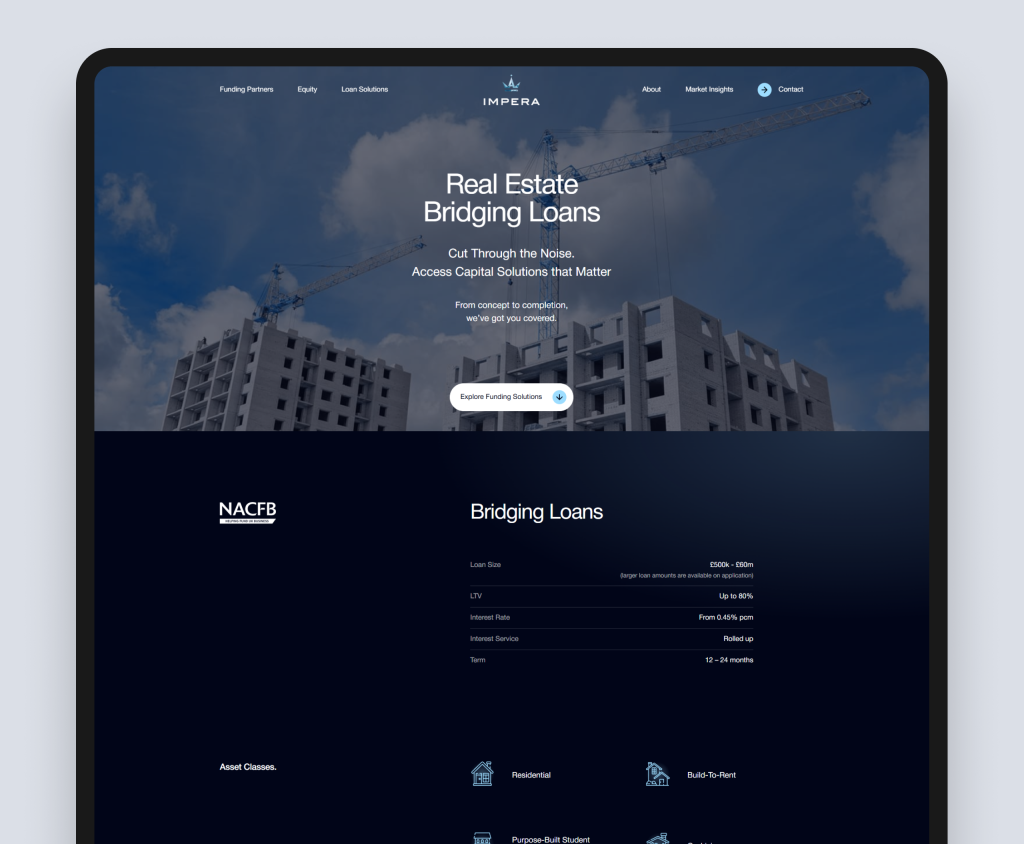
| Case study: Impera Finance (Real estate capital advisory, WordPress + HubSpot) |
| Impera Finance is a London-based real estate finance advisory that has arranged and executed more than £500 million in funding across debt and equity transactions. Their previous website did not communicate their market reputation or provide the technical foundations needed to support digital marketing. Rudo designed and built a new custom WordPress website with a full UX and UI design system that communicated the firm's authority to sophisticated property developers and investors. A suite of conversion-focused campaign landing pages was built specifically for Impera's LinkedIn campaigns. HubSpot CRM was integrated natively for lead capture, source tracking, and pipeline reporting. Within three months of launch: 35% increase in visitor engagement, 25% boost in page views per session, and 20% growth in organic traffic. Full case study: rudo.co.uk/case-studies/impera-finance/ |
7. Content strategy for property websites
Content on a property website does three things simultaneously: builds topical authority for organic search, communicates expertise to buyers who are evaluating you, and supports the lead nurturing process for contacts who are not yet ready to transact. A property company with no content beyond its service pages is leaving all three of these commercial opportunities on the table.
Market commentary and investment insights
For property investment companies and advisories, market commentary — views on yield movements, planning policy, development finance markets, or specific geographies — communicates analytical capability to exactly the audience that is evaluating whether to place capital with you. An investor who reads three pieces of incisive market commentary on your website before making contact arrives with a different level of confidence than one who has only seen your service pages.
Case studies
Case studies in property are among the most commercially valuable content assets available. A well-structured property case study — the challenge, the structure of the solution, the outcome, with specific numbers wherever confidentiality allows — demonstrates that the claimed capability is real. It gives prospective clients a basis for evaluating fit that generic service descriptions cannot provide.
Audience-specific content journeys
A property investment company serving first-time investors and experienced landlords simultaneously cannot serve both audiences with the same content journey. First-time investors need education, reassurance, and a clear explanation of process. Experienced landlords need portfolio data, yield analysis, and a faster path to conversation. Building content journeys that branch by audience type, whether through separate navigation sections, pillar pages, or smart content delivery via HubSpot, consistently improves both engagement and conversion for property companies with multiple investor profiles.
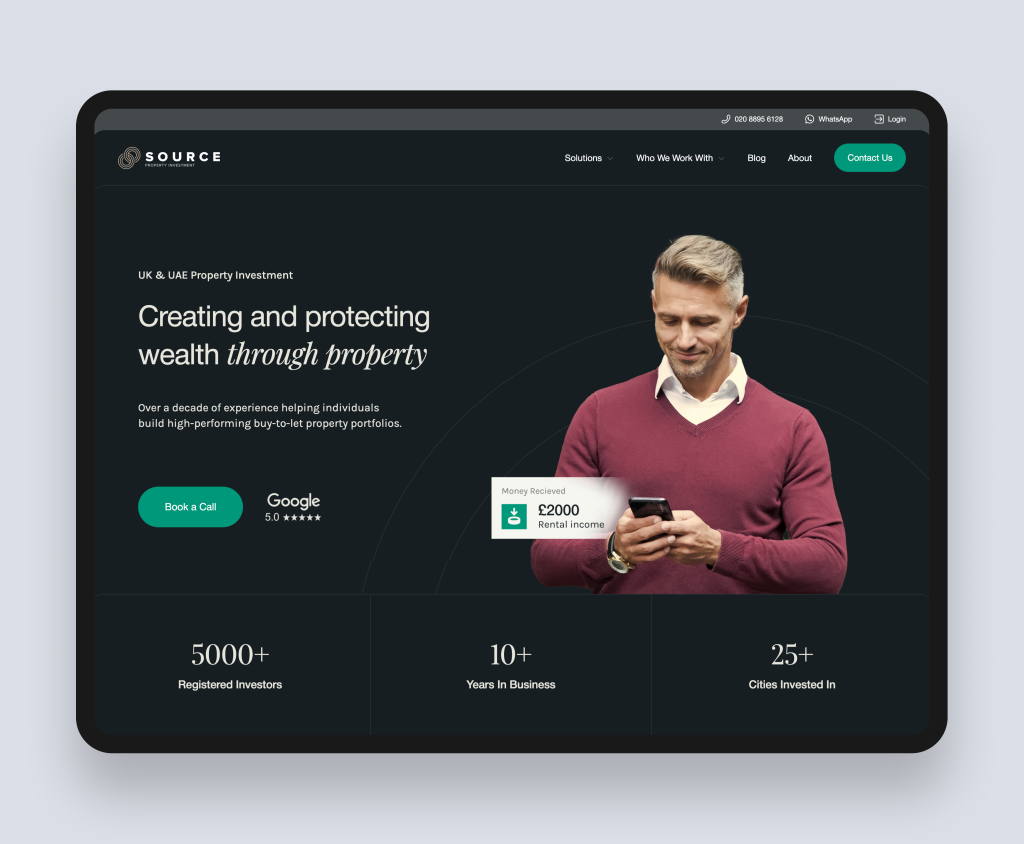
| Case study: Source Investments (UK property investment company, WordPress) |
| Source Investments is a UK-based property investment company helping clients buy, manage, and sell residential investment properties. With a team that had grown from 5 to 13 and clients spanning domestic and international investors from Turkey and the UAE, their existing website no longer reflected the company's sophistication or communicated their three-service offering clearly. Rudo's discovery process identified that Source wanted to position closer to a service and trust brand than a transactional listing platform. The new website was structured around three distinct audience journeys: new investors, existing landlords, and international buyers. A modular design system was built for ongoing independence. Custom HubSpot campaign landing pages were built for targeted campaigns. The sister brand, Home Cloud, received a rebrand and a website with API-driven property listing functionality. Full case study: rudo.co.uk/case-studies/source-investments/ |
8. What a property website project involves
A property website project at Rudo follows the same strategic foundation as any B2B project, with phases specific to property's commercial complexity and audience diversity.
Discovery and strategy: weeks 1 to 2
Stakeholder interviews with commercial, marketing, and compliance leads. Buyer persona development for each distinct investor or client type the site needs to serve. Competitor analysis of how peer companies are positioned digitally and where the gaps are. For property clients, this phase also typically includes a review of existing campaign activity: what is currently generating enquiries, where those enquiries are coming from, and how the new website will connect to and improve the existing lead generation infrastructure.
Copywriting: three tiers
- Strategic guidance (£1,500 to £3,000): Rudo team provides detailed page-by-page outlines with the messaging hierarchy and credibility claims for each page. Your team writes the final copy. Works when you have an experienced financial or property writer internally.
- Hybrid (£3,500 to £7,000): Rudo team writes the commercial-facing pages — homepage, service pages, campaign landing pages — while your team writes supporting content. The most commonly chosen option for property clients.
- Full copywriting (£6,000 to £14,000): Rudo team writes everything from a messaging workshop. The right choice for companies repositioning, entering new markets, or without internal writing resource for the project.
UX and design: weeks 3 to 7
Information architecture for the full site, including audience-specific content journeys and the campaign landing page structure. High-fidelity Figma design across all templates. For property clients, the design phase typically involves more iteration on the credibility architecture — the specific placement and presentation of track record statistics, team profiles, and compliance credentials — than in other sectors.
Development: weeks 8 to 13
Custom theme or platform build. CRM integration and campaign landing page infrastructure. Any custom functionality: investor calculators, portfolio data displays, API integrations (for property listing data), or gated resource libraries. For HubSpot builds, this phase includes the full marketing configuration: workflow setup, form design, smart content rules, and reporting dashboards.
Launch and handover: weeks 14 to 15
Pre-launch SEO configuration. QA across all pages, forms, integrations, and campaign journeys. Team training: how to add case studies, update market commentary, build new campaign landing pages, and manage CRM workflows from the website. Post-launch monitoring during the first 30 days.
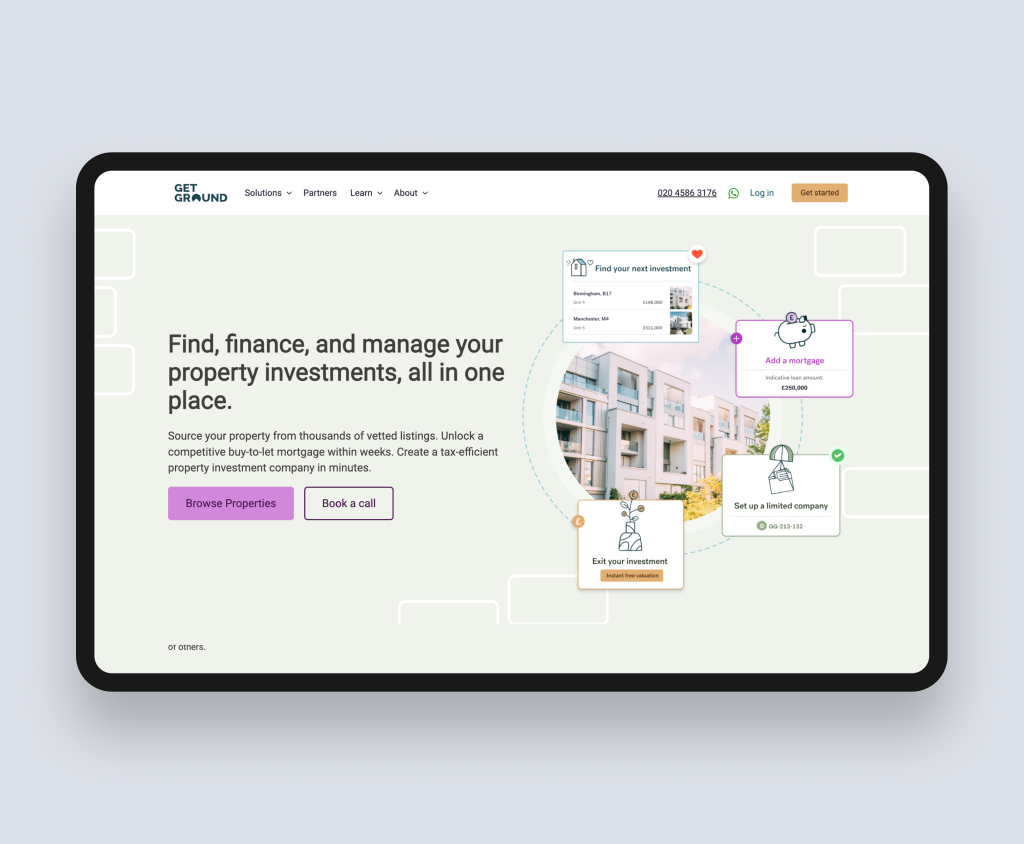
| Case study: GetGround (PropTech SaaS, buy-to-let company formation, HubSpot CMS) |
| GetGround is the UK's only digital company formation and management platform for buy-to-let property investment, allowing investors to source, finance, and establish tax-efficient investment entities. The existing website fell short of conveying the platform's ambitious goals or guiding multiple user types — from seasoned investors to property newcomers — through the platform's capabilities. Rudo produced a comprehensive sitemap, updated copy, illustrations, and layouts for major pages. Wireframes were designed to ensure optimal user flow for distinct user segments. HubSpot CMS was chosen as the platform for its integrated marketing tools and content management capability. Distinct content journeys were built for each audience segment, with campaign landing pages and CRM routing configured to support the marketing team's ongoing campaign activity. Full case study: rudo.co.uk/case-studies/getground/ |
9. How much does a property website cost?
Standard build: £12,000 to £25,000
A fully custom-designed property website with discovery and strategy, up to 25 page templates, one or two audience journeys, campaign landing page templates, CRM integration, pre-launch SEO, and team training. Appropriate for property investment companies, boutique advisories, and smaller developers making a first serious digital investment.
Complex build: £25,000 to £50,000
Larger sites with multiple audience types requiring distinct content journeys, complex campaign landing page infrastructure, smart content delivery, multi-language variants for international investor audiences, or custom functionality such as investment calculators, portfolio data displays, or API-driven property listing integration. Most established property investment companies and advisory firms with active campaign programmes fall in this band.
Enterprise: £50,000 and above
Institutional-grade platforms, multi-brand deployments, complex regulatory compliance requirements, or deep integration with proprietary property data systems. Scoped individually.
Ongoing costs
Platform costs range from WordPress hosting at £50 to £200 per month through to HubSpot CMS Professional at approximately £400 per month. Content maintenance — market commentary, case studies, investment updates — is an ongoing investment that compounds significantly over time as organic search visibility and returning visitor engagement build.
For a detailed cost breakdown, read our guides to WordPress website cost, HubSpot CMS for B2B, and Webflow for B2B.
10. Property sectors we work in
Rudo has designed and built websites for property companies across investment, advisory, development, and PropTech — three published case studies and an active pipeline across all sub-sectors of the UK property market.
We also design and build websites for B2B companies in financial services and technology and SaaS.
Ready to build a property website that generates qualified enquiries?
Rudo is a London-based B2B web design agency with proven experience across property investment, capital advisory, property development, and PropTech. We understand the specific trust and credibility requirements of the property sector, and we build websites that meet them.
Ranked number one UK web design agency on DesignRush and top ten on Clutch. Every property project begins with a thorough understanding of your investor audiences, your commercial objectives, and the lead generation infrastructure the site needs to support.
Find out more about our property web design service.
Book a no-obligation intro call.
We will review your current website, discuss your investor audiences, and give you an honest view of what a website built specifically for your property business should do.
11. Frequently asked questions
What makes a good property company website?
A good property company website establishes trust through specific, verifiable credibility signals within the first scroll: named track record with real numbers, visible team credentials, and transparent process explanation. It serves multiple investor or client types simultaneously with appropriate content journeys for each. It connects natively to the CRM driving the lead generation programme. And it is fast, mobile-optimised, and technically sound enough to support organic search visibility.
How much does a property website cost in the UK?
A standard property website build typically costs £12,000 to £25,000 for a well-designed custom site serving one or two audience types with CRM integration. More complex builds involving multiple investor journeys, smart content, campaign landing page infrastructure, or custom functionality typically cost £25,000 to £50,000. Ongoing platform and maintenance costs range from £50 to £200 per month (WordPress) to approximately £400 per month (HubSpot CMS Professional).
What CMS should a property company use?
HubSpot CMS is the strongest choice for property companies running active inbound campaigns — LinkedIn, Google, email — who need native pipeline integration and smart content delivery by investor profile. WordPress is the best choice for companies with complex content architecture, specific integration requirements, or very large content operations. Webflow suits design-led property brands with moderate complexity. The right choice depends on your existing toolstack and the nature of your marketing activity.
How do you design a property website for multiple investor types?
The most effective approach is audience-segmented navigation and content architecture: distinct pathways for each investor type (for example, new investors, existing landlords, international buyers) that lead to content specifically relevant to their stage and profile. For companies using HubSpot, smart content rules can serve different messaging to returning visitors based on their profile and behaviour. For companies on WordPress or Webflow, clearly signposted audience navigation sections with appropriately framed content for each serve the same purpose.
For a detailed guide to property investment website design, read our property investment website design guide.
How important is CRM integration for a property website?
Essential for any property company with an active digital marketing programme. Property deals are long — buyers may take six to eighteen months from initial digital touchpoint to transaction. Without CRM integration tracking the source and behaviour of every enquiry, the business cannot attribute revenue to digital activity, cannot nurture long-cycle leads effectively, and cannot optimise campaign spend based on what is actually producing pipeline. CRM integration should be scoped from the start of every property website project.
How long does a property website project take?
A standard property website project typically takes 12 to 15 weeks. Projects involving complex audience architectures, smart content configuration, API integrations (property listing data), or large-scale content migration take 16 to 20 weeks. The most variable factor in property projects is copywriting — particularly for investment companies where financial promotion rules require careful review of copy before publication.
For property website examples from Rudo's portfolio, read our property website design examples guide.
Also in this series: property investment website design, PropTech website design, property website design examples, how to choose a property web design agency.
Back to the complete guide to web design for property companies.
About Rudo
Rudo is a strategy-led B2B web design agency based in London. We design and build websites for property investment companies, real estate advisories, property developers, and PropTech platforms. Ranked number one UK web design agency on DesignRush and top ten on Clutch.
Find out more about our property web design service.

Written by
Rudo Agency
Rudo is a strategy-led web design and development agency specialising in B2B. Based in the UK and working with clients globally, we help ambitious brands turn complex ideas into high-performing websites. Our team combines digital strategy, UX/UI design, custom development, and SEO to deliver results-focused websites that support real business growth.
