Overview
Most property companies approach agency selection the same way: search online, request three proposals, compare prices and portfolios, and choose. The result is frequently a website that looks professionally competent and fails to generate the enquiries the business needs. Not because the agency was bad at web design, but because they did not understand what a property website actually needs to do — and there is a significant difference.
A property company website is not a general B2B website with property imagery. It is a high-stakes trust communication tool that needs to simultaneously serve multiple sophisticated buyer types, address genuine financial risk concerns, build credibility in a sector with a documented history of poor actors, and connect natively to the commercial infrastructure the business uses to manage relationships over long decision timescales. Very few agencies understand all of this. The ones that do produce very different outcomes from the ones that do not.
In this article:
- Why agency choice matters more in property than most sectors
- The types of agency property companies encounter
- What genuine property web design expertise looks like
- Strategy: the foundation most agencies skip
- Trust and credibility design: the property-specific skill
- Audience architecture: the complexity most agencies underestimate
- Where Rudo fits and what we bring to property projects
- Questions to ask any agency before hiring
- Frequently asked questions
This article is part of the complete guide to web design for property companies.
Find out more about our property web design service.
1. Why agency choice matters more in property than most sectors
The financial stakes of the decisions being made on property websites are higher than in almost any other B2B sector. A buyer evaluating a £200,000 investment in a buy-to-let property through an investment company, or a developer seeking £10 million in debt finance from a capital advisory firm, is making a decision that carries genuine personal financial risk. The website is doing active work in that decision from the first page load.
An agency that does not understand property's specific trust requirements — that defaults to attractive design rather than evidenced credibility — will produce a website that looks good and fails to convert serious buyers and investors. The cost of this failure is not a missed design opportunity. It is missed pipeline at values that can be significant.
| The visible cost of a poor agency choice |
| A property investment company that receives two additional qualified investor enquiries per month from a properly built website, at an average investment value of £150,000, is generating £300,000 per month in additional pipeline from the website alone. The cost difference between a generic agency build and a strategy-led property specialist build is typically £5,000 to £15,000. The payback on the additional investment is measured in weeks, not years. |
2. The types of agency property companies encounter
The web design agency market spans a wide range of capability and sector focus. Understanding the main categories prevents the most common mismatches.
| Agency type | What they do well | Where they fall short for property |
| Estate agent platform specialists | Rightmove and Zoopla portal integration, listing management | Built for estate agents, not for investment companies, advisories, or PropTech |
| General marketing agency | Multi-channel campaigns, branding | No depth in property-specific trust requirements, investor psychology, or financial promotion compliance |
| Generalist B2B agency | B2B conversion thinking, CRM integration | Limited property sector experience; apply generic B2B frameworks to a category with specific requirements |
| Luxury design agency | Premium visual design, brand identity | Strategy and conversion architecture typically secondary; may produce beautiful websites that do not generate enquiries |
| PropTech specialist | Technology product websites, platform product explanation | May not understand the full property sector breadth — particularly advisory and investment company requirements |
| Strategy-led B2B agency with property experience | Full strategic, design, content and technical capability with proven property results | Fewer in number; typically higher investment than the alternatives |
The most common mismatch for property companies is the generalist B2B agency. They understand conversion design and CRM integration better than a luxury design agency, but they have not worked through the specific problems of property web design: the trust architecture requirements, the multi-investor-type content journey challenge, the financial promotion compliance implications, and the long decision cycle conversion architecture. They apply B2B principles that are correct in general and insufficient in this specific category.
3. What genuine property web design expertise looks like
Ask any agency whether they have property sector experience and most will say yes. The claim is cheap. The evidence of genuine expertise is specific, verifiable, and visible in the actual work.
Portfolio depth in property
Not one property project alongside twenty from other sectors. Multiple property projects, across different property sub-sectors — investment companies, advisory firms, developers, PropTech platforms — that demonstrate a pattern of solving property-specific problems rather than applying a generic design template. Evaluate those sites directly: does the homepage establish credibility within the first scroll? Are the investor journeys distinct and purposeful? Is the track record surfaced as primary content or buried on an about page?
Understanding of property's specific trust requirements
An agency with genuine property expertise will ask commercial questions early: who are the different investor or buyer types, what specific financial anxieties do they carry into the evaluation process, what credibility signals does the market look for, and how does the website connect to the sales team's CRM and lead management process. An agency without this understanding will ask about brand identity, aesthetic preferences, and page count.
Knowledge of the regulatory context
Financial promotion rules for FCA-authorised property investment companies, RICS and other professional body credential requirements, GDPR implications for collecting investor personal data — an agency with genuine property sector experience has encountered these requirements and knows how to handle them in the build. One without this experience may not flag them at all until a compliance issue arises post-launch.
4. Strategy: the foundation most agencies skip
The single most important differentiator between agencies that produce commercially effective property websites and those that produce visually adequate ones is whether strategy precedes design. Most agencies — even competent ones — move too quickly from brief to wireframes. The work that should happen between them, and that determines whether the finished site actually generates enquiries, is abbreviated or skipped.
What strategy means in property
Strategy in a property website project is not a brand positioning workshop. It is a disciplined process of answering specific commercial questions before any design begins: which distinct investor or buyer types does this website need to serve, what specific questions does each type need answered before they feel confident enough to enquire, what does the competitive landscape look like digitally and where is the opportunity to differentiate, what commercial outcomes does the website need to drive in the first 12 months, and how does the website connect to the existing marketing and CRM infrastructure.
The answers to these questions determine the information architecture, the content priorities, the audience journey structure, and the conversion design. A website built without these answers reflects the agency's generic B2B assumptions rather than the specific commercial reality of the property business it is supposed to represent.
| The most expensive website mistakes in property are not design mistakes. They are strategic mistakes that look fine in a design review and fail commercially after launch. A homepage that leads with aspirational imagery rather than specific credibility. Service pages that describe what the company does without explaining why a buyer should choose this company over its competitors. Investment content that speaks to owner-occupier buyers. These mistakes are invisible to a non-specialist eye and commercially consequential. |
5. Trust and credibility design: the property-specific skill
In property, trust is not a brand value. It is a structural design requirement. The placement of credibility signals — where they appear in the page hierarchy, what form they take, and how they connect to verifiable external evidence — determines whether a sophisticated investor or buyer concludes that this company clears their due diligence threshold.
Agencies without property experience treat credibility as a content decision (what to write on the about page) rather than a design decision (where to place the specific evidence that creates trust at each stage of the buyer journey). The difference is commercially significant: a trust signal buried on an about page serves the one visitor in ten who navigates there; a trust signal positioned in the homepage hero section serves every visitor.
Property-specific trust design involves: surfacing the track record as a primary credibility anchor before the fold rather than as supporting detail; positioning regulatory credentials (FCA status, RICS membership) on every page where a financial evaluation might take place; designing team profiles that communicate individual expertise and background, not just job titles; and ensuring that the overall visual quality of the design communicates professional-grade operations at the appropriate market level.
6. Audience architecture: the complexity most agencies underestimate
Most property companies serve more than one investor or buyer type simultaneously. A property investment company may serve first-time BTL investors, experienced landlords, and international buyers from multiple geographies. A developer may serve owner-occupiers and investment buyers. An advisory firm may serve residential developers, commercial developers, and institutional investors.
Designing a website that serves all of these audiences effectively — with distinct content journeys, appropriate messaging for each audience's knowledge level, and conversion paths suited to each audience's decision timescale — is a complex architectural challenge that most agencies significantly underestimate.
The most common approach is to create a single homepage and service page structure that attempts to address all audiences simultaneously. The result serves none of them particularly well: too basic for the experienced investor, too complex for the newcomer, and too domestic for the international buyer. Designing distinct audience journeys requires more strategic investment in the discovery phase and more structural thinking in the information architecture phase — which is why agencies that skip strategy default to the single-journey approach.
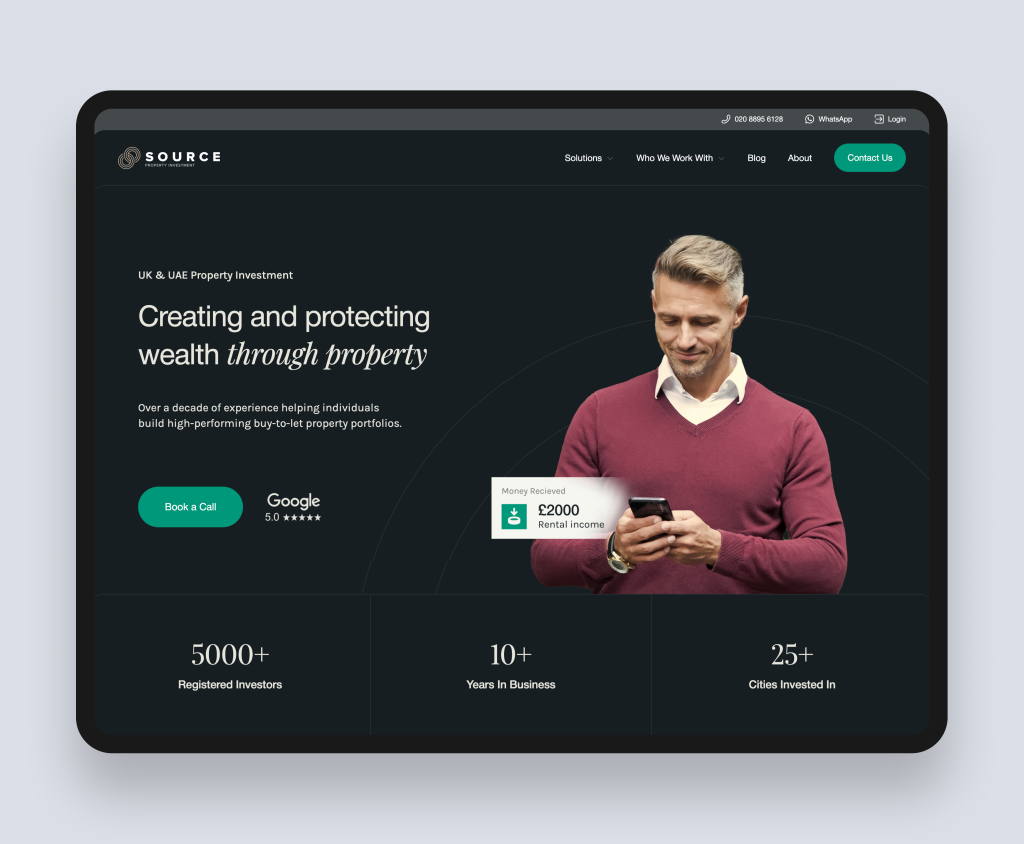
| Case study: Source Investments (Multi-audience property investment company, WordPress) |
| Source Investments' previous website presented a single, undifferentiated property investment offering. Their three distinct audience types — new investors, existing landlords, and international buyers — were served by the same content journey, which meant none of them were served particularly well. Rudo's discovery phase identified this as the primary commercial gap and structured the new website around three explicitly distinct audience journeys, each leading to appropriately framed content and appropriate conversion architecture. The result was a website that worked simultaneously as a new investor acquisition tool, an existing client engagement platform, and an international buyer onboarding resource. Full case study: rudo.co.uk/case-studies/source-investments/ |
7. Where Rudo fits and what we bring to property projects
Rudo is a strategy-led B2B web design agency with specific, proven experience across the UK property sector. Our property portfolio spans real estate capital advisory, property investment companies, and PropTech platforms — different business models with different audiences, each requiring a different approach to trust architecture, audience segmentation, and commercial conversion.
Strategy before design, always
Every Rudo property project begins with a discovery phase that includes stakeholder interviews with commercial, marketing, and compliance leads; buyer and investor persona development for each distinct audience the site needs to serve; a competitor analysis of how peer companies are positioned digitally; and a commercial goal-setting conversation that defines what success looks like twelve months after launch. The design work begins only after this foundation is in place.
Trust architecture as a primary design skill
We treat the placement and presentation of credibility signals — track record data, regulatory credentials, team profiles, case studies — as primary design decisions, not afterthoughts. The question of where the FCA number appears, how the track record is surfaced, and what information a prospective investor sees before they are asked to enquire shapes every page we build.
Audience architecture built for conversion
Our property builds are designed to serve each distinct investor or buyer type with appropriate content journeys rather than defaulting to a single path for all audiences. This requires more discovery work and more architectural thinking but consistently produces better commercial outcomes across all audience types.
Proven results across property sub-sectors
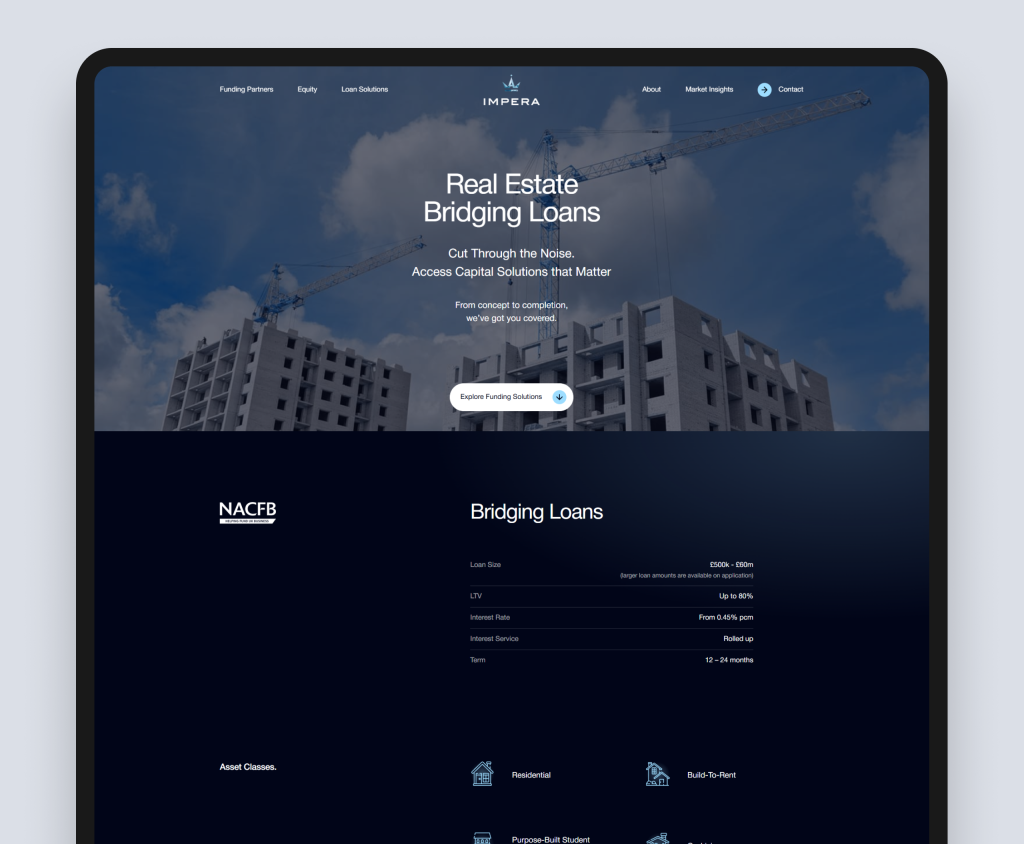
| Case study: Impera Finance (Real estate capital advisory, WordPress + HubSpot) |
| Impera Finance is a London-based real estate finance advisory with £500m+ in funding arranged. Their previous website failed to communicate their market standing or support digital lead generation. Rudo built a credibility-led custom WordPress website with a campaign landing page infrastructure for LinkedIn and HubSpot CRM integration for full lead attribution. Within three months: 35% increase in visitor engagement, 25% boost in pages per session, 20% growth in organic traffic. Full case study: rudo.co.uk/case-studies/impera-finance/ |
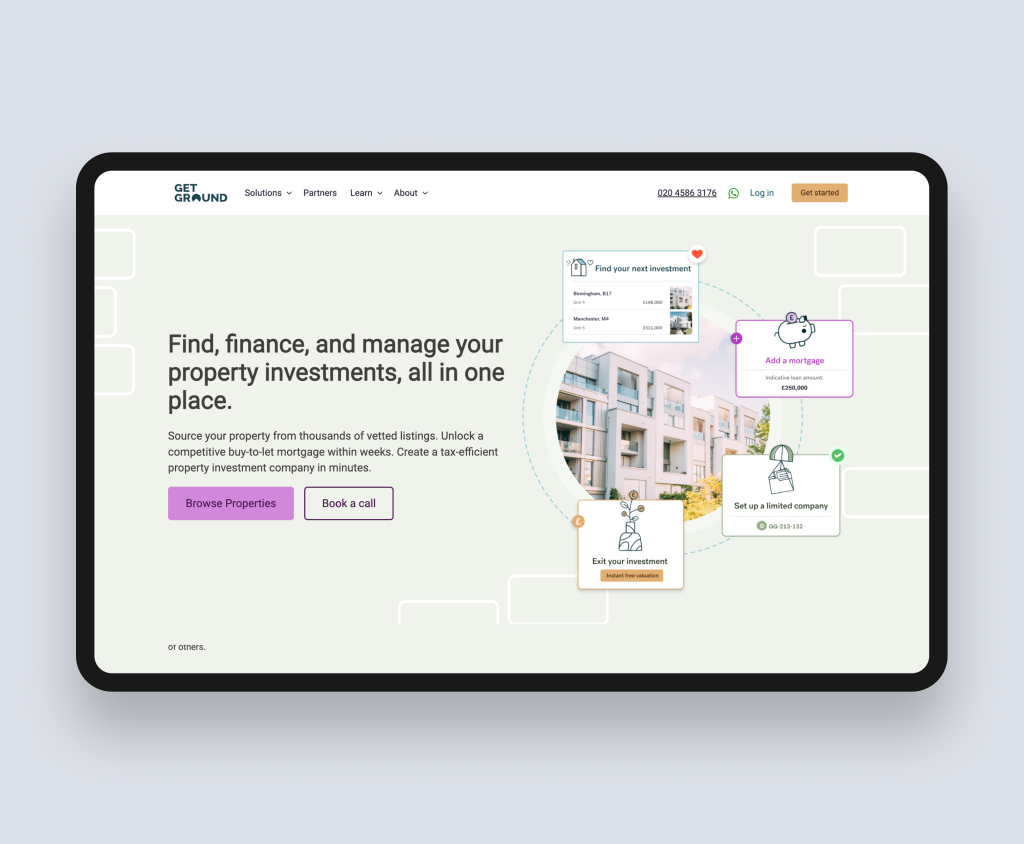
| Case study: GetGround (PropTech SaaS — buy-to-let company formation platform, HubSpot CMS) |
| GetGround is the UK's only digital company formation and management platform for buy-to-let investors. Their existing website failed to communicate the platform's value proposition or guide their diverse user segments effectively. Rudo produced a comprehensive sitemap, audience-specific content journeys, updated copy and illustrations, and a HubSpot CMS build with campaign landing pages and CRM routing. The redesigned site solidified GetGround's position as an innovator in UK real estate SaaS. Full case study: rudo.co.uk/case-studies/getground/ |
Rudo is ranked number one UK web design agency on DesignRush and top ten on Clutch. Find out more about our property web design service.
8. Questions to ask any agency before hiring
On sector experience
- Can you show us property websites you have delivered and can we speak to the clients? Portfolio images are curated. Real conversations with real property clients reveal what the agency actually delivered and what commercial impact it had.
- How do you approach trust architecture for property websites specifically? Listen for specific thinking about credibility signal placement, regulatory credential surfacing, and the relationship between visual design quality and perceived market positioning. Generic answers about 'building trust through design' indicate shallow property understanding.
- How do you serve multiple investor types from a single website? Listen for specific audience journey thinking — distinct content paths for different investor profiles, appropriate messaging for different knowledge levels, and CTA logic appropriate for different decision timescales. Generic answers about 'clear navigation' are insufficient.
On process and accountability
- What does your discovery phase include for a property project? An agency with genuine depth will describe buyer persona work, a competitor analysis, a commercial goal-setting conversation, and a review of the existing CRM and lead generation infrastructure. An agency without it will describe a brief intake form and a meeting with the design team.
- How do you handle financial promotion compliance? Any agency building a website for an FCA-authorised property investment company should know what financial promotion rules are and how they affect the copywriting and approval process. An agency that does not mention this has not built property investment websites at a professional level.
- What does post-launch look like? A good agency has a clear view of the 30-day post-launch period: performance monitoring, CMS training, Search Console submission, and a defined process for addressing issues that emerge in the first month. Agencies that disappear after launch are not partners.
For a full guide to what a property website should do, read our complete guide to web design for property companies.
9. Frequently asked questions
What should I look for in a property web design agency?
Specific property portfolio depth — not one project among many but multiple property websites across different sub-sectors; evidence of understanding property's specific trust requirements and multi-audience design challenges; a discovery and strategy process that precedes design; knowledge of the regulatory context for property websites including financial promotion rules for investment companies; and property-specific client references you can speak to directly.
How much does a property web design agency charge?
A standard property website build at a strategy-led B2B agency typically costs £12,000 to £25,000. More complex projects involving multiple audience journeys, campaign landing page infrastructure, smart content delivery, or custom functionality typically cost £25,000 to £50,000. General marketing agency and estate agent platform specialist builds cost less upfront and typically underdeliver on the commercial requirements of property investment and advisory companies.
Does a property web design agency need to understand FCA regulation?
For investment companies carrying out regulated activities, yes. An agency building a website where financial promotions will appear should understand what financial promotion rules require — what content must be approved and by whom, what risk disclosures are needed, and how to structure the content management workflow to accommodate compliance review. An agency that has not built property investment websites at a professional level will not raise these questions.
How long does a property website project take?
A standard property website project typically takes 12 to 15 weeks. Projects involving complex audience architectures, HubSpot smart content configuration, or large-scale content migration take 15 to 20 weeks. The most variable factor in property projects is copywriting — particularly for FCA-authorised companies where financial promotion copy requires compliance review before publication.
What is the most important thing a property web design agency should do?
Start with strategy before design. The most commercially damaging mistakes on property websites — homepage content that fails to establish credibility, investor journeys that serve all audiences with a single path, service descriptions that explain what the company does without differentiating it from competitors — are strategy failures, not design failures. They are invisible in a design review and costly in commercial outcomes. The only way to prevent them is to do the strategic work before any design begins.
Find out more about our property web design service.
Ready to work with a property web design agency that starts with strategy?
Rudo has built property websites for capital advisory firms, investment companies, and PropTech platforms. Book an intro call — we will review your current site, discuss your investor audiences, and give you an honest view of what it would take to build something that genuinely generates pipeline.
Also in this series: property investment website design, PropTech website design, property website design examples, property developer website design.
Back to the complete guide to web design for property companies.

Written by
Rudo Agency
Rudo is a strategy-led web design and development agency specialising in B2B. Based in the UK and working with clients globally, we help ambitious brands turn complex ideas into high-performing websites. Our team combines digital strategy, UX/UI design, custom development, and SEO to deliver results-focused websites that support real business growth.
