Overview
A property investment company website has one primary commercial job: to create the conditions under which a prospective investor feels confident enough to make contact. Everything else — the visual design, the content structure, the technical performance — is in service of this single outcome. Getting there requires understanding exactly who your investor audiences are, what specific anxieties they carry into their evaluation of a new investment company, and how the website can address those anxieties through design, content, and structural choices.
This guide covers the practical decisions that determine whether a property investment website generates qualified enquiries or fails to convert the significant traffic that investment-related search terms can drive.
In this article:
- The specific challenge of property investment web design
- Understanding your investor audiences
- Trust architecture for investment websites
- Designing for the investment journey
- International investor considerations
- CRM integration and lead nurturing
- Platform choice for property investment companies
- Frequently asked questions
This article is part of the complete guide to web design for property companies.
Find out more about our property web design service.
1. The specific challenge of property investment web design
Property investment sits at an unusual intersection of financial services and real estate. The regulatory environment carries FCA implications for some operators. The sums involved are substantial. The decision timescales are long. And the sector has a documented history of poor actors whose failed schemes have left investors out of pocket.
Every sophisticated investor brings this context — consciously or not — to their evaluation of a new investment company. The website is the first place they look for evidence that this company is different from the ones that have failed others. If the website does not address the trust question directly and specifically, the evaluation ends there.
The design challenge is not to make the site look impressive. It is to make it feel credible — and credibility in property investment comes from specific, verifiable evidence, not from aspirational imagery or generic claims about returns and relationships.
| What sophisticated investors are actually doing on your website |
| Before making contact with any investment company, a serious investor will: verify regulatory status (FCA register search), check Companies House for financial health indicators, look for named track record with specific deal outcomes, identify the team and cross-reference their backgrounds on LinkedIn, and look for red flags in the way the service is described. A website that makes this due diligence easy — that surfaces the right information in the right places — converts at a dramatically higher rate than one that buries credentials or omits them entirely. |
2. Understanding your investor audiences
Most property investment companies serve more than one investor type simultaneously. Designing the website to serve all of them effectively — rather than defaulting to one and leaving others underserved — requires a clear understanding of the distinct needs of each group.
First-time property investors
Approaching the market with genuine interest but significant uncertainty. Need: clear explanation of the investment model, transparent risk disclosure, education about the process from initial conversation to completed investment, and reassurance that the company has experience guiding people like them. Their primary barrier is not scepticism about the company but anxiety about whether property investment is right for them. The website needs to address this directly.
Experienced buy-to-let landlords
Already invested in property. Evaluating whether to expand their portfolio or switch management to a new company. Need: performance data, yield analysis, portfolio management quality signals, and evidence that the company can add value beyond what they are currently achieving independently. They are less interested in education and more interested in commercial differentiation. A website that explains the basics of buy-to-let investment to an experienced landlord is wasting their time.
High-net-worth investors seeking diversification
May be coming from equities, private equity, or other asset classes. Evaluating property as a portfolio allocation. Need: institutional-quality analysis, market positioning, risk-return data presented in formats they recognise from other investment contexts, and evidence of professional-grade operations. The design register appropriate for this audience is closer to a wealth management firm than a property portal.
International investors
Often from markets where UK property is a well-established store of value: the Middle East, Hong Kong, Turkey, and parts of Eastern Europe. Need: specific guidance on the UK buying process as it applies to non-residents, currency and tax implications clearly explained, and team members with demonstrated experience of international investor relationships. A website that does not acknowledge the international investor journey explicitly will lose this audience to competitors who do.
For guidance on structuring multi-audience content journeys, read our complete guide to web design for property companies.
3. Trust architecture for investment websites
Trust architecture is the deliberate placement of credibility signals throughout the website at the moments when a prospective investor's confidence is most fragile. It is not the same as listing credentials on an about page. It is integrating specific evidence of trustworthiness into every commercially significant page of the site.
Above-the-fold credibility
The homepage hero section should establish credibility immediately: the value of assets managed or transactions completed (with specific numbers), years of operation, any regulatory authorisation, and ideally a named client outcome or recognisable investor name. These signals appear before the investor has read a word of copy about what the company actually does — because for a sophisticated investor, whether to keep reading depends on whether the company clears a basic credibility threshold first.
Track record as content
Deal history, portfolio performance, and case outcomes should be content assets presented throughout the site — not a one-line claim on the about page. A well-structured investment case study describes the investor profile, the property type, the financing structure, the outcome, and the timescale. Where regulatory requirements prevent specific named client detail, deals can still be described with enough specificity (value, structure, geography, yield achieved) to communicate real capability.
Team profiles that work commercially
In property investment, the team is a significant part of the product. Investors are choosing to trust specific people with substantial sums over a multi-year period. Team profiles that communicate relevant experience, previous roles, deal history, and personal investment philosophy perform substantially better than corporate headshots with generic role descriptions.
Regulatory and compliance transparency
FCA authorisation number, regulatory status, FSCS protection status (where applicable), and any professional body memberships should be surfaced clearly — not buried in footer small print. An investor who finds the FCA number easily and confirms authorisation is much closer to making contact than one who had to search for it.
4. Designing for the investment journey
The conversion journey on a property investment website is not a single decision. It is a sequence of smaller confidence-building steps that move a prospective investor from initial awareness to qualified enquiry. Designing this journey deliberately — rather than leaving it to chance — is one of the highest-value structural decisions in the project.
Content for the awareness stage
Buyers at the awareness stage are researching property investment broadly, not evaluating specific companies yet. Content that ranks for general property investment queries — guides to buy-to-let investment, UK property market analysis, tax implications for property investors — captures this audience and begins building familiarity before they reach the company evaluation stage.
Content for the evaluation stage
At the evaluation stage, the investor is comparing options. Service pages that explain the investment model clearly, FAQs that address real investor concerns honestly, and case studies that demonstrate specific outcomes give evaluating investors the evidence they need to shortlist. This is where most property investment websites have the weakest content — service descriptions that are vague and case studies that are generic.
The enquiry conversion point
The enquiry form on a property investment website should be designed for the investor, not for the company. It should acknowledge that making contact is a meaningful step, set clear expectations for response time and what the initial conversation will involve, and ask only the questions needed to have a productive first conversation. Forms that feel like compliance exercises rather than welcoming invitations convert at a fraction of the rate of forms that feel like the beginning of a relationship.
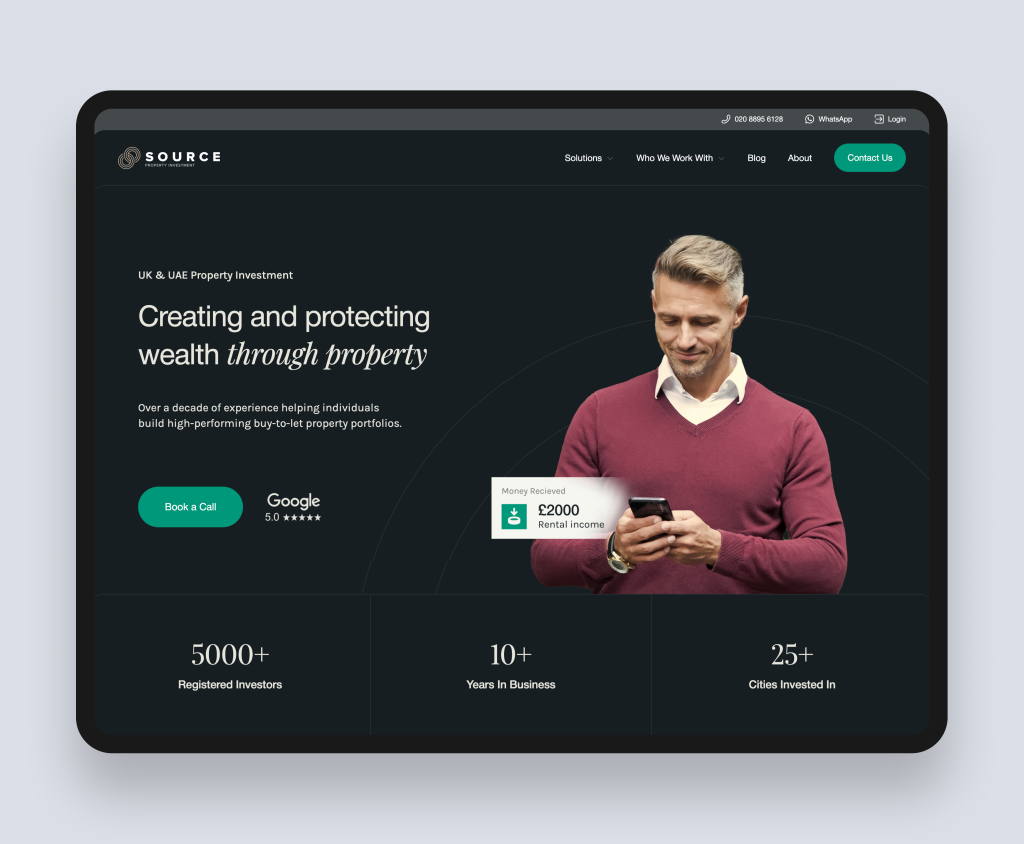
| Case study: Source Investments (UK property investment company, WordPress) |
| Source Investments is a UK-based property investment company helping clients buy, manage, and sell residential investment properties. Their team had grown from 5 to 13 and their client base spanned both domestic and international investors — but their website still spoke to an earlier, smaller version of the business. Rudo's solution structured the new website around three distinct audience journeys: new investors, existing landlords, and international buyers. Each journey led to content specifically relevant to that investor profile and converged on a conversion architecture designed for considered financial decisions. Custom HubSpot campaign landing pages supported targeted campaigns to each segment. The new site functions as lead generation engine, brand showcase, and investor onboarding touchpoint simultaneously. Full case study: rudo.co.uk/case-studies/source-investments/ |
5. International investor considerations
UK property investment companies serving international buyers need websites that acknowledge the specific challenges and questions of the cross-border investor — not as a footnote but as a dedicated content architecture.
- Explicit international navigation. A dedicated section or audience path for international investors that explains the UK buying process for non-residents, ownership structures (SPV vs personal name), stamp duty land tax implications for overseas buyers, and the typical timeline from initial enquiry to completed acquisition.
- Currency and tax transparency. International investors are particularly focused on currency risk, remittance taxation, and the tax treaty status of their home country with the UK. A website that addresses these questions directly — even at a high level with appropriate regulatory caveats — builds more confidence than one that leaves the investor to research the implications independently.
- International social proof. Named clients or case studies from investors in the same geographies the company is targeting — Turkey, UAE, Hong Kong — are disproportionately persuasive for international visitors. An investor from Istanbul who sees that another Istanbul-based investor has successfully completed a transaction with this company has significantly more confidence than one who cannot find any evidence of international client experience.
- Language and cultural considerations. For companies with significant investor bases in specific international markets, translated content or dedicated market pages in Arabic, Turkish, or Mandarin may be worth the investment. At minimum, the site should be designed with international readability in mind: clear English, short sentences, and visual content that does not rely on UK-specific cultural context.
6. CRM integration and lead nurturing
Property investment decisions are long. A prospective investor who visits the website today may not be ready to commit capital for six, twelve, or eighteen months. A website that captures only the enquiries of investors who are ready to transact today is missing the majority of the pipeline.
CRM integration — connecting every website touchpoint to a structured pipeline that allows the commercial team to nurture relationships over extended timescales — is the mechanism by which a property investment website becomes a genuinely commercial asset rather than a brochure.
For property investment companies using HubSpot, this means configuring lead scoring based on engagement behaviour (pages visited, content downloaded, forms completed), setting up nurture sequences that deliver relevant content to investor profiles over time, and ensuring that when an investor is ready to transact, the commercial team has a full history of their digital engagement to draw on.
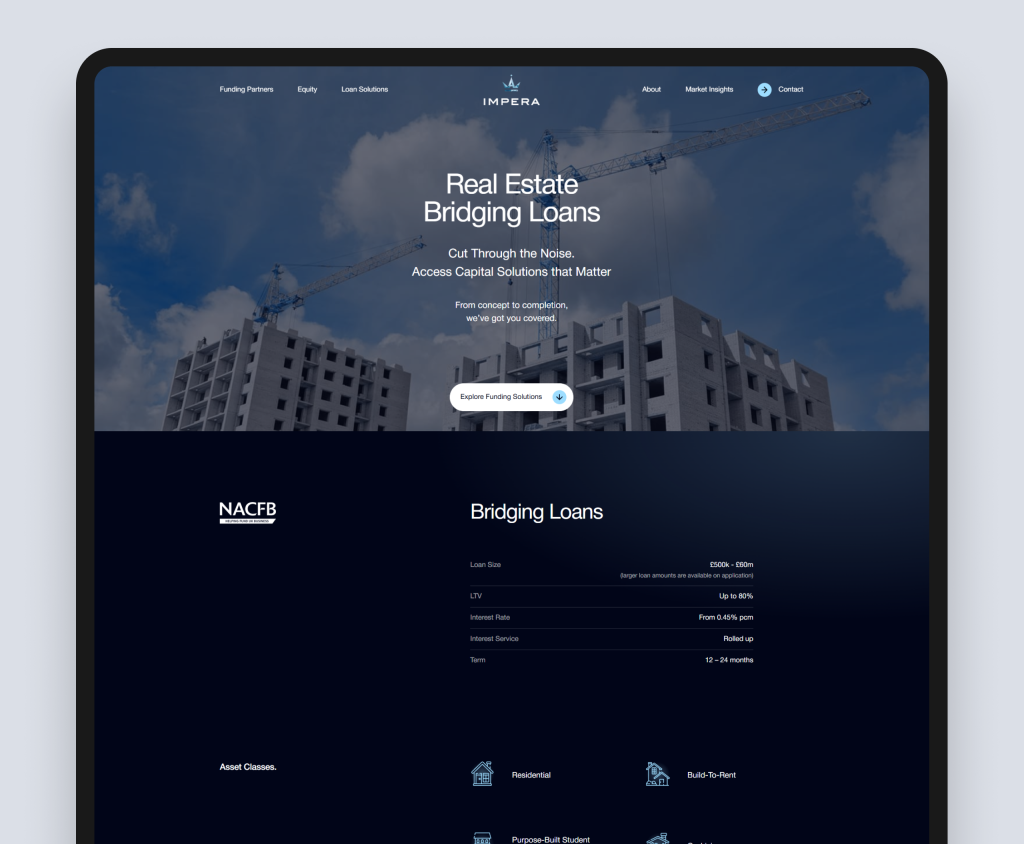
| Case study: Impera Finance (Real estate capital advisory, WordPress + HubSpot) |
| Impera Finance is a London-based real estate finance advisory that has arranged more than £500 million in funding across debt and equity transactions. Their previous website did not communicate their market reputation or support digital lead generation. Rudo built a new custom WordPress website with a full credibility-led design system and a suite of LinkedIn campaign landing pages. HubSpot CRM was integrated natively: every enquiry flows into the pipeline with source attribution, campaign tracking, and full engagement history. Within three months of launch, Impera saw a 35% increase in visitor engagement, a 25% boost in pages per session, and 20% growth in organic traffic. Full case study: rudo.co.uk/case-studies/impera-finance/ |
7. Platform choice for property investment companies
The platform decision for a property investment website should be driven by the nature of the marketing activity and the existing toolstack.
- HubSpot CMS: The strongest choice for investment companies running active inbound campaigns — LinkedIn, Google, email nurture — who need native pipeline integration, smart content delivery by investor profile, and campaign landing pages built without developer involvement. Particularly powerful for companies with multiple investor segments where different content journeys need to be delivered to different profiles.
- WordPress: The best choice for investment companies with complex content architecture, specific integration requirements (bespoke CRM systems, data feeds), or large content operations. Gives the marketing team full control over content without platform constraints.
- Webflow: Appropriate for design-led investment companies with moderate content complexity and no specific CRM requirements. Strong design fidelity for companies where visual positioning is a commercial differentiator.
Let's discuss your property website
Rudo designs property investment websites that serve sophisticated domestic and international investors, build genuine credibility, and connect natively to the marketing and CRM infrastructure driving lead generation. Book an intro call to discuss your investor audiences and what your website needs to do.
8. Frequently asked questions
What should a property investment company website include?
At minimum: a specific, evidenced track record with real numbers (AUM, deal volume, years operating); named team profiles with relevant experience; a clear explanation of the investment model and process; transparent regulatory and compliance information (FCA status, FSCS coverage where applicable); case studies or deal references that demonstrate specific outcomes; audience-appropriate content for each investor type served; and a conversion architecture designed for considered financial decisions rather than impulse enquiry.
How do you design a property investment website for international investors?
Dedicate specific content architecture to the international investor journey: explain the UK buying process for non-residents, address currency, tax, and ownership structure questions directly, include case studies or references from investors in the target geographies, and consider whether translated content is justified for the primary international markets you serve. International investors should not have to work to understand whether your company has experience serving buyers in their situation.
How important is FCA authorisation information on a property investment website?
Very important for regulated activities. The FCA registration number, regulatory status, and any relevant permissions should be visible and easily verifiable — not just in footer small print but accessible from any page where an investor might be evaluating the company's credentials. An investor who finds and verifies regulatory authorisation easily is significantly more likely to progress to enquiry. One who cannot find it quickly may assume it does not exist.
What is the best CMS for a property investment company?
HubSpot CMS for investment companies running active campaigns with multiple investor segments who need native CRM integration and smart content delivery. WordPress for companies with complex content requirements or specific integration needs. The choice should be driven by the marketing team's operational requirements, not by the website build budget alone.
Find out more about our property web design service.
Also in this series: property investment website design, PropTech website design, property website design examples, how to choose a property web design agency.
Back to the complete guide to web design for property companies.

Written by
Rudo Agency
Rudo is a strategy-led web design and development agency specialising in B2B. Based in the UK and working with clients globally, we help ambitious brands turn complex ideas into high-performing websites. Our team combines digital strategy, UX/UI design, custom development, and SEO to deliver results-focused websites that support real business growth.
