Overview
PropTech companies occupy a distinctive position in the web design landscape. They are technology businesses — with the fast-moving roadmaps, investor-facing pressures, and product complexity of a SaaS company — operating in a sector where trust and credibility are evaluated against real estate standards. The website has to satisfy two sets of expectations simultaneously: it needs to feel as polished and technically sophisticated as a fintech or SaaS platform, while also building the specific confidence that property buyers, landlords, and investors expect before engaging with a company handling significant financial decisions.
This guide covers the specific design and strategic decisions that determine whether a PropTech website converts effectively across its distinct audience segments.
In this article
- The PropTech website design challenge
- PropTech audience segmentation
- Explaining complex products clearly
- Conversion architecture for PropTech
- Design patterns that work for PropTech
- Platform choice for PropTech companies
- Supporting a fast-moving product roadmap
- Frequently asked questions
This article is part of the complete guide to web design for property companies.
Find out more about our property web design service.
1. The PropTech website design challenge
PropTech sits at the intersection of two demanding categories. From the technology side, it needs the product clarity, the onboarding architecture, and the conversion efficiency of a SaaS website. From the property side, it needs the credibility, the compliance awareness, and the trust signals of a real estate company. Most PropTech websites fail at one or the other: they have the SaaS aesthetic without the property credibility, or the property credibility without the product clarity.
The additional complication is audience diversity. A PropTech platform serving the buy-to-let market may need to acquire new investors (who need education and reassurance), serve existing users (who need product updates and support resources), and satisfy institutional or professional investor audiences (who need regulatory and compliance information). Each requires different content, different design emphasis, and different conversion paths.
| The product explanation problem |
| The most common failure on PropTech websites is assuming the visitor already understands why the product exists. Most PropTech platforms solve a real, specific problem in the property market — but that problem is not always obvious to someone encountering the company for the first time. A PropTech website that starts with the solution rather than the problem loses every visitor who has not yet recognised they have the problem the product solves. |
2. PropTech audience segmentation
PropTech platforms typically serve at least three distinct audience types, each with fundamentally different needs.
New users: acquisition and education
Prospective users who are evaluating whether the platform is right for them. They may not fully understand the problem the platform solves or the process by which it solves it. They need: a clear explanation of the problem, evidence that the solution works (testimonials, outcomes, named users), a transparent explanation of how the platform works and what the onboarding process looks like, and a frictionless path to trial or demo.
Professional and institutional audiences
Solicitors, mortgage brokers, property managers, and institutional investors who may use the platform professionally or recommend it to clients. They need: evidence of regulatory compliance, integration capabilities with professional toolsets, case studies from professional use contexts, and dedicated content that acknowledges their specific professional requirements and responsibilities.
Existing users and community
Current platform users who return for resources, updates, and community content. They need: product update communications, educational content that helps them get more value from the platform, community content that validates their choice, and a clear path to support when needed. Serving existing users well is also a conversion tool: user-generated social proof (testimonials, case studies, community reviews) is among the most persuasive content available for acquiring new users.
| Case study: GetGround (PropTech SaaS — UK buy-to-let company formation, HubSpot CMS) |
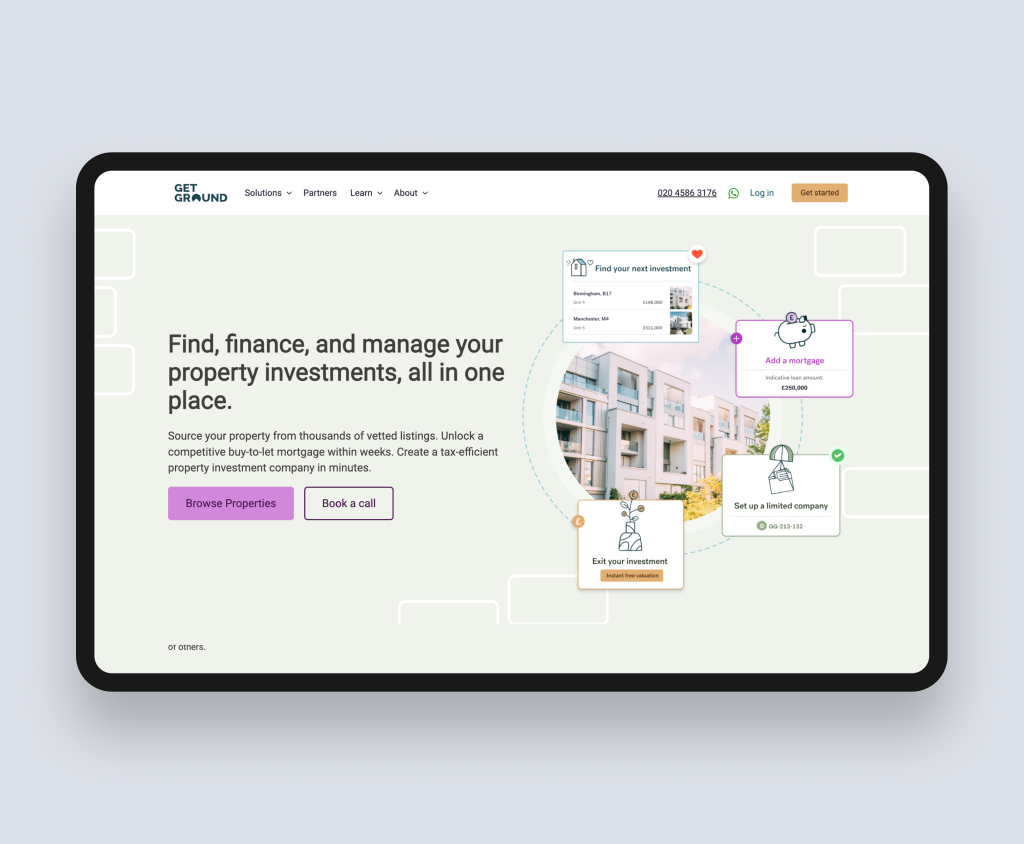
| GetGround is the UK's only digital company formation and management platform for buy-to-let property investment. The platform allows investors to source, finance, and establish tax-efficient limited company structures for property investment — a genuinely novel product in a market where most investors either use complex professional advisers or go without the structure entirely. The existing website failed to communicate the platform's value proposition clearly or guide the diverse user base — from experienced portfolio investors to first-time BTL buyers — through the product's capabilities. Rudo designed distinct content journeys for each user segment, with audience-specific messaging, onboarding paths, and CTA logic. HubSpot CMS provided the backend infrastructure for content management and campaign integration. The redesigned site solidified GetGround's position as an innovator in the real estate SaaS landscape. Full case study: rudo.co.uk/case-studies/getground/ |
3. Explaining complex products clearly
PropTech products are frequently complex. Company formation for property investment, fractional ownership platforms, AI-driven property valuation tools, integrated mortgage origination systems — these are not products that explain themselves to a first-time visitor.
Problem-first framing
Every PropTech homepage should answer the problem question before the product question: what is the problem that this platform exists to solve, and who experiences it? A visitor who recognises the problem being described will engage far more readily with the solution than one who encounters the solution before understanding the problem. The temptation to lead with product features rather than buyer problems is one of the most common and costly mistakes in PropTech web design.
The three-step product explanation
For complex PropTech products, a three-step explanation structure consistently outperforms longer or more complex alternatives: the problem (what the platform exists to solve), the mechanism (the key innovation or process that makes the solution work), and the outcome (what life looks like for the user after the problem is solved). This structure works for homepage hero sections, product page introductions, and campaign landing pages.
Visual explanation tools
Property technology platforms benefit significantly from visual explanation: product screenshots, animated process diagrams, interactive demos, and before-and-after illustrations of the workflow the platform replaces. Text-only product explanations for complex technical processes leave users uncertain. Visual explanations of the same processes build confidence much faster. For PropTech companies, the investment in high-quality product screenshots and process illustrations is consistently justified by conversion improvement.
4. Conversion architecture for PropTech
PropTech conversion architecture is more complex than most SaaS categories because the financial and regulatory stakes of the underlying product create a longer and more considered decision journey.
Multiple conversion entry points
Not all PropTech visitors are ready to sign up or book a demo on their first visit. Conversion architecture should offer entry points appropriate for different stages of the decision journey: a free guide or report for early-stage researchers, a demo or product walkthrough for mid-stage evaluators, and a direct sign-up or consultation booking for visitors ready to proceed. Each entry point captures different visitor cohorts and allows them to be nurtured toward the primary conversion.
Social proof that fits the context
For PropTech platforms where the underlying transactions involve real money and real property, social proof needs to be specific and credible. Generic star ratings and anonymous testimonials do not work at the trust threshold of property investment. Named users with specific outcomes (the portfolio size they have built, the time the platform has saved, the tax position they have achieved) are far more persuasive. Where platform data is available — total properties managed, total investment facilitated, number of companies formed — this aggregate social proof should be presented prominently with current numbers.
Regulatory and compliance reassurance
PropTech platforms handling money, mortgages, company formation, or investment are operating in a regulated environment. The website must address compliance and security questions proactively — not as defensive fine print but as active trust-building content. FCA authorisation status, data security certifications, Companies House registration, and professional indemnity cover are all credibility signals that PropTech audiences look for and that should be visible rather than buried.
5. Design patterns that work for PropTech
PropTech sits between SaaS and financial services in design terms. The most effective PropTech websites borrow from both categories: the product clarity and onboarding efficiency of SaaS, and the credibility and restraint of financial services.
- Clean, systematic layout. PropTech platforms are technical products. The website design should communicate that the company thinks systematically — in organised information hierarchies, consistent visual patterns, and logical user flows. Chaotic or overly playful design aesthetics undermine the credibility of a financial technology product.
- Product in context. Platform screenshots and product illustrations should show the product in use — not floating UI elements or generic dashboard screenshots, but actual product interfaces in the context of a real user workflow. Contextual product imagery builds confidence that the platform is real, functional, and polished.
- Trust signals at key decision points. FCA status, security certifications, user counts, and transaction volumes should be positioned at the points in the conversion journey where a visitor's confidence is most fragile: the pricing page, the sign-up form, the demo request, and the first scroll of the homepage.
- Mobile-first execution. Property investors and landlords increasingly use mobile as their primary research device, including for evaluating PropTech platforms. A PropTech website that is difficult to use on mobile is losing a disproportionate share of its most engaged potential users.
6. Platform choice for PropTech companies
PropTech companies have specific platform requirements driven by the need for fast iteration, campaign flexibility, and CRM integration.
- HubSpot CMS: The strongest choice for PropTech companies with active marketing campaigns, multiple audience segments, and a need to deliver different content to different user profiles based on behaviour and CRM data. The native integration between website content and the HubSpot CRM enables the audience segmentation and personalisation that PropTech's diverse user base requires.
- Webflow: Strong for design-led PropTech brands at the earlier stages of their marketing maturity, where visual quality is a competitive differentiator and the content operation is not yet complex enough to require CRM-native personalisation.
- WordPress: Best for PropTech companies with complex content operations — large editorial teams, extensive resource libraries, or specific third-party integration requirements that managed platforms cannot accommodate.
For a detailed comparison of platform options, read our guides to HubSpot CMS, Webflow, and WordPress.
Ready to build a PropTech website?
Rudo designs and builds PropTech websites that explain complex products clearly, build appropriate credibility, and convert diverse user audiences into engaged platform users. Book an intro call to discuss your product and your audiences.
7. Supporting a fast-moving product roadmap
PropTech companies update their products frequently. The website needs to accommodate this without requiring developer involvement for every product update, pricing change, or feature announcement.
The CMS architecture should be designed from the start with the product team's update cadence in mind: product pages that can be updated by non-technical team members, pricing tables that can be modified without code changes, feature lists and comparison pages that can be updated independently, and a news or update section where product announcements can be published quickly.
Campaign landing pages — for product launches, feature announcements, or specific audience acquisition campaigns — should be buildable by the marketing team without developer involvement. For PropTech companies using HubSpot, this is a native capability. For those on WordPress or Webflow, it requires deliberate template design during the build to ensure the marketing team has the flexibility they need post-launch.
8. Frequently asked questions
What makes a good PropTech website?
A good PropTech website explains the problem the platform solves before it explains the platform, offers distinct content journeys for each of its audience types, provides specific and credible social proof relevant to the trust threshold of property investment, addresses regulatory and compliance questions proactively, and is built on a CMS that allows the marketing team to iterate quickly without developer dependency. Design quality should be at the level of a financial services company, not a generic SaaS product.
How do you explain a complex PropTech product on a website?
Start with the problem, not the solution. Describe who experiences the problem and what life looks like when it is not solved. Then explain the mechanism — the key innovation or process that makes your solution different. Then show the outcome. Support the text explanation with visual product illustration: screenshots, process diagrams, and before-and-after comparisons of the workflow the platform replaces. This three-part structure (problem, mechanism, outcome) works across homepage hero sections, product pages, and campaign landing pages.
What CMS should a PropTech company use?
HubSpot CMS for PropTech companies with active inbound campaigns, multiple audience segments, and a need for CRM-native content personalisation. Webflow for design-led PropTech brands at earlier marketing maturity stages. WordPress for companies with complex content operations or specific integration requirements. The marketing team's operational requirements should lead the decision, not the build cost.
How do you design a PropTech website for multiple audience types?
Create distinct content journeys for each audience type — typically new users, professional or institutional audiences, and existing users — that lead each group to the content most relevant to their specific needs and confidence level. The navigation should make these journeys explicit: named sections or entry points that acknowledge each audience type and direct them to appropriate content. Avoid the common mistake of designing a single content journey that serves none of the audiences fully.
Find out more about our property web design service.
Also in this series: property investment website design, PropTech website design, property website design examples, how to choose a property web design agency.
Back to the complete guide to web design for property companies.

Written by
Rudo Agency
Rudo is a strategy-led web design and development agency specialising in B2B. Based in the UK and working with clients globally, we help ambitious brands turn complex ideas into high-performing websites. Our team combines digital strategy, UX/UI design, custom development, and SEO to deliver results-focused websites that support real business growth.
