Your manufacturing website should generate qualified enquiries— not just sit there.
Most manufacturing websites bury a serious business under a hard-to-navigate catalogue and a dated brochure design. Technical buyers can't find the right product, and the marketing team fights the CMS to update anything. We design and build B2B manufacturing websites that organise complex product ranges clearly, build credibility, and turn specifiers and distributors into enquiries — on the platform that fits your catalogue.

#1 UK on DesignRush

Top 10 on Clutch

Based in London, UK

B2B-only since 2020
B2B companies who chose to partner with Rudo






What this means
A manufacturing website design agency is not the same as a general web agency
A manufacturing website usually has to do something a general B2B site never does: organise a large product catalogue — often thousands of SKUs across many categories and several sub-brands — so a technical buyer can find the exact right product in seconds. When the taxonomy is inconsistent and brands run into each other, buyers navigate by guesswork and leave.
It must present specifications, data sheets, and certifications clearly, build credibility for long and considered purchasing decisions, and often coexist cleanly with a separate e-catalogue or ERP system. A consistent product taxonomy and a clear parent-and-sub-brand architecture are structural elements that require specialist thinking.
Rudo has worked exclusively with B2B companies since 2020, including automotive parts, specialty chemicals, and industrial manufacturers. We understand large-catalogue architecture and what a website needs to do to move a manufacturing buyer from first visit to qualified enquiry — while staying maintainable for your in-house team.
75%
Of buyers judge a company's credibility by its website design — decisive when specifying a long-term supplier.
1000s
Of SKUs on a typical manufacturing catalogue — findability is the difference between an enquiry and a bounce.
90%
Of buying journeys start on your website — long before a buyer contacts your sales team.
Large-catalogue architecture
Thousands of SKUs and multiple sub-brands organised under one consistent taxonomy, so a buyer who learns one range can navigate them all.
Credibility & technical depth
Specifications, data sheets, and certifications presented clearly — the proof technical buyers and specifiers need before they enquire.
Marketing team independence
Your team publishes new product pages, ranges, and bulletins without raising a developer ticket every time.
Services
What's included in every
manufacturing website project
We don't sell design separately from development, or development separately from strategy. Every manufacturing project is end-to-end — from discovery to launch and team training. No subcontractors. One team.
Strategy & Positioning
Stakeholder interviews across product, marketing, technical and sales, catalogue and brand-architecture audit, competitive positioning, and conversion goal definition. The phase that prevents the most expensive mistakes.
 Included on all tiers
Architecture & Taxonomy
A unified product taxonomy across every category and sub-brand, navigation and user flows, and wireframes. We rebuild findability from the ground up so buyers reach the right product in fewer clicks.
Included on all tiersVisual Design
High-fidelity Figma design across all templates, with each sub-brand distinct but every product page behaving consistently. Mobile-first. Reviewed against conversion criteria before development.
Included on all tiersManufacturing Copywriting
Product and category messaging, technical-to-benefit translation, capability and certification pages, and CTA hierarchy — written for specifiers, distributors, and OEM buyers, not a generic audience.
 Optional add-on
Development & Integrations
Clean, scalable builds on WordPress, HubSpot CMS, or Webflow with a modular block library. CRM integration, e-catalogue and ERP coexistence, analytics, Core Web Vitals, and SEO included.
Included on all tiersLaunch & Training
Pre-launch SEO audit, cross-device QA, schema and metadata templates at brand and category level, 301 redirects, and hands-on team training so a catalogue of any size stays maintainable in-house.
Included on all tiersTransparent pricing
What does a manufacturing website cost?
We publish our pricing so you know if we're the right fit before committing to a conversation. All projects are scoped specifically — these are starting points, not fixed menus.
Essential
from
£17,000
For manufacturers making a first serious investment, replacing a dated site, or launching a new brand.
- Discovery & Strategy
- UX/UI design in Figma
- Up to 12 page templates
- Webflow, HubSpot CMS, or WordPress build
- Forms, CTAs & basic CRM integration
- Pre-launch SEO configuration
- Marketing team training
Growth
from
£25,000
For established manufacturers with active marketing programmes that need a commercial engine — not just a website.
- Full strategy & discovery phase
- Up to 25 page templates
- UX/UI design in Figma
- Webflow, HubSpot CMS, or WordPress build
- Copywriting support (commercial pages)
- CRM integration
- Workflow automation setup
- Campaign landing page infrastructure
- Marketing team training
Enterprise
from
£40,000
For complex manufacturing builds — large multi-brand catalogues, e-catalogue or ERP coexistence, or custom integrations. Scoped individually.
- Everything in Growth
- Complex catalogue architecture
- Multi-audience journeys
- Custom integrations & APIs
- Full copywriting across all pages
- Dedicated project team
Ongoing retainer
Post-launch support, new product pages and ranges, content and bulletin updates, SEO improvements, A/B test builds, and campaign landing pages. For manufacturing marketing teams that need to move fast after launch.
Fit check
We work with some manufacturers. Not all of them. Deliberately.
We'd rather tell you now than waste 30 minutes on a call. Here is who we are genuinely right for — and who would be better served elsewhere.
We're probably right for you if…
- You are a B2B manufacturer or industrial business — components, parts, chemicals, materials, engineering, or industrial distribution — with a real product range and a sales or enquiry process.
- Your budget is £17,000 or above. Below this, we cannot deliver the strategy and development quality that produces commercial results.
- You have a large or complex catalogue — many categories, multiple sub-brands, specifications and data sheets — that needs organising properly.
- Your marketing team needs independence. Publish product pages, ranges, and bulletins — without raising a developer ticket.
- You want a strategic partner, not a build shop. You care about what the website achieves commercially, not just how it looks.
We're probably not the right fit if…
- You need a low-cost brochure template. For a very small manufacturer with a handful of pages, a configured off-the-shelf solution will serve you better than a bespoke project.
- Your budget is under £17,000. Below this, the strategy and UX work cannot be done properly. We'd rather tell you that than compromise.
- You need it in under eight weeks. A properly-built manufacturing website takes 10–16 weeks. We do not compress timelines to win briefs.
- You sell to consumers only. We are B2B-only. Consumer e-commerce conversion design is a genuinely different discipline.
- You want to validate a decision already made. If platform, structure, and direction are set and you need execution only, we are not that kind of agency.
Our Work
Results, not just websites

ELTA Automotive
Automotive Aftermarket Parts · B2B
Thousands of SKUs across 10+ categories and multiple sub-brands — including the Lucas brand, VXPRO and VisionPRO — on a site built incrementally over years. Rudo rebuilt the information architecture from the ground up with a unified taxonomy and a custom WordPress theme, so buyers find the right part in fewer clicks and the team publishes without developers.
 Catalogue architecture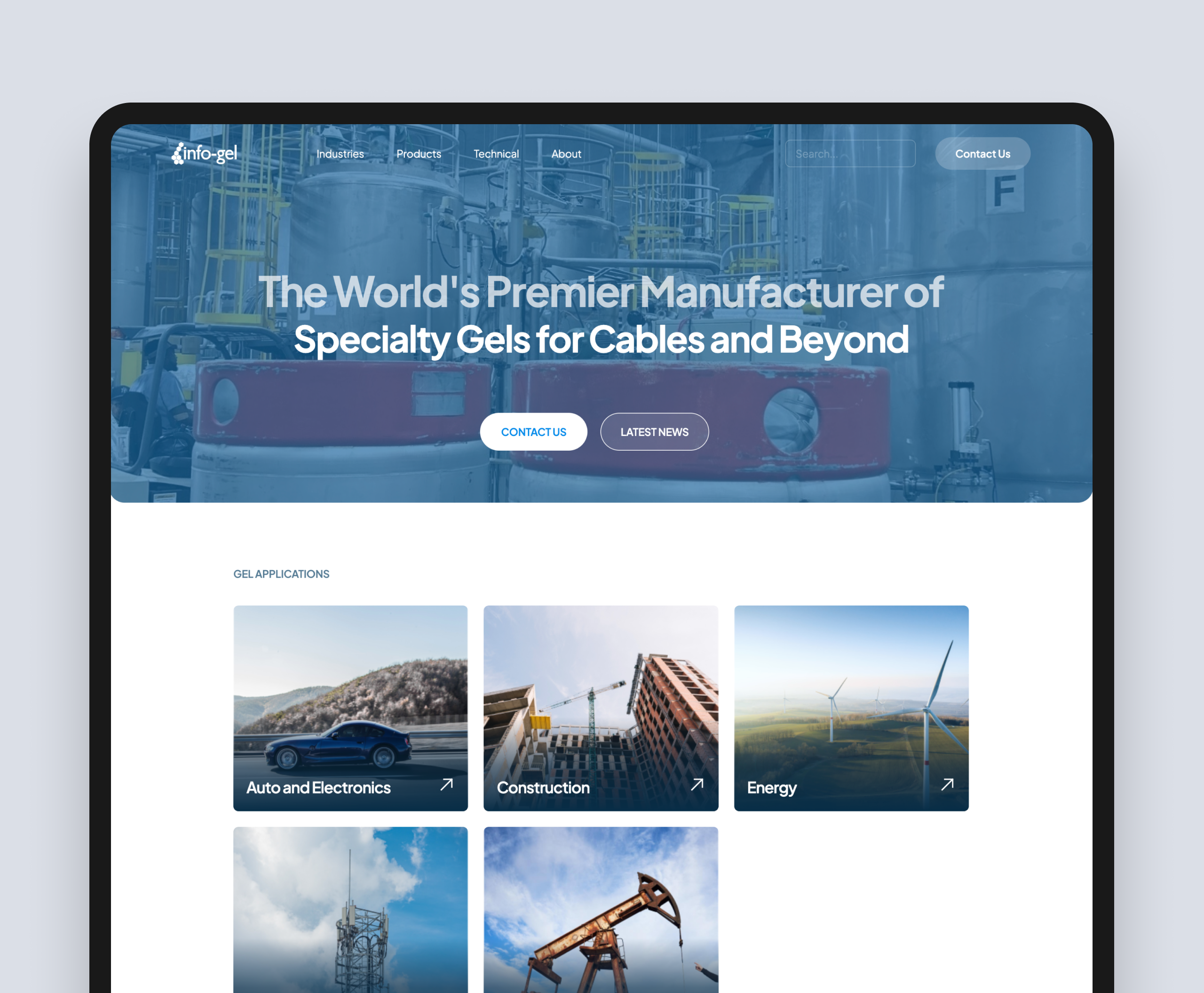
Info-Gel
Specialty Gels for Cables · B2B
A vast catalogue of specialty gels with no cohesive structure and no efficient way to find product data sheets. Rudo delivered a HubSpot CMS site with a clear catalogue structure and robust search, making TDS and SDS documents easy to access — and opening up advanced marketing in the process.
Findability 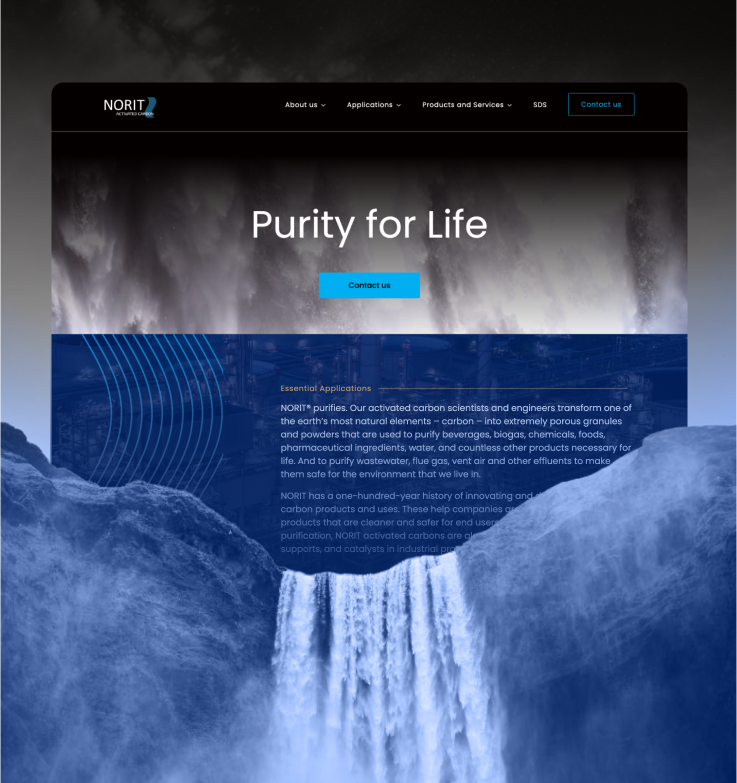
Norit
Activated Carbon Manufacturing · B2B
A global activated carbon producer with a century of heritage, 400+ grades, and products supplied to 100+ countries. Rudo helped present a deep technical portfolio clearly to industrial and municipal buyers, supporting a sophisticated, credibility-led proposition across multiple applications and markets.
Technical clarity How it works
A defined process. No surprises.
Every phase has a defined output and your sign-off before we proceed. Changes at strategy cost hours. At design, days. At development, weeks.
Everything in-house. Strategy, UX, design, development, and copywriting are all delivered by the Rudo team. We do not subcontract any part of your project. One consistent team from kickoff to launch.

Discovery & Strategy
Stakeholder interviews across product, marketing, technical and sales, a catalogue and brand-architecture audit, and competitive analysis. The phase most agencies skip — and the one that determines whether the site performs.
Audience & Journey Mapping
We rebuild the product taxonomy and navigation so every category and sub-brand behaves consistently, then validate wireframes and conversion pathways before any visual design.
Visual Design
High-fidelity Figma design across all templates. Each brand distinct, every product page consistent. Mobile-first. You approve before a line of code is written.
Development
Clean build on your chosen platform with a modular block library. CRM integration, e-catalogue and ERP coexistence, schema, and SEO. No page builders. No technical debt.
Launch & Training
Cross-device QA, pre-launch SEO audit, 301 redirects, and hands-on training. Your team publishes new products and ranges independently from day one.
The team
The people who'll work on
your Manufacturing website project
Eight people. All in-house. No juniors assigned while seniors pitch new business.
The same team who presents at kickoff builds the site.

Charlotte
Head of Strategy
With over 10 years in B2B marketing, Charlotte leads with insight and precision. She shapes smart, scalable strategies that help complex brands connect, convert, and grow.

Mike
Tech Lead
Mike turns vision into reality through clean, scalable code. Whether it’s WordPress, HubSpot, or full-stack builds, he ensures our websites are fast, flexible, and future-proof.

Nick
Design Lead
Nick leads with clarity and creativity. His UX and visual design work distills complexity into experiences that feel intuitive and look world-class across every screen.

Petra
SEO Specialist
From SEO to messaging, Petra knows how to turn content into conversions. She brings energy and creativity to every campaign — and helps clients get found for all the right reasons.

Ivi
Paid Media Specialist
Ivi plans and optimises multi-channel campaigns across Google, LinkedIn, and Meta. She brings precision, performance thinking, and a results-first mindset to every paid strategy.

Oleg
UX/UI Designer
Oleg blends empathy and structure to create beautiful, conversion-focused interfaces. His designs are always rooted in strategy and built for users, not just screens.

Anna-Bet
Content Specialist
Anna-Bet crafts messaging that’s sharp, human, and aligned with your brand’s voice. From positioning to site copy, she turns big ideas into meaningful stories that stick.

Umesh
HubSpot Specialist
Umesh makes HubSpot work harder for your business. From Content Hub to CRM integration to custom modules, he ensures your marketing tools are smart, smooth, and seamlessly connected.
Platform selection
Which platform is right
for your Manufacturing company?
We build on three platforms and recommend whichever fits your catalogue size and commercial model — including when that is not the one we find most commercially interesting.
Webflow
Marketing-team independence
Clean, fast code and a structured CMS for resources and landing pages. Best suited to manufacturers with a smaller catalogue who want maximum design control and speed.
Right for: Manufacturers with a smaller or simpler catalogue who want a fast, polished marketing site their team can update easily.

HubSpot CMS
Best CRM integration
Every enquiry and download flows natively into your sales pipeline. Strong for catalogues with data-sheet libraries and search, plus marketing automation built in from day one.
Right for: Manufacturers where lead intelligence and marketing automation are the priority — and where the catalogue suits a structured CMS.

WordPress
Most recommended for large catalogues
Handles complex taxonomies, multiple sub-brands, and high page counts well. A custom theme with a modular block library lets your team publish new products and ranges without developer involvement.
Right for: Manufacturers with large, multi-brand catalogues that need a consistent product taxonomy and full content control.

Integrations
We connect your manufacturing website to the tools your team already uses
Client outcomes
Not about the process.
About what happened after.
Process is expected. Commercial outcomes are what matter.
Here is what our clients report after their builds went live.
Common questions
Everything you need to know about working with a manufacturing web agency
These are the questions we hear most from manufacturers and industrial companies evaluating agencies. Answered directly — including when the answer is that we're not the right fit.
What does a manufacturing website design agency do?
A manufacturing website design agency designs and builds websites specifically for manufacturers, industrial, and engineering companies. Unlike general web agencies, a manufacturing specialist understands large product catalogues and multiple sub-brands, long and technical buying cycles, the need to present specifications and data sheets clearly, and how to generate qualified enquiries from distributors, specifiers, and OEM buyers. The agency handles strategy, UX, design, copywriting, and development of the marketing website — working alongside any separate e-catalogue or ERP system.
How much does a manufacturing website design agency charge in the UK?
Manufacturing website design in the UK ranges from £17,000 for an Essential project (up to 12 pages, custom design and build) to £40,000+ for an Enterprise project with strategy, full copywriting, and complex catalogue or integration requirements. Mid-range Growth projects — 12 to 25 pages with discovery, UX, design, and development — start from £25,000. The key cost drivers are catalogue size and number of sub-brands, whether copywriting is included, CRM and ERP integration requirements, and platform complexity.
Which CMS should a manufacturing company use — Webflow, HubSpot, or WordPress?
WordPress is often the right fit for manufacturers with large product catalogues and multiple sub-brands, because it handles complex taxonomies and high page counts well. HubSpot CMS is right when enquiries and lead data need to flow natively into your CRM and sales process. Webflow suits manufacturers wanting marketing-team independence with clean, fast pages and a smaller catalogue. We build on all three and recommend whichever fits your catalogue size and commercial model.
How long does a manufacturing website project take?
A properly built B2B manufacturing website takes 10–16 weeks from kickoff to launch: 2 weeks discovery and strategy, 2 weeks UX and wireframing, 3 weeks visual design (with revisions), 4 weeks development, 1 week launch and QA. Large catalogues or multi-brand architectures can extend the development phase. Projects that compress this timeline almost always result in a compromised strategy or architecture phase — where the most important findability decisions are made. We do not compress timelines to win briefs.
What is the difference between a manufacturing website and a general B2B website?
A manufacturing website usually has to organise a large product catalogue — often thousands of SKUs across many categories and several sub-brands — so that a technical buyer can find the exact right product fast. It must present specifications, data sheets, and certifications clearly, build credibility for long and considered purchasing decisions, and often coexist with a separate e-catalogue or ERP system. A consistent product taxonomy and brand architecture are structural elements specific to manufacturing that a general B2B site does not need.
Will my marketing team be able to update the site without a developer?
Yes — and this is a deliberate design goal on every project. On WordPress: a custom theme with a modular block library so new product pages, ranges, and bulletins publish without developer involvement. On HubSpot CMS: a drag-and-drop builder aligned to your design system. On Webflow: a structured CMS and custom block library. Every project includes hands-on team training at launch, because the long-term success of a catalogue this size depends on the team being able to maintain it confidently.
Do you work with manufacturers, industrial, and engineering companies?
Yes. Rudo works with B2B manufacturers and industrial businesses — component and parts manufacturers, chemical and materials producers, engineering firms, and industrial distributors. Our manufacturing clients include ELTA Automotive, Info-Gel, Norit, and Remark Group. Minimum project budget is £17,000. We are less suited to very small manufacturers needing a low-cost brochure template, where an off-the-shelf solution will serve better.
What results can I expect from a manufacturing website redesign?
The metrics we track post-launch include: enquiry rate and quality, product and data-sheet discovery, time-to-find for technical buyers, organic search visibility, and the time your team spends maintaining the site. A well-structured manufacturing site with a clear product taxonomy typically improves both the volume and the quality of qualified enquiries within 90 days of launch, while cutting the time the marketing team spends on updates. Lead-quality improvements take 60–90 days to measure accurately.
Further reading
Manufacturing web design guides and resources
Practical guides on manufacturing website strategy, large-catalogue architecture, and what good looks like — written by the Rudo team.
Manufacturing website design: the complete guide for B2B manufacturers
Pillar guide · 8,000 words
Manufacturing product catalogue websites: how to get it right Manufacturing product catalogue websites: how to get it right
Article · How To
How much does a manufacturing website cost in the UK? How much does a manufacturing website cost in the UK?
Article · UK pricing guide
Manufacturing website examples: B2B sites built by Rudo
Article · Portfolio examples
SEO for manufacturers: how to get your manufacturing website found
Article · SEO Optimisation
How to Design a Manufacturing Website That Generates Enquiries
Article · How To
Ready to talk about what your manufacturing website needs to achieve?
Not what it needs to look like. Not which platform. What it needs to achieve commercially — qualified enquiries, a catalogue buyers can actually navigate, and a site your team can maintain without fighting the CMS.