Overview
Financial services companies occupy a unique position in the web design landscape. The clients they serve are making consequential decisions — investing capital, committing to financial partnerships, selecting platforms through which they will manage significant assets. The stakes of those decisions are high, the clients are financially sophisticated, and the regulatory environment governing how financial services are communicated is strict.
In this context, a financial services website is not a general B2B marketing tool with a finance-appropriate colour scheme. It is a precision instrument. Its job is to communicate authority and expertise to clients who will conduct real due diligence before engaging. To meet FCA and regulatory requirements without sacrificing commercial effectiveness. To serve multiple client types — retail investors, institutional allocators, professional counterparties — from a single coherent digital presence. And to generate qualified leads in a sector where a single client relationship can be worth more than a year of marketing spend.
This guide covers everything a UK financial services company needs to know about building a website that performs this job well.
In this guide:
- Why financial services website design is a distinct discipline
- The financial services sector is not one market
- What financially sophisticated clients expect from a website
- FCA compliance and regulatory considerations
- Design principles that communicate authority
- Platform choice for financial services companies
- CRM integration and lead generation for financial services
- Content strategy for financial services websites
- What a financial services website project involves
- How much does a financial services website cost?
- Financial services sectors we work in
- Frequently asked questions
Find out more about our financial services web design agency.
1. Why financial services website design is a distinct discipline
Ask any experienced financial services marketing professional what makes a financial services website different from a standard B2B website, and the answer is consistent: the trust threshold is categorically higher. A professional services firm or a technology company can earn a client's confidence through a well-designed website and a good pitch. A financial services company must earn a client's confidence before the pitch even begins, because the client is evaluating whether to give them money or manage their money before they agree to a conversation.
This creates specific design requirements that have no equivalent in most other B2B sectors.
The due diligence reality
Before a sophisticated investor, institutional allocator, or professional client engages with a financial services firm, they conduct online due diligence. They check the FCA register. They look for the firm on Companies House. They search for named individuals on LinkedIn. They look for track record evidence — specific deals, funds, performance data, or client references. They assess the quality of the digital presence as a proxy for the quality of the firm's operations. And they compare what they find against competitors who are competing for the same mandate.
A financial services website that fails to surface the right information at the right moment in this evaluation process is not just a missed opportunity. It is an active liability: a digital presence that tells a prospective client that this firm does not operate at the standard they require.
The regulatory constraint
UK financial services companies operating under FCA authorisation face specific obligations around how financial products and services are communicated. Financial promotions must be fair, clear, and not misleading. Risk disclosures must be appropriate. Certain content requires FCA approval before publication. These are not design considerations — they are legal requirements. A financial services website that is commercially optimised but not compliant is not just a risk to search rankings; it is a risk to the firm's regulatory standing.
The best financial services web design agencies understand these constraints and build them into the design and content process from the start. Compliance is not a filter applied after a website is designed; it is a parameter that shapes what the website can say and how it can say it.
The institutional quality signal
In financial services, the quality of the digital presence is a signal about the quality of the firm. A hedge fund or investment manager whose website looks like it was built on a generic template communicates something about its operational standards. An asset manager whose team page has no named individuals with verifiable backgrounds communicates something about its willingness to be held accountable. A wealth management firm whose website contains no evidence of client outcomes or case references communicates something about its confidence in its own track record.
These signals are not necessarily fair — a firm can be excellent at what it does and have a mediocre website. But in a market where a prospective client is comparing two or three firms with similar propositions, the firm with the better digital presence gets the first conversation. Consistently.
| The commercial case |
| A financial services firm that generates one additional qualified client enquiry per month from improved digital presence, at an average relationship value of £50,000 in annual revenue, is generating £600,000 per year in additional pipeline from the website. The cost of a properly built financial services website is recovered in the first engagement it generates that the previous website could not. |
2. The financial services sector is not one market
Financial services is the broadest industry category in this guide. It encompasses business models with fundamentally different client types, different regulatory regimes, different design requirements, and different commercial objectives. Building a website for a fintech startup requires a different approach from building one for an established wealth management firm, which requires a different approach again from building one for a commodities trading platform.
Fintech and financial technology companies
Technology businesses operating in the financial sector. Products include payment platforms, investment apps, company formation tools, risk analytics platforms, insurance technology, and trading tools. The design challenge is translating complex or novel financial technology into clear, accessible propositions without sacrificing the credibility that financial services audiences require. The audience ranges from retail consumers to professional users, depending on the product.
See our guide to fintech website design.
Investment firms and asset managers
Fund managers, asset managers, investment advisories, and capital markets firms. Clients are typically institutional allocators, sophisticated investors, or high-net-worth individuals. The design requirement is institutional credibility: the website must feel like it was built by a firm that manages other people's money with appropriate rigour. Track record, team credentials, investment philosophy, and regulatory status are primary content requirements.
See our guide to investment firm website design.
Wealth management and financial advisory firms
IFAs, financial planners, wealth managers, and private client advisors. Clients range from mass-affluent individuals to ultra-high-net-worth families. The design requirement is approachable authority: sophisticated enough to be credible to wealthy clients, accessible enough to explain complex financial planning in terms that build rather than intimidate. The personal relationship is central — named advisors with genuine depth of profile are a commercial necessity.
See our guide to wealth management website design.
Financial services website costs
Understanding the investment in a financial services website — and what drives the cost up or down — is one of the most commercially useful things a financial services firm can know before beginning a project. Costs vary significantly across sub-sectors: a boutique wealth management firm has a different project scope to a fintech platform or a capital advisory firm running active campaign infrastructure. Our dedicated cost guide covers pricing across all financial services firm types, build complexity tiers, platform costs, and the ongoing investment needed to keep a financial services website performing.
See our guide to financial services website cost.
Property finance and alternative lending
Bridging lenders, development finance brokers, property debt advisories, and specialist lending platforms. Clients are property developers, investors, and professional borrowers. The design requirement is track record and lender network depth. A separate cluster article covers this category in the property section.
3. What financially sophisticated clients expect from a website
Specific, verifiable credentials — not generic claims
Any financial services company can claim to deliver superior returns, expert advice, or market-leading technology. Sophisticated financial clients are trained to discount generic claims and look for specific, verifiable evidence instead. AUM figures with a date. Named clients or named fund structures. FCA registration numbers that resolve on the FCA register. Team members whose backgrounds can be verified on LinkedIn. Performance data with clear methodology disclosures.
A financial services website that leads with claims rather than evidence is not just less persuasive — it actively signals that the firm does not have the evidence to offer. In a sector where evidence is table stakes, this is a commercial liability.
Professional depth without jargon overload
Financial services websites occupy a difficult balance: they need to be technically credible to sophisticated professional audiences, while remaining accessible enough to explain the firm's proposition clearly to clients who may be experts in their own field but not in finance. The solution is layered content: clear, accessible positioning at the page level with technical depth available on demand — through downloadable documentation, dedicated strategy pages, or expandable sections — rather than leading with complexity.
Named individuals with verifiable backgrounds
In financial services, the people running the firm are a significant part of what clients are buying. A fund manager's investment philosophy, a wealth advisor's qualifications and approach, or a fintech founder's previous experience at recognised institutions are all commercially relevant. Team pages with generic biographical statements and stock-quality headshots communicate that the firm is not confident in what its people bring. Named individuals with specific, honest biographies communicate the opposite.
Regulatory transparency
FCA authorisation status, regulatory permissions, risk disclosures, and compliance documentation should be findable and verifiable quickly. A sophisticated client who has to search for the FCA number is a client whose confidence is being eroded, not built. Regulatory information is not just a compliance requirement — placed correctly, it is a trust signal.
Evidence of outcomes
Case studies, investment performance data, client references, and deal history — presented within appropriate regulatory constraints — are among the most commercially valuable content on a financial services website. Clients making significant financial commitments want to know that this company has delivered for clients in comparable situations. Generic service descriptions do not provide this reassurance. Specific outcomes do.
4. FCA compliance and regulatory considerations
UK financial services companies operating under FCA authorisation face specific legal obligations regarding how their services are communicated digitally. These obligations are not optional and are not satisfied by adding a disclaimer to the footer.
Financial promotions
Under COBS 4 of the FCA Handbook, a financial promotion is any communication that invites or induces a person to engage in investment activity. Website content describing regulated financial products or services is likely to constitute a financial promotion and must be approved by an authorised person before publication. The financial promotion must be fair, clear, and not misleading. It must contain appropriate risk warnings. And it must not omit information that could cause a client to misunderstand the nature of what is being offered.
These requirements have direct design implications. Risk warnings must be appropriately prominent — not hidden in footer small print. Past performance disclaimers must accompany any performance data. Product descriptions must be balanced, not one-sided. A financial services web design agency that does not flag these requirements is not equipped to build a compliant financial services website.
Consumer Duty
The FCA's Consumer Duty (effective 2023) requires firms serving retail clients to ensure that their communications — including website content — actively support good client outcomes. The duty extends to the design of the website itself: navigation that obscures important risk information, calls to action that create false urgency, or content that presents returns without appropriate risk context may be considered contrary to Consumer Duty requirements.
Building compliance into the project
Compliance review should be built into the website project timeline, not treated as a post-launch consideration. The copywriting phase for any page containing regulated content should include a compliance review step before the content is approved for development. The CMS should include a workflow that allows the compliance team to approve content before publication. And the design team should be briefed on the specific compliance requirements that apply to the firm's activities from the start of the project.
| A financial services website that is designed first and compliance-reviewed second creates two rounds of expensive rework. A website designed with compliance requirements as a parameter from the start is more efficient to produce and more robust in operation. |
5. Design principles that communicate authority
Financial services website design has a well-developed visual language that has evolved around the specific credibility requirements of the sector. Understanding when to work within this language and when to differentiate from it is a key skill for agencies building in this space.
Restraint as a credibility signal
The design register of institutional financial services — restrained colour palettes anchored in dark blues, navies, and greys; precise, well-chosen typography; generous whitespace; high-quality photography of real people and real environments — communicates operational quality before a word of copy is read. A financial services firm that launches with a loud, maximalist design is communicating something unintentional about its market positioning.
Fintech companies have more latitude here. The fintech design language is more varied and more willing to use bold colour, dynamic motion, and consumer-friendly aesthetics. But even fintech companies targeting professional or institutional audiences benefit from restraint — the design should feel modern and capable, not playful or chaotic.
Typography and information hierarchy
Financial services clients read websites with a specific objective: to extract specific information as efficiently as possible. Clear typographic hierarchy — distinct heading weights, comfortable reading line lengths, sufficient contrast — serves this objective. Dense, undifferentiated text slows extraction and increases cognitive load. In a sector where the client's time is valuable and their attention is finite, good typographic hierarchy is a commercial asset.
Data presentation
For investment firms, asset managers, and trading platforms, data presented clearly and contextually is one of the most powerful design tools available. AUM figures, performance charts, deal volumes, and market statistics presented in clean, readable formats — not buried in PDFs or presented as walls of prose — communicate analytical rigour and commercial substance. The choice of how to present data is a design decision that affects whether a client registers the evidence or scrolls past it.
Photography: real over generic
The distinction between real photography and stock photography is immediately apparent to the financial services clients who have spent careers visiting fund managers, advisors, and trading desks. Real photographs of the actual team in the actual office, or of the actual platform in use, communicate specificity. Stock photographs of people in suits shaking hands communicate nothing.
6. Platform choice for financial services companies
The right platform for a financial services website depends on the nature of the business, the regulatory requirements, the volume and complexity of campaign activity, and the commercial toolstack already in place.
HubSpot CMS: for marketing-led financial firms
For financial services companies running active inbound marketing programmes — LinkedIn campaigns, email nurture sequences, gated content — HubSpot CMS provides native pipeline integration between every website interaction and the commercial team's contact database. Smart content can serve different messaging to different client profiles. Campaign landing pages can be built without developer involvement. Every enquiry is tracked from first touchpoint to closed relationship.
HubSpot CMS is particularly strong for fintech companies with multiple audience segments, wealth management firms running active prospect campaigns, and capital advisory firms using LinkedIn for business development.
For more on HubSpot CMS, read our complete HubSpot CMS guide.
WordPress: for complex content and integrations
For financial services companies with complex content architectures — large research libraries, multiple fund or product pages, investor portals, or integration with proprietary data systems — WordPress with a custom theme provides the flexibility that managed platforms cannot. The open architecture accommodates any content model and any integration without platform constraints.
WordPress is also the appropriate choice for financial services companies with strict data sovereignty or hosting requirements that managed platforms cannot satisfy — for example, firms requiring UK-hosted infrastructure with specific security certifications.
For more on WordPress, read our complete WordPress guide.
Webflow: for design-led financial brands
For financial services companies where visual positioning is a primary competitive differentiator — boutique investment managers, design-forward fintech brands, or premium advisory firms — Webflow's design fidelity makes it a strong option. Less appropriate for firms with complex CRM requirements or large content operations.
For more on Webflow, read our complete Webflow guide.
For a full platform comparison, read our guide to WordPress vs Webflow vs HubSpot.
7. CRM integration and lead generation for financial services
Financial services client relationships are long. A prospective client who visits the website for the first time may not be ready to commit to a relationship for months or years. The website's job is not just to capture enquiries from clients who are ready to act today — it is to begin a relationship with clients who are months away from being ready, and to maintain that relationship until the moment they are.
CRM integration — connecting every website interaction to a structured commercial pipeline — is the mechanism by which this happens. Without it, the firm has no visibility into who is engaging with the website, no ability to nurture relationships over long timescales, and no way to attribute revenue to the digital activity that generated it.
LinkedIn as the primary acquisition channel
For most UK financial services companies targeting professional clients, LinkedIn is the highest-return digital acquisition channel available. Professional targeting by job title, seniority, firm type, and AUM range allows financial services companies to reach exactly the client profiles they are targeting. Campaign landing pages built alongside the main website, connected natively to the CRM, and optimised for the specific conversion path of each audience segment consistently outperform sending campaign traffic to the main website homepage.
Gated content and lead capture
Research reports, market outlook documents, due diligence questionnaires, and investment strategy papers are content assets that financial services clients will provide contact details to access. A well-designed gated content programme builds a database of prospects who have identified themselves by their interest in specific topics, which allows the commercial team to have more relevant first conversations.
| Case study: Impera Finance (Real estate capital advisory, £500m+ in funding arranged, WordPress + HubSpot) |
| Impera Finance is a London-based real estate finance advisory that has arranged and executed more than £500 million in funding across debt and equity transactions. Their previous website failed to communicate this track record or provide the technical infrastructure for digital marketing. Rudo designed and built a credibility-led custom WordPress website with a suite of LinkedIn campaign landing pages and native HubSpot CRM integration. Every enquiry enters the pipeline with full source attribution and campaign tracking. Within three months of launch: 35% increase in visitor engagement, 25% boost in page views per session, 20% growth in organic traffic. Full case study: rudo.co.uk/case-studies/impera-finance/ |

8. Content strategy for financial services websites
Financial services companies that invest consistently in high-quality content build two commercial assets: organic search visibility that drives qualified traffic, and on-site content that converts that traffic by demonstrating the depth of expertise behind the brand.
Market commentary and thought leadership
Regular, substantive market commentary — investment outlooks, sector analysis, regulatory updates, macroeconomic commentary — demonstrates that the firm has genuine analytical capability and current market knowledge. For institutional and professional audiences evaluating financial services partners, thought leadership content is evidence of expertise rather than a claim of it. It is also a powerful organic search asset: long-form, specific, expert content ranks for the queries that sophisticated financial clients use when researching.
Regulatory and product explainers
For fintech companies and financial services firms serving clients who may be encountering certain financial structures or regulations for the first time, clear explanatory content — how does this product work, what are the regulatory requirements, what should a client consider — serves a dual purpose. It ranks organically for the research queries that precede a purchase decision, and it pre-educates prospective clients before the first conversation.
Case studies within regulatory constraints
Financial services case studies require more care than case studies in most other sectors. Client confidentiality, financial promotion rules, and the requirement for fair and balanced presentation all constrain what can be said and how. But these constraints do not prevent case study content entirely — they shape it. Anonymised deal structures, described at sufficient specificity to communicate real capability without identifying the client, are appropriate and commercially valuable. Named case studies with client consent are more powerful still.
| Case study: Tolerisk (Financial SaaS — investment risk analytics for financial advisors, WordPress) |
| Tolerisk is a math-intensive financial SaaS platform providing investment risk modelling tools for financial advisors. Their marketing website needed a complete redesign timed to coincide with a platform release, with a six-week delivery deadline. Rudo built a custom WordPress marketing site that communicated the platform's sophisticated risk analytics capability to a professional financial advisor audience — balancing technical credibility with the accessibility needed for a marketing site. The site launched alongside the application release, meeting the tight deadline, with a design system that elevated the Tolerisk brand and provided a robust digital foundation for their commercial launch. Full case study: rudo.co.uk/case-studies/tolerisk/ |

9. What a financial services website project involves
Discovery and strategy: weeks 1 to 2
Stakeholder interviews with commercial, compliance, and marketing leads. Client persona development for each audience type. Competitor analysis of how peer firms are positioned digitally. Review of existing regulatory obligations and their design implications. For financial services projects, the discovery phase should explicitly include a conversation with the compliance team about what content requires pre-approval and what the approval workflow looks like — building this into the project timeline prevents post-launch delays.
Copywriting: three tiers
- Strategic guidance (£1,500 to £3,000): Rudo team provides page-by-page copy outlines with the messaging hierarchy and regulatory requirements flagged. Your team writes the final copy and manages compliance review. Works when you have an experienced financial copywriter internally.
- Hybrid (£3,500 to £7,000): Rudo team writes the commercial pages — homepage, key service pages, campaign landing pages — while your team writes technical product or strategy content. The most commonly chosen option for financial services clients.
- Full copywriting (£6,000 to £14,000): Rudo team writes everything from a messaging workshop. Compliance review is built into the production timeline. The right choice for firms repositioning, launching new products, or without internal financial copywriting resource.
UX and design: weeks 3 to 7
Information architecture for the full site, including any audience-specific content journeys and the campaign landing page structure. High-fidelity design in Figma across all templates. For financial services projects, this phase includes deliberate decisions about the placement of regulatory information — risk warnings, FCA disclosures, compliance statements — ensuring they are compliant without being design-disruptive.
Development: weeks 8 to 13
Custom theme or platform build. CRM integration with appropriate data handling documentation for GDPR compliance. Campaign landing page infrastructure. Any custom functionality: investor calculators, portfolio data displays, document libraries, or gated content systems. Security configuration appropriate for a financial services context — SSL, secure form handling, appropriate data retention policies.
Launch and handover: weeks 14 to 15
Pre-launch compliance review of all live content. Technical SEO configuration. QA across all pages, forms, and integrations. Team training on CMS, content management, and campaign landing page creation. Post-launch monitoring.
10. How much does a financial services website cost?
Standard build: £12,000 to £25,000
A fully custom-designed financial services website with discovery and strategy, up to 25 page templates, one or two audience journeys, campaign landing page templates, CRM integration, compliance-aware content support, pre-launch SEO, and team training. Appropriate for growing financial services firms, fintech companies at the marketing site stage, and smaller investment or advisory firms making a first serious digital investment.
Complex build: £25,000 to £50,000
Larger sites with multiple audience segments, complex campaign landing page infrastructure, HubSpot smart content and workflow configuration, investor portal or gated document library functionality, or integration with proprietary data systems. Most established financial services firms with active marketing programmes fall in this band.
Enterprise: £50,000 and above
Institutional-grade platforms, multi-product or multi-jurisdiction deployments, complex compliance workflow integration, or bespoke functionality such as real-time market data display, fund NAV feeds, or investor reporting infrastructure. Scoped individually.
Ongoing costs
Platform costs: WordPress hosting from £50 to £200 per month, HubSpot CMS Professional from approximately £400 per month. Content maintenance — market commentary, regulatory updates, new case studies — is an ongoing investment. For regulated firms, a compliance review step in the content publication workflow adds overhead that should be planned for operationally.
11. Financial services sectors we work in
Rudo has designed and built websites for financial services companies across fintech, capital markets, investment management, wealth management, and financial advisory — four published case studies and an active pipeline across the sector's sub-categories.
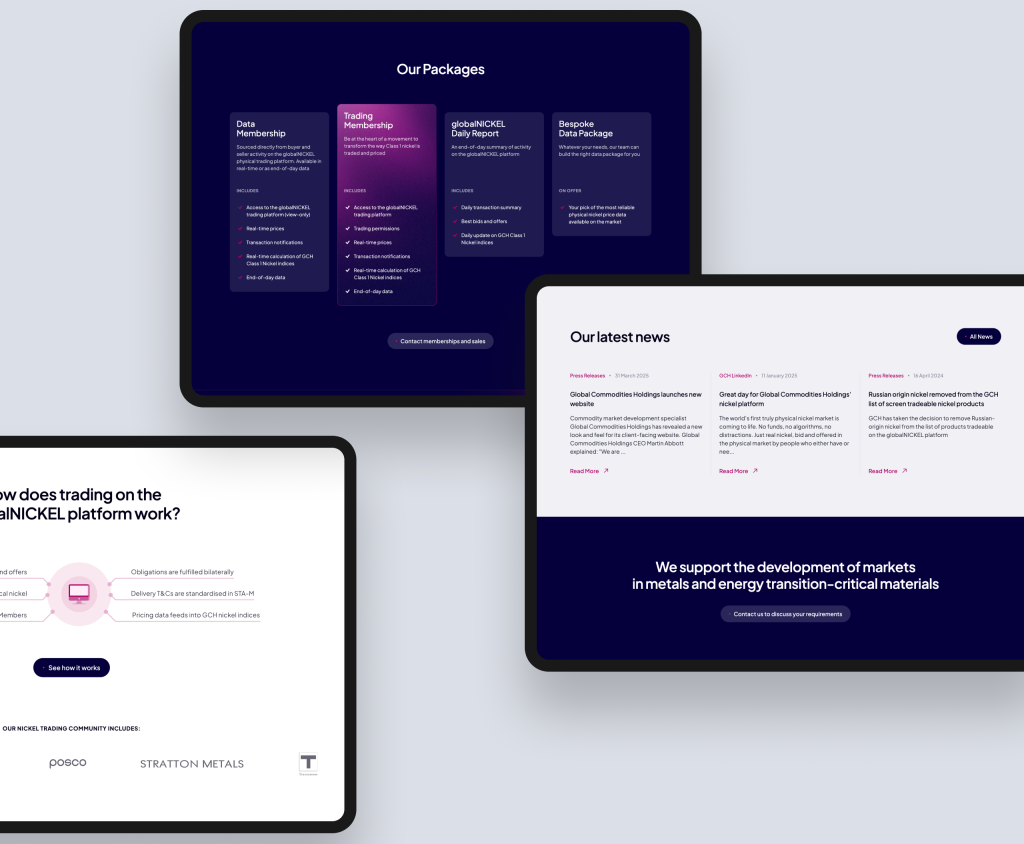
| Case study: Global Commodities Holdings (Commodities trading digital marketplace, WordPress) |
| Global Commodities Holdings operates a digital marketplace connecting buyers and sellers of physical commodities. Best known for globalCOAL, their established coal trading platform, the company is expanding into metals trading with nickel and planning further expansion into lithium and cobalt. They needed a dedicated website distinct from the legacy coal platform — with a modern UI, flexible structure, and the credibility of an established industry leader combined with the forward-facing positioning needed for new commodity markets. Rudo designed and built a custom WordPress site with a modular layout system allowing consistent rollout across new commodity verticals, a streamlined UX explaining the marketplace model and onboarding process, and a design system that balanced institutional authority with modern usability. Full case study: rudo.co.uk/case-studies/global-commodities-holdings/ |
Ready to build a financial services website that generates qualified enquiries?
Rudo is a London-based B2B web design agency with proven experience across financial services — fintech, capital markets, investment management, wealth management, and property finance. We understand the credibility requirements of the sector, the FCA compliance context, and the commercial infrastructure needed to generate qualified leads at scale.
Ranked number one UK web design agency on DesignRush and top ten on Clutch. Every financial services project begins with a thorough understanding of your client audiences, your regulatory obligations, and the commercial objectives the website needs to deliver.
Book a no-obligation intro call.
We will review your current website, discuss your client audiences and regulatory context, and give you an honest view of what a website built for your financial services business should do.
12. Frequently asked questions
What makes a good financial services website?
A good financial services website communicates authority through specific, verifiable evidence — not generic claims. It meets FCA compliance requirements without sacrificing commercial effectiveness. It serves multiple client types simultaneously with appropriate content for each. It surfaces team credentials, track record, and regulatory status prominently. And it is connected to a CRM that allows the commercial team to manage relationships over the long timescales of financial services decision-making. Design quality matters because it is a proxy for operational quality in a sector where clients are evaluating firms on every available signal.
Does a financial services website need FCA compliance review?
For firms carrying out regulated activities, website content that constitutes a financial promotion must be approved by an FCA-authorised person before publication. The definition of financial promotion is broader than many firms assume — service descriptions, performance references, and product content may all qualify. Compliance review should be built into the content production workflow from the start of the project, not treated as a post-launch check. A financial services web design agency that does not raise this requirement has not built financial services websites at a professional level.
How much does a financial services website cost in the UK?
A standard financial services website build typically costs £12,000 to £25,000. More complex builds involving multiple audience segments, HubSpot smart content, gated document libraries, or custom integrations typically cost £25,000 to £50,000. Enterprise-grade platforms cost £50,000 and above. Ongoing platform costs range from £50 to £200 per month for WordPress to approximately £400 per month for HubSpot CMS Professional.
What is the best platform for a financial services website?
HubSpot CMS for firms running active marketing campaigns who need native CRM integration, smart content delivery by client profile, and campaign landing page flexibility. WordPress for firms with complex content architectures, specific integration requirements, or data sovereignty needs. Webflow for design-led financial brands with moderate content complexity. The right platform is determined by the firm's marketing team's operational requirements and the CRM already in place — not by the website build cost alone.
How long does a financial services website project take?
A standard financial services website project takes 12 to 15 weeks. Projects involving complex multi-audience architectures, HubSpot configuration, or custom functionality take 15 to 20 weeks. The most variable factor is the compliance review workflow — for firms where all regulated content requires pre-publication approval, building this into the project timeline adds time that is impossible to compress. Planning the compliance review process at the start of the project prevents this from becoming a launch blocker.
Further reading on this subject
This pillar connects to six supporting guides covering specific aspects of financial services web design: fintech website design, investment firm website design, wealth management website design, financial services website examples, financial services website cost, and how to choose a financial services web design agency.
About Rudo
Rudo is a strategy-led B2B web design agency based in London. We design and build websites for financial services companies across fintech, investment management, wealth management, and property finance. Ranked number one UK web design agency on DesignRush and top ten on Clutch.
Find out more about our financial services web design agency.

Written by
Rudo Agency
Rudo is a strategy-led web design and development agency specialising in B2B. Based in the UK and working with clients globally, we help ambitious brands turn complex ideas into high-performing websites. Our team combines digital strategy, UX/UI design, custom development, and SEO to deliver results-focused websites that support real business growth.
