Overview
The most instructive way to understand what makes a financial services website perform commercially is to examine real examples: the specific challenges each company faced, the design and strategic decisions made in response, and the outcomes those decisions produced. Portfolio screenshots show you what a site looks like. Understanding the reasoning behind the decisions tells you what to think about for your own project.
This guide draws on three financial services website builds from Rudo's portfolio, covering real estate capital advisory, commodities trading, and financial technology — three different business models with different audiences, different regulatory contexts, and different commercial objectives. The thread connecting all three is the same challenge that defines financial services web design: communicating authority and capability to sophisticated audiences who evaluate before they engage.
In this article:
- What makes a high-performing financial services website
- Impera Finance: real estate capital advisory
- Global Commodities Holdings: commodities trading marketplace
- Tolerisk: financial SaaS platform
- What the three sites have in common
- Applying these lessons to your financial services website
This article is part of the complete guide to financial services website design.
Find out more about our financial services web design agency.
1. What makes a high-performing financial services website
Before examining specific examples, it is worth being precise about the criteria that matter in financial services web design — because several things that matter in other sectors matter less here, and several things that matter here are rarely discussed.
- Specific evidence over generic claims. Any financial services company can claim expertise, experience, and client focus. The firms whose websites convert provide specific, verifiable evidence: track record data with appropriate context, named deal history, named clients where permitted, specific qualifications and authorisations. Evidence differentiates; claims do not.
- Regulatory credentials surfaced prominently. FCA authorisation number, relevant permissions, and regulatory status should be visible and verifiable without requiring the visitor to search. An investor who has to look for the FCA number has a worse experience than one who finds it immediately. Trust is built or lost in these moments of effort.
- Design quality as a proxy for operational quality. Financial services clients evaluate the quality of the digital presence as a signal of the quality of the firm's operations. A poorly designed financial services website does not just look bad — it communicates something about how the firm operates. The inverse is also true: a well-designed financial services website communicates operational rigour before any content is read.
- Conversion architecture suited to the decision timescale. Financial services decisions take time. The website must accommodate the prospect who is ready to act this week and the one who is beginning an evaluation that will take months. Multiple conversion entry points, appropriate nurture infrastructure, and CRM integration from day one are commercial requirements, not nice-to-haves.
2. Impera Finance: real estate capital advisory

The client and the challenge
Impera Finance is a London-based real estate finance advisory that has arranged and executed more than £500 million in funding across debt and equity transactions. Their lender network and transactional track record positioned them strongly in the market — but their previous website communicated neither their reputation nor the analytical depth that sophisticated property developers and investors look for when evaluating an advisory relationship online.
The commercial challenge was specific: design a website that communicates Impera's track record convincingly enough to generate qualified inbound enquiries from developers and investors who would otherwise only encounter the firm through referral or direct relationship, while simultaneously building the digital infrastructure needed to support LinkedIn campaign activity targeting specific developer profiles.
The design and build decisions
Rudo began with a discovery phase that included stakeholder interviews to understand the specific client types Impera serves, the nature of their deal flow, and the credibility signals their market looks for when evaluating an advisory relationship. The information architecture was structured around the track record as the primary commercial asset — the £500m+ figure positioned as an above-fold credibility anchor rather than buried in an about page as a supporting claim.
The design system communicated institutional authority: restrained palette, precise typography, high-quality team photography, and a visual language calibrated to the professional developers and institutional investors who are Impera's primary audience. A custom WordPress theme was built for technical performance and SEO readiness. A suite of campaign landing pages was designed alongside the main site, each targeting a specific developer profile and optimised for LinkedIn traffic. HubSpot CRM was integrated natively, with form routing by enquiry type and full campaign attribution.
The outcomes
Within three months of launch: 35% increase in visitor engagement, 25% boost in page views per session, and 20% growth in organic traffic. The campaign landing page infrastructure became an active commercial tool generating qualified developer enquiries at measurable cost per lead.
Read the full case study: Impera Finance case study.
Key lesson
Track record is the primary commercial asset for any financial advisory or capital markets firm. Every design and structural decision should be oriented around surfacing that track record as specifically and prominently as possible. The campaign landing page infrastructure is not a secondary consideration — for firms using LinkedIn for business development, it is the mechanism by which the website generates pipeline rather than simply representing the firm.
3. Global Commodities Holdings: commodities trading marketplace
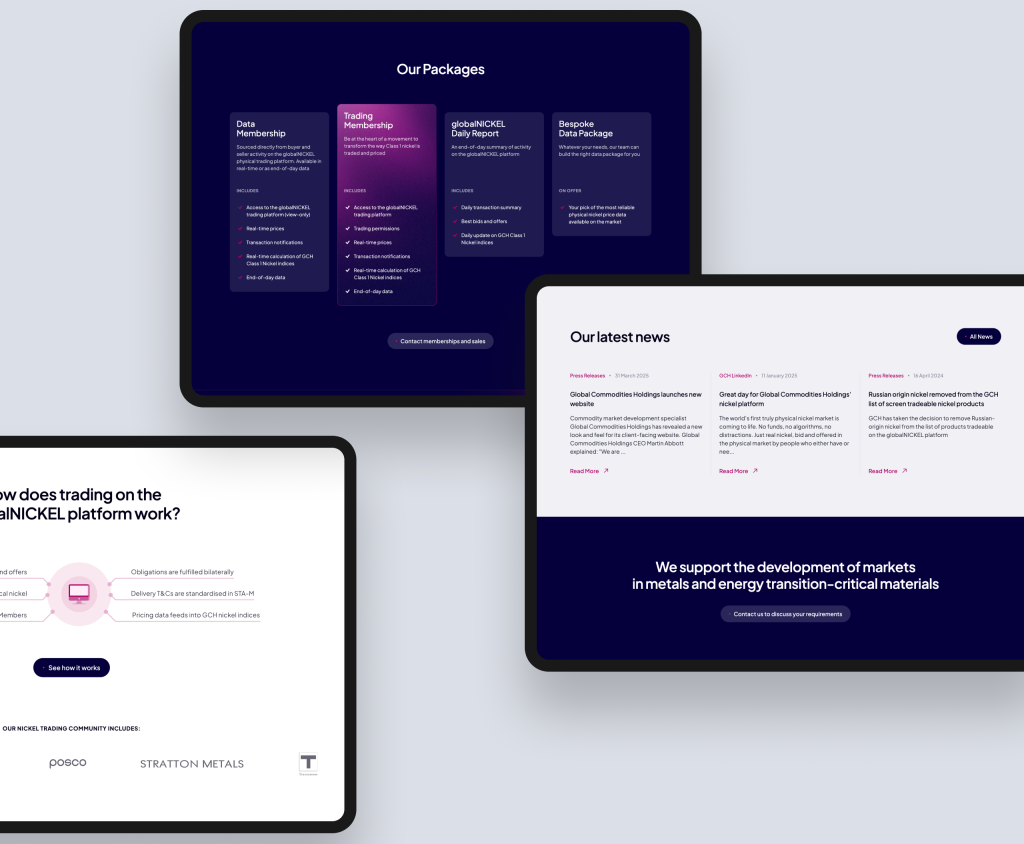
The client and the challenge
Global Commodities Holdings operates a digital marketplace connecting buyers and sellers of physical commodities. Best known for globalCOAL — a long-established marketplace connecting buyers and sellers of thermal and metallurgical coal — the company is expanding its digital marketplace model into metals trading, starting with nickel and planning further expansion into lithium and cobalt.
The challenge was positioning: the new website needed to carry the credibility and authority of an established industry leader while feeling fresh and forward-facing enough to credibly address emerging commodity markets. The visual and functional distance from the legacy coal platform was important — the new site needed to represent the expanded strategic vision without being confused with the established coal marketplace.
The design and build decisions
Rudo approached the project by understanding what made the original coal platform successful: trust, market structure, and ease of transaction. These strengths were translated into a new brand expression for Global Commodities Holdings that could serve as the digital front door for the expansion into metals trading. The design is clean, authoritative, and modular — with a layout system built to allow consistent rollout across new commodity verticals without requiring a rebuild for each market.
The UX explains the marketplace model, onboarding process, and trading tools clearly, emphasising credibility through content structure and visual language. A custom WordPress theme provides the flexible foundation for the company's ongoing expansion. The institutional authority of an established player is communicated through the design register, while the forward-facing positioning is communicated through the visual language and content framing.
The outcomes
The new Global Commodities Holdings website positions the company as a credible, forward-thinking player in global commodity markets beyond coal. The modular architecture allows new commodity verticals to be launched consistently as the business grows — the investment in the design system pays dividends with each new market entered.
Read the full case study: Global Commodities Holdings case study.
Key lesson
For established financial market operators expanding into adjacent markets, the website's job is to carry the authority of the existing position into the new context — not to abandon it in favour of a fresh start. A modular architecture that can grow consistently with the business is a more valuable investment than a fixed design built only for the current state of the product.
4. Tolerisk: financial SaaS platform

The client and the challenge
Tolerisk is a math-intensive financial SaaS platform providing investment risk modelling tools for financial advisors. The platform offers a more rigorous, mathematically grounded approach to investment risk tolerance assessment than the conventional questionnaire-based tools that most advisory practices rely on. The target audience is professional financial advisors evaluating Tolerisk against the tools they currently use.
The challenge was a combination of product explanation difficulty and timeline pressure. The marketing website needed to communicate a genuinely complex analytical product clearly to a professional audience — without losing the technical credibility that makes the product valuable to that audience. And it needed to be delivered in six weeks, timed to coincide with the application release.
The design and build decisions
Rudo worked collaboratively with the Tolerisk team to define a streamlined user flow and wireframes that captured the essence of the math-intensive platform for a financial advisor audience. The content architecture led with the problem — the limitations of conventional risk questionnaires — before introducing the mechanism (Tolerisk's mathematically rigorous approach) and the outcome (better-matched investment portfolios for advisors' clients).
A custom WordPress theme was built for speed, security, and tailored functionality. Rapid iteration on design and content through efficient communication and an iterative review process allowed the project to meet its six-week deadline without compromising on the design standard required to represent a premium financial analytics platform.
The outcomes
The site launched on time alongside the application release. The custom WordPress theme optimised speed and security while delivering a seamless user experience for the financial advisor audience. The collaborative process elevated the Tolerisk brand and provided a robust digital foundation for communicating their value proposition at launch.
Read the full case study: Tolerisk case study.
Key lesson
For financial technology companies with complex products and hard deadlines, a custom WordPress theme built from a clean codebase with a clear design brief is often faster than attempting to rework an existing site or configure a page builder. The six-week delivery at Tolerisk was possible because the project started clean and was executed with clear scope. Speed and quality are not always in tension — they are in tension specifically when the process is unclear or the brief is incomplete.
5. What the three sites have in common
- Strategy preceded design in every case. All three projects began with a discovery phase that produced specific strategic outputs before any design work began: audience analysis, competitor positioning review, commercial goal definition, and information architecture decisions. The design work was executed against a clear brief, not used to generate the brief.
- Credibility was a primary design consideration. In all three cases, the placement and presentation of credibility signals — track record data, team credentials, regulatory authorisation, market authority indicators — was treated as a design decision with commercial consequences, not as content to be added after the visual design was complete.
- The CMS was built for the team's independence. All three clients can manage their own content post-launch: update team profiles, publish market commentary, add new content types, without raising a developer ticket. This is a commercial requirement for financial services firms whose regulatory and market context requires regular content updates.
- Technical quality was non-negotiable. Financial services audiences evaluate digital quality as a proxy for operational quality. All three sites were built to perform well on Core Web Vitals, load quickly on mobile, and function without errors across browsers and devices. A financial services website that is slow or technically unreliable communicates something about the firm — and not something positive.
Ready to build a financial services website that performs like these?
Rudo designs and builds financial services websites for capital advisories, fintech platforms, investment managers, and wealth managers. Book an intro call — we will review your current site, discuss your audiences, and give you an honest view of what it would take to build something that genuinely generates qualified enquiries.
6. Applying these lessons to your financial services website
The commercial principles behind these three websites are not specific to these firms. They apply to any financial services company — investment manager, fintech platform, wealth advisory, capital markets firm — that wants its website to function as a commercial asset rather than a brochure.
Find out more about our financial services web design agency.
Also in this series: fintech website design, investment firm website design, wealth management website design, financial services website examples, financial services website cost.
Back to the complete guide to financial services website design.

Written by
Rudo Agency
Rudo is a strategy-led web design and development agency specialising in B2B. Based in the UK and working with clients globally, we help ambitious brands turn complex ideas into high-performing websites. Our team combines digital strategy, UX/UI design, custom development, and SEO to deliver results-focused websites that support real business growth.
