Overview
An investment firm's website serves an audience that conducts genuine due diligence before committing capital. Institutional allocators, sophisticated private investors, and family offices approach an investment firm's digital presence the same way they approach any other part of their investment evaluation: systematically, sceptically, and with specific criteria in mind. They are looking for evidence of capability, evidence of character, and evidence of process — in that order.
A website that provides this evidence clearly and specifically will be shortlisted. One that substitutes generic claims for specific evidence will not. This guide covers the design and content decisions that determine which category an investment firm's website falls into.
In this article:
- What sophisticated investors look for on an investment firm website
- Track record: the primary commercial asset
- Designing for institutional credibility
- Team profiles that convert
- Investment strategy and philosophy content
- Regulatory and compliance design requirements
- Platform choice for investment firms
- Case study: Impera Finance and Global Commodities Holdings
- Frequently asked questions
This article is part of the complete guide to financial services website design.
Find out more about our financial services web design agency.
1. What sophisticated investors look for on an investment firm website
Investors evaluating an investment firm online are not browsing. They have a specific purpose and a specific set of questions. The website either answers those questions efficiently or it does not.
Performance and track record
The first and most important evaluation criterion. Investors want to see: what has this firm delivered, over what time period, through what market conditions, and how does that compare to relevant benchmarks? Track record presentation requires careful calibration — it must be specific enough to be credible, compliant with FCA financial promotion rules, and presented with appropriate risk disclosures. Generic claims of 'strong performance' without data are discounted immediately by sophisticated investors.
Investment philosophy and process
How the firm makes investment decisions — the philosophy, the process, the edge — is the second major evaluation criterion. Investors want to understand what the firm believes and why, how those beliefs are translated into investment decisions, and what differentiates the approach from the alternatives available in the market. Vague descriptions of 'rigorous analysis' and 'disciplined process' tell an experienced allocator nothing.
Team depth and key person risk
Who is running the money, what is their track record individually, what are their qualifications and backgrounds, and what happens if a key person leaves? Institutional allocators in particular are focused on key person risk — the question of whether the firm's performance is attributable to a specific individual and what the succession plan looks like. Team pages that provide genuine depth of information on named individuals address this question directly.
Operational infrastructure
Custody arrangements, valuation procedures, auditor relationships, prime broker relationships, legal counsel, compliance arrangements, and operational controls. Institutional investors are looking for evidence that the firm operates with the professional infrastructure they would expect from a manager of their capital. This content belongs in investor-facing documentation, not on the public website — but the website should provide clear pathways to request it.
2. Track record: the primary commercial asset
The track record of an investment firm is its most valuable commercial asset. It is also the content category most often handled poorly on investment firm websites — either absent entirely, present but so hedged as to be commercially useless, or presented in violation of financial promotion rules.
What can be published and how
FCA rules on financial promotions require that performance data is presented fairly, clearly, and in a way that is not misleading. This means: past performance must be accompanied by a clear past performance disclaimer; performance data must be presented with sufficient context (time period, benchmark, fees, methodology) that a reasonable investor can evaluate it; and risk warnings appropriate to the investment strategy must be prominent.
Within these constraints, specific, contextualised performance data is more commercially valuable than anything else on the website. An investment firm that presents five years of audited annual returns, with benchmark comparison and clear methodology disclosure, is communicating its track record as a credible institutional investor would present it. One that omits performance data entirely or provides only vague qualitative descriptions is signalling either that the track record does not exist or that the firm is unwilling to be held accountable for it.
Deal and transaction history for advisory firms
For capital advisory and transaction-oriented firms — those that arrange and execute specific deals rather than manage funds on an ongoing basis — the deal history is the equivalent of the fund manager's performance track record. Volume of transactions arranged, deal sizes, asset classes, and structures are the evidence of capability. Case references, presented with appropriate specificity (value, structure, sector, geography) without identifying the client where confidentiality requires, demonstrate real capability.
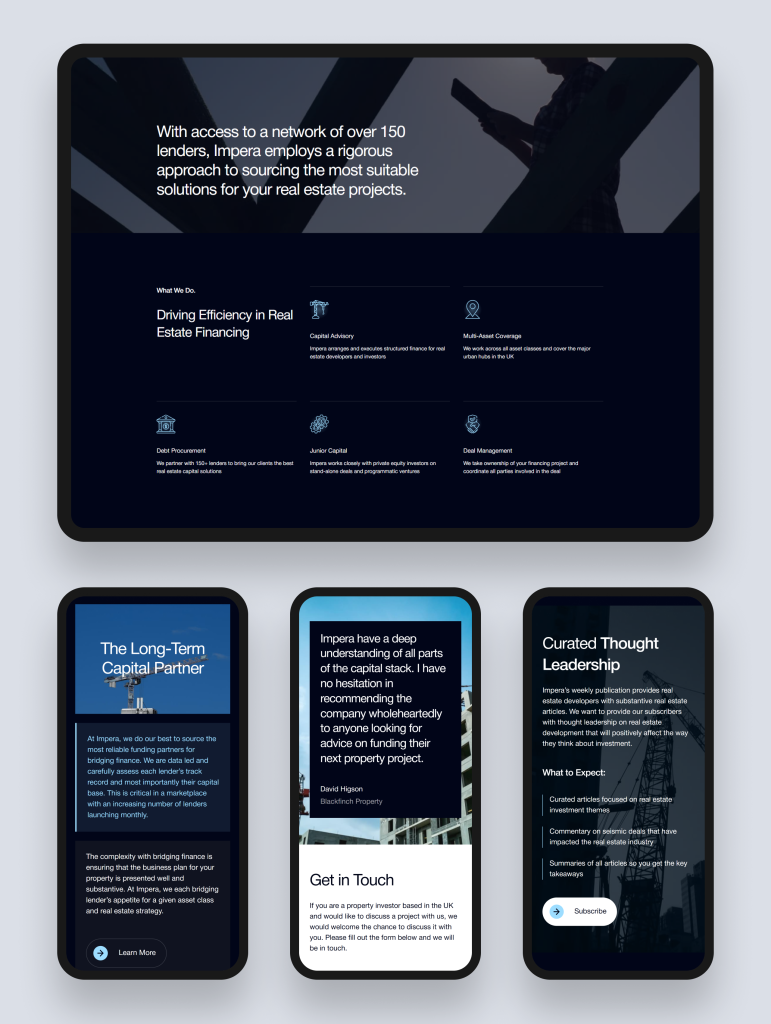
| Case study: Impera Finance (Real estate capital advisory, £500m+ in funding arranged, WordPress + HubSpot) |
| Impera Finance is a London-based real estate finance advisory that has arranged and executed more than £500 million in funding across debt and equity transactions. Their website challenge was classic for an advisory firm: a genuinely impressive track record that was not being communicated effectively to the sophisticated developers and investors evaluating advisory relationships online. Rudo restructured the website around the £500m+ track record figure as the primary above-fold credibility anchor, built a design system communicating institutional authority, and created LinkedIn campaign landing pages targeting specific developer profiles. Within three months: 35% increase in visitor engagement, 25% boost in pages per session, 20% growth in organic traffic. Full case study: rudo.co.uk/case-studies/impera-finance/ |
3. Designing for institutional credibility
Investment firm websites serving institutional or sophisticated investor audiences have a well-established design language that has developed around the specific credibility requirements of the sector. Understanding this language — and knowing when to work within it — is as important as the visual design itself.
The institutional design register
Restrained colour palettes anchored in dark blues, navies, and greys. Precise, well-chosen typography that communicates rigour and seriousness. Generous whitespace that communicates confidence rather than anxiety about filling the page. High-quality photography of real team members in real environments — not stock photography of men in suits or abstract financial imagery. Clean data presentation that makes numbers legible and contextual rather than decorative.
This design language communicates operational quality before any content is read. An investment firm whose website feels chaotic, visually busy, or aesthetically generic is communicating something about its operational standards — whether or not that impression is accurate.
Above-fold credibility — the ten-second test
A sophisticated investor landing on an investment firm website should be able to answer the question 'does this firm operate at the level I require?' within ten seconds — before any scrolling. The signals available in this window: AUM or deal volume with specific numbers, years of operation, names of recognisable investors or counterparties, regulatory authorisation status, and the overall quality of the design as a proxy for operational quality.
Whitespace as a credibility signal
Dense, cluttered layouts communicate anxiety — the anxiety of a firm that feels it needs to say everything simultaneously to be convincing. Generous whitespace communicates confidence — the confidence of a firm that knows what its most important message is and trusts that message to do its work without being surrounded by noise. This is not an aesthetic preference; it is a commercial design principle specific to investment firm audiences.
4. Team profiles that convert
In investment management, the team is a central part of the product. Investors are choosing specific people to trust with their capital over an extended period. Team pages that provide genuine depth of information convert significantly better than those with generic biographical statements and stock-quality headshots.
What a compelling investment firm team profile includes
- Specific career history. Previous firms with names, roles, and — where relevant — the performance or outcomes achieved there. A portfolio manager who previously ran a specific strategy at a recognisable institution brings that institution's credibility with them.
- Investment philosophy in the individual's own voice. What does this person believe about investing? What are their convictions, their approach to risk, their view of their edge? A team profile that captures a genuine investment perspective is more persuasive than a list of qualifications.
- Qualifications and accreditations. CFA, CAIA, FCA-approved person status, and relevant academic credentials. These signal commitment to professional standards and are verifiable by the allocator conducting due diligence.
- Real photography. A professional photograph that looks like the person actually looks — not a corporate headshot from 2010 or a generic professional stock photograph — communicates authenticity.
5. Investment strategy and philosophy content
Investment strategy and philosophy content is where an investment firm can differentiate itself from the hundreds of competitors who claim similar approaches. This content does not have to be long — it has to be specific. A firm with a genuinely differentiated investment philosophy can communicate it in three paragraphs; a firm without one will not be able to communicate it clearly regardless of how many pages it writes.
What good strategy content communicates
The specific market inefficiency or opportunity the firm is seeking to exploit. The reason the team believes it has an edge in identifying or capturing this opportunity. The constraints they place on the strategy — the things they will not do, the concentrations they avoid, the conditions under which they would not deploy capital. And the evidence — historical or conceptual — that the approach has worked or should work in the conditions they target.
Thought leadership content
Regular publication of substantive market commentary and investment analysis does two things: it demonstrates active, current investment thinking (rather than a static 'philosophy' statement that was written once and never updated), and it provides organic search value for queries that sophisticated investors use when researching managers in specific investment categories.
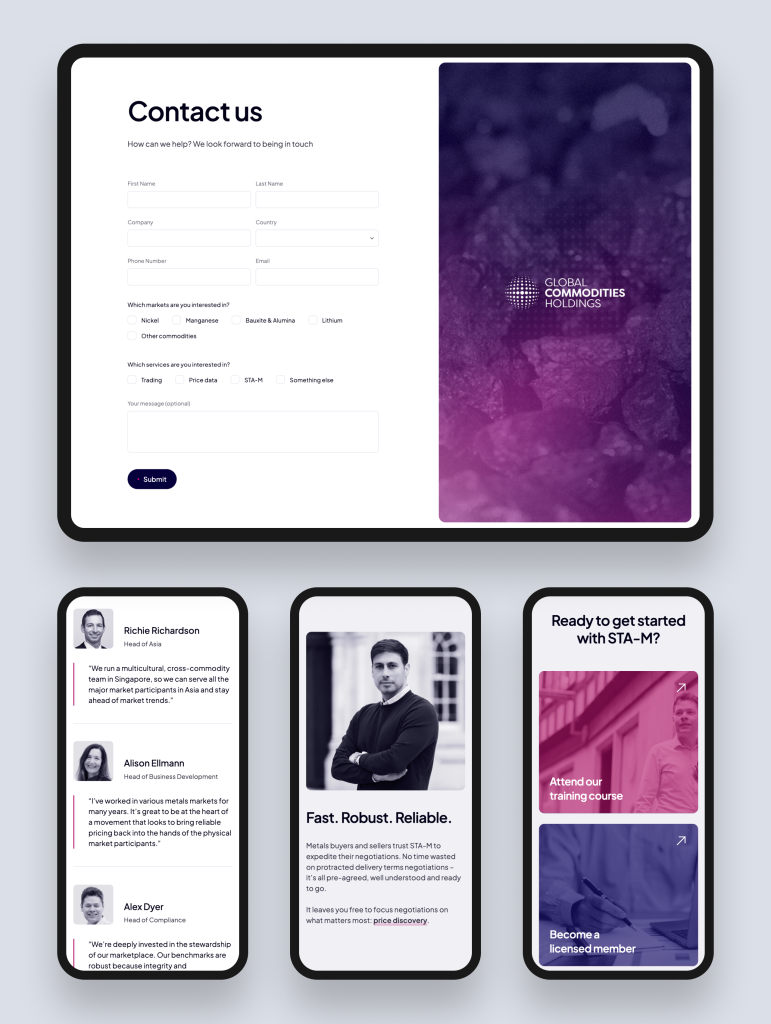
| Case study: Global Commodities Holdings (Commodities trading digital marketplace, WordPress) |
| Global Commodities Holdings operates a digital marketplace connecting buyers and sellers of physical commodities — expanding from an established coal trading platform into metals trading starting with nickel. The website challenge was positioning the company as a credible, forward-thinking player in new commodity markets while communicating the authority of an established industry operator. Rudo built a clean, authoritative WordPress site with a modular layout system allowing consistent rollout across new commodity verticals — translating the trust and market structure that made the coal platform successful into a fresh brand expression for the metals expansion. Full case study: rudo.co.uk/case-studies/global-commodities-holdings/ |
6. Regulatory and compliance design requirements
Investment firms operating under FCA authorisation face specific obligations that affect the design and content of their websites. These are not optional and are not satisfied by adding a disclaimer to the footer.
- Financial promotion approval. Content promoting collective investment schemes, investment products, or investment services must be approved by an FCA-authorised person before publication.
- Past performance disclaimers. Any reference to historical performance must be accompanied by a clear and prominent past performance disclaimer. The disclaimer must be appropriately prominent — not in small print at the bottom of the page, but visible in the context of the performance data it relates to.
- Risk warnings. Investment products carry risk of loss. Risk warnings appropriate to the specific investment strategy must be present on all pages describing the investment proposition.
- Qualified investor restrictions. Some investment products are restricted to professional or sophisticated investors. Where this is the case, the website must include appropriate access controls or prominent statements of the investor qualification requirements.
Compliance review should be built into the content production workflow — not applied as a post-launch check. The design team should be briefed on these requirements from the start of the project.
7. Platform choice for investment firms
- HubSpot CMS: For investment firms running active marketing programmes who need native pipeline integration between website enquiries and investor relationship management, campaign landing pages for specific investment strategies or events, and smart content delivery based on investor profile. Particularly strong for firms using LinkedIn for investor acquisition.
- WordPress: For investment firms with complex content requirements — large research libraries, multiple fund pages with performance data feeds, investor portals, or integration with proprietary reporting systems. WordPress's open architecture accommodates any content model without platform constraints.
- Webflow: For boutique investment managers where visual positioning is a primary differentiator and the content operation is not yet complex enough to require CRM-native personalisation. Strong design fidelity at competitive build cost.
8. Case studies: Impera Finance and Global Commodities Holdings
Two examples from Rudo's portfolio illustrate different aspects of investment firm website design at the high end of the market.
Impera Finance demonstrates the challenge of communicating a substantial advisory track record to sophisticated developer and investor audiences through digital channels, and the commercial value of building a LinkedIn campaign infrastructure alongside the main website. The £500m+ track record, surfaced as an above-fold credibility anchor and supported by a campaign landing page programme, generated a measurable increase in qualified inbound enquiries within three months of launch.
Global Commodities Holdings demonstrates the challenge of positioning an established market operator entering new markets — retaining the institutional authority of an established player while communicating the ambition and capability needed to credibly expand into adjacent markets. The modular WordPress architecture allows new commodity verticals to be added consistently as the business grows.
Read the full case studies: Impera Finance and Global Commodities Holdings.
Ready to build an investment firm website?
Rudo designs and builds websites for investment firms, asset managers, and capital advisories. We understand institutional credibility requirements, FCA compliance constraints, and the commercial architecture needed to generate qualified investor enquiries. Book an intro call to discuss your firm and your audiences.
9. Frequently asked questions
What should an investment firm website include?
Specific, FCA-compliant track record or deal history; named team profiles with individual backgrounds and investment philosophy; investment strategy and process explained specifically rather than generically; regulatory authorisation status and compliance information clearly visible; a clear path to requesting investor documentation (IM, DDQ, audited accounts); and social proof appropriate to the firm's investor audience — institutional references for institutional managers, outcome-focused testimonials for private client advisors.
How do investment firm websites handle FCA compliance?
All content constituting a financial promotion must be approved by an FCA-authorised person before publication. Performance data requires past performance disclaimers and risk warnings that are appropriately prominent. Products restricted to professional or sophisticated investors require access controls or clear investor qualification statements. Compliance review should be integrated into the content production workflow from the start of the project — not applied as a post-launch consideration.
How important is the team page on an investment firm website?
Very important. Investors are choosing specific people to trust with their capital. Team profiles that provide genuine depth — specific career history, individual investment philosophy, verifiable qualifications, and real photography — are commercially meaningful assets. Generic team pages with stock headshots and brief role descriptions communicate a firm that is not confident in what its people bring. Named individuals with genuine depth communicate the opposite.
What platform is best for an investment firm website?
HubSpot CMS for firms running active marketing programmes who need native investor relationship pipeline integration. WordPress for firms with complex content requirements, performance data feeds, or investor portal functionality. Webflow for boutique managers where visual positioning is the primary differentiator and content complexity is moderate. The choice should be driven by the firm's marketing and investor relations requirements, not by build cost alone.
Find out more about our financial services web design agency.
Also in this series: fintech website design, investment firm website design, wealth management website design, financial services website examples, financial services website cost.
Back to the complete guide to financial services website design.

Written by
Rudo Agency
Rudo is a strategy-led web design and development agency specialising in B2B. Based in the UK and working with clients globally, we help ambitious brands turn complex ideas into high-performing websites. Our team combines digital strategy, UX/UI design, custom development, and SEO to deliver results-focused websites that support real business growth.
