Overview
Financial services companies approach agency selection with the same rigour they apply to any other significant commercial decision — which is more than most other sectors. They research, they compare, they ask questions, and they evaluate references. What they do not always do is evaluate agencies against the specific criteria that determine whether a financial services website will actually perform commercially: regulatory knowledge, institutional credibility design, audience complexity experience, and the track record of generating qualified enquiries from sophisticated financial audiences.
This guide is a practical framework for that evaluation — the types of agency you will encounter, the evidence of genuine expertise versus surface-level familiarity, and the questions that reliably separate the two.
In this article:
- Why agency choice matters more in financial services
- The types of agency financial services companies encounter
- What genuine financial services expertise looks like
- Regulatory knowledge: the non-negotiable
- Strategy before design: separating the capable from the capable-looking
- Where Rudo fits and what we bring to financial services projects
- Questions to ask any agency before hiring
- Frequently asked questions
This article is part of the complete guide to financial services website design.
Find out more about our financial services web design agency.
1. Why agency choice matters more in financial services
Financial services websites serve audiences who conduct genuine due diligence before engaging. They are not casual visitors. A website built by an agency that does not understand financial services audiences — that optimises for visual impact rather than evidenced credibility, that misses FCA compliance requirements in the copy, or that builds a generic contact form where a qualified lead capture mechanism should be — is commercially damaging in ways that a poorly designed website in other sectors typically is not.
The cost of getting it wrong is asymmetric. A financial services firm whose website fails to convert a sophisticated institutional allocator or a high-net-worth prospect — because the design communicates the wrong market level, because the track record is not surfaced appropriately, or because the compliance disclosures are missing — is losing relationships that could be worth decades of revenue. The cost difference between a generic agency and a specialist agency is typically 5,000 to 15,000. The cost of a single missed client relationship in most financial services contexts is significantly more.
| The institutional quality signal |
| In financial services, the quality of the digital presence is a signal about the quality of the firm. This means that the choice of agency — the firm you trust to represent your brand digitally — is itself a commercial decision with reputational implications. A financial services firm that launches with a visibly generic website is communicating something about its standards. One that launches with a well-crafted, institutionally credible digital presence is communicating something different. |
2. The types of agency financial services companies encounter
| Agency type | What they do well | Where they fall short for financial services |
| General marketing agency | Multi-channel campaigns, brand identity | No depth in regulated content, FCA compliance, or financial audience credibility design |
| Consumer digital agency | UX, product design, consumer app experience | Optimised for consumer psychology, not institutional or regulated financial credibility |
| Generalist B2B agency | B2B conversion design, CRM integration | Limited financial sector depth — apply generic B2B frameworks to a regulated category |
| Financial services specialist agency | Deep sector expertise, compliance knowledge | May be heavily focused on retail financial products (IFA, mortgage) rather than institutional or fintech |
| Fintech agency | Fintech product design, startup-scale delivery | May not understand the credibility requirements of established financial institutions or regulated advisory firms |
| Strategy-led B2B agency with financial services experience | Full strategic, design, content, and technical capability with proven financial services results | Fewer in number; typically higher investment than the alternatives |
The most common mismatch for financial services companies is the generalist B2B agency. They understand conversion design and CRM integration, but they have not navigated the specific challenges of financial services web design: FCA compliance requirements in copy, institutional credibility design for sophisticated audiences, performance data presentation, and the specific trust architecture that financial clients look for. The output is a website that is technically competent and commercially insufficient.
3. What genuine financial services expertise looks like
Claimed financial services experience is easy to find. Genuine financial services expertise is specific, verifiable, and visible in the actual work.
Portfolio depth across financial services sub-sectors
A financial services web design specialist should have multiple completed projects across the sector's sub-categories — not one wealth management site and twenty from retail and technology. Look for investment management, advisory, fintech, and capital markets work. Evaluate those sites directly: does the above-fold content establish credibility within ten seconds? Are regulatory credentials visible and correctly presented? Is the track record or deal history surfaced as primary content or buried? These practical evaluations reveal the quality of the work far more reliably than portfolio screenshots.
Knowledge of FCA compliance requirements
An agency with genuine financial services expertise will raise FCA compliance requirements proactively — not wait to be asked. They will be able to describe the specific obligations that apply to the firm's regulated activities, explain what content requires pre-publication approval, and describe how the compliance review workflow should be built into the project timeline. An agency that has not built financial services websites at a professional level will not raise these requirements at all — discovering them mid-project.
Understanding of institutional credibility design
Institutional credibility in financial services is not a design style — it is a specific set of design decisions about what information to surface, where to surface it, and at what level of specificity. An agency with genuine financial services expertise can explain how they approach the placement of track record data, team credentials, and regulatory information — not as decorative content but as commercial signals placed deliberately at the moments in the evaluation journey where investor confidence is most fragile.
4. Regulatory knowledge: the non-negotiable
This is the single most reliable test of whether an agency has genuine financial services website experience. Ask any agency you are evaluating: what FCA compliance requirements do you anticipate applying to our website content, and how will we build the compliance review process into the project timeline?
An agency with genuine experience will answer this question specifically. They will describe financial promotion rules under COBS 4, the Consumer Duty implications for consumer-facing firms, the past performance disclaimer requirements, and the access control considerations for content restricted to professional investors. They will propose a concrete compliance review workflow — who reviews, at what stage, with what approval mechanism before content goes to development.
An agency without genuine experience will give a vague answer about 'making sure the content is compliant' or will not raise the topic at all. Either response is a signal that the agency has not built financial services websites at the level your firm requires.
| The compliance question is not just about regulatory risk — it is a proxy for sector depth. An agency that understands FCA compliance requirements has done enough financial services work to have encountered them. One that does not has not. There is no other way to acquire this knowledge. |
5. Strategy before design: separating the capable from the capable-looking
The most commercially damaging mistakes in financial services website design are not design mistakes. They are strategy mistakes — decisions about information architecture, content prioritisation, and audience architecture that look acceptable in a design review and fail commercially after launch.
A homepage that communicates generic claims rather than specific evidenced track record. Service pages that describe the firm's offering in terms that could apply to any competitor. Team profiles that list qualifications without communicating individual investment philosophy or approach. A conversion mechanism that is too generic for the firm's actual enquiry qualification needs.
These mistakes are strategy failures that no amount of good design will fix. The way to prevent them is to do genuine strategic discovery work before any design begins — and the way to evaluate whether an agency does this is to ask specifically what the discovery phase involves and what it produces.
An agency with genuine strategic capability will describe a discovery phase that includes: buyer persona development for each distinct audience type, competitor digital analysis, commercial goal-setting that defines what success looks like twelve months after launch, and information architecture decisions that emerge from the discovery outputs. One without it will describe a brief intake meeting and a design kickoff.
6. Where Rudo fits and what we bring to financial services projects
Rudo is a strategy-led B2B web design agency with specific, proven experience across the financial services sector. Our financial services portfolio spans capital advisory, commodities trading, and financial SaaS — different business models with different audiences and different regulatory contexts, each requiring the specific combination of institutional credibility design and commercial conversion architecture that financial services audiences demand.
Strategy before design, always
Every Rudo financial services project begins with a discovery phase that includes: stakeholder interviews with commercial, compliance, and marketing leads; audience analysis for each distinct client or investor type; competitor positioning review; commercial goal definition; and explicit mapping of the compliance review workflow and its implications for the content production timeline. Design work begins only when this foundation is in place.
Compliance awareness built in from the start
We raise FCA compliance requirements proactively in the project conversation — not as a limitation to work around, but as a project parameter that shapes what the website can say and how it can say it. We have built financial services websites at a professional level and understand the specific obligations that apply across the sector's sub-categories. Compliance review is built into the content production workflow from the first brief, not discovered during development.
Proven results across financial services sub-sectors
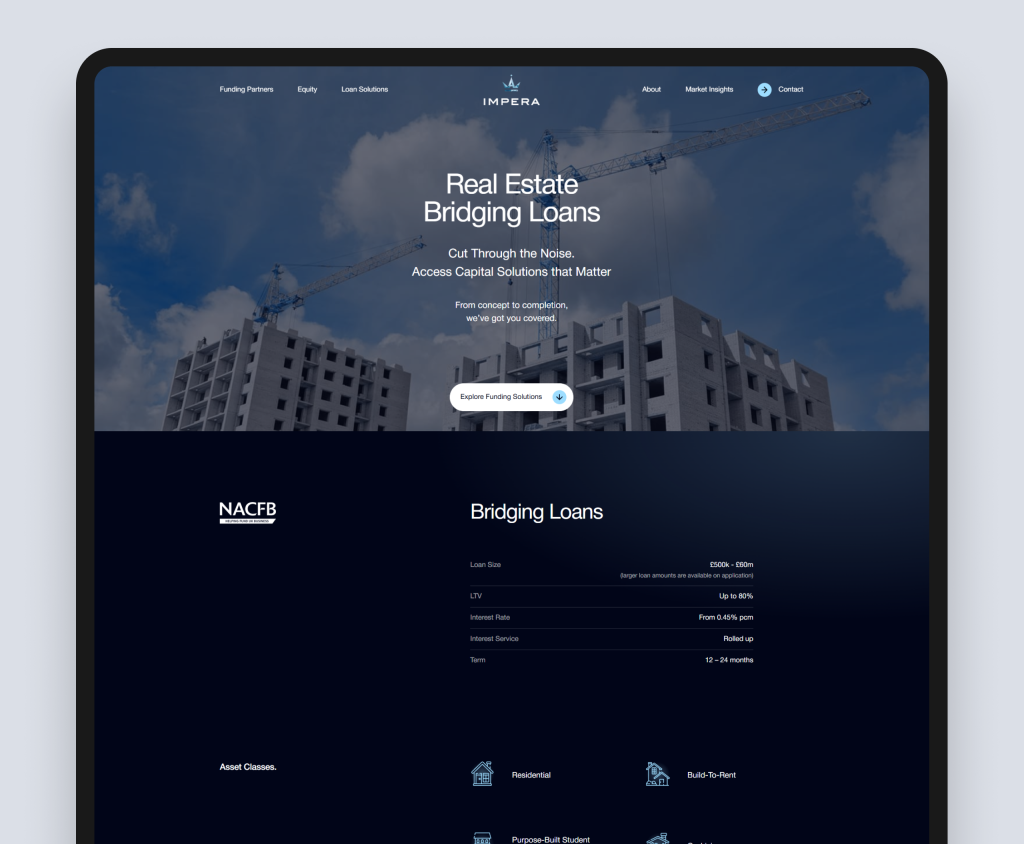
| Case study: Impera Finance (Real estate capital advisory, WordPress + HubSpot, £500m+ deal track record) |
| Impera Finance is a London-based real estate finance advisory with more than £500 million in funding arranged across debt and equity transactions. Their previous website failed to communicate their market standing or provide the digital infrastructure for lead generation campaigns. Rudo built a credibility-led custom WordPress website with a full campaign landing page infrastructure for LinkedIn and native HubSpot CRM integration. Within three months: 35% increase in visitor engagement, 25% boost in pages per session, 20% growth in organic traffic. The campaign landing pages became an active lead generation tool generating qualified developer enquiries at measurable cost per lead. Full case study: rudo.co.uk/case-studies/impera-finance/ |
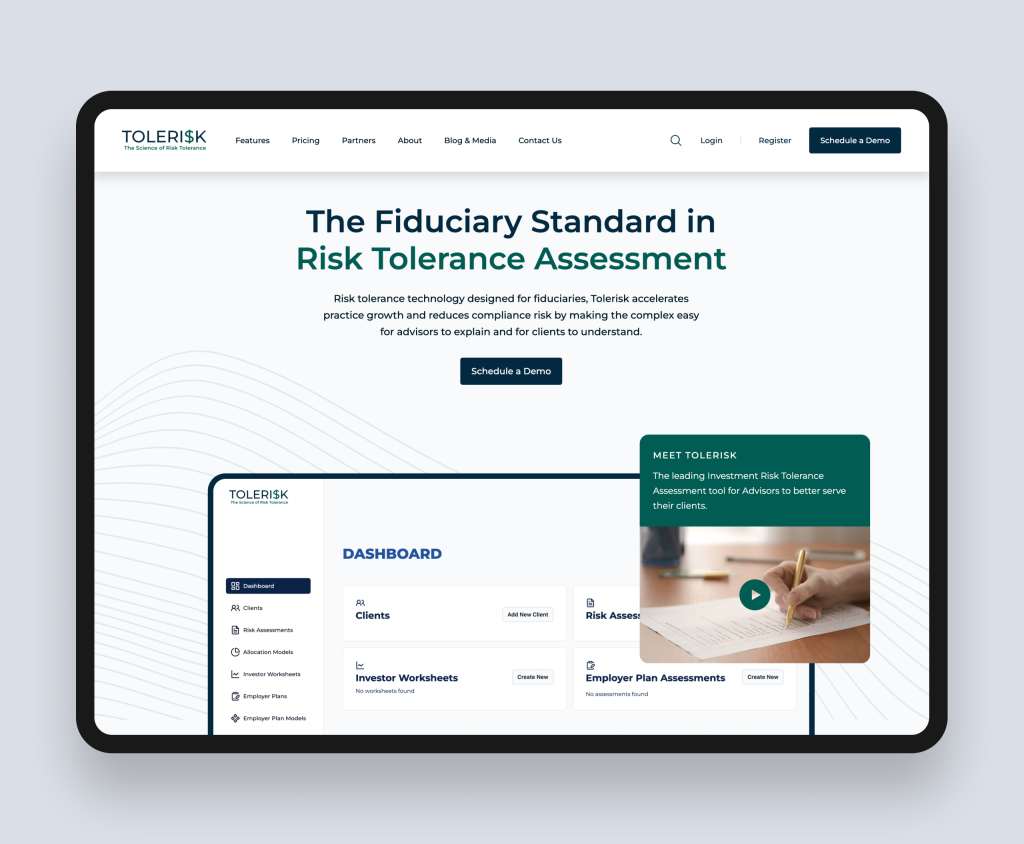
| Case study: Tolerisk (Financial SaaS, WordPress, six-week delivery) |
| Tolerisk is a math-intensive financial SaaS platform for financial advisors. Their marketing website needed a complete rebuild timed to coincide with a platform release, on a six-week deadline. Rudo built a custom WordPress site that communicated the platform's analytical sophistication to a professional financial advisor audience within the required timeline. The site launched alongside the application release, elevated the Tolerisk brand, and provided a robust digital foundation for communicating their value proposition at commercial launch. Full case study: rudo.co.uk/case-studies/tolerisk/ |
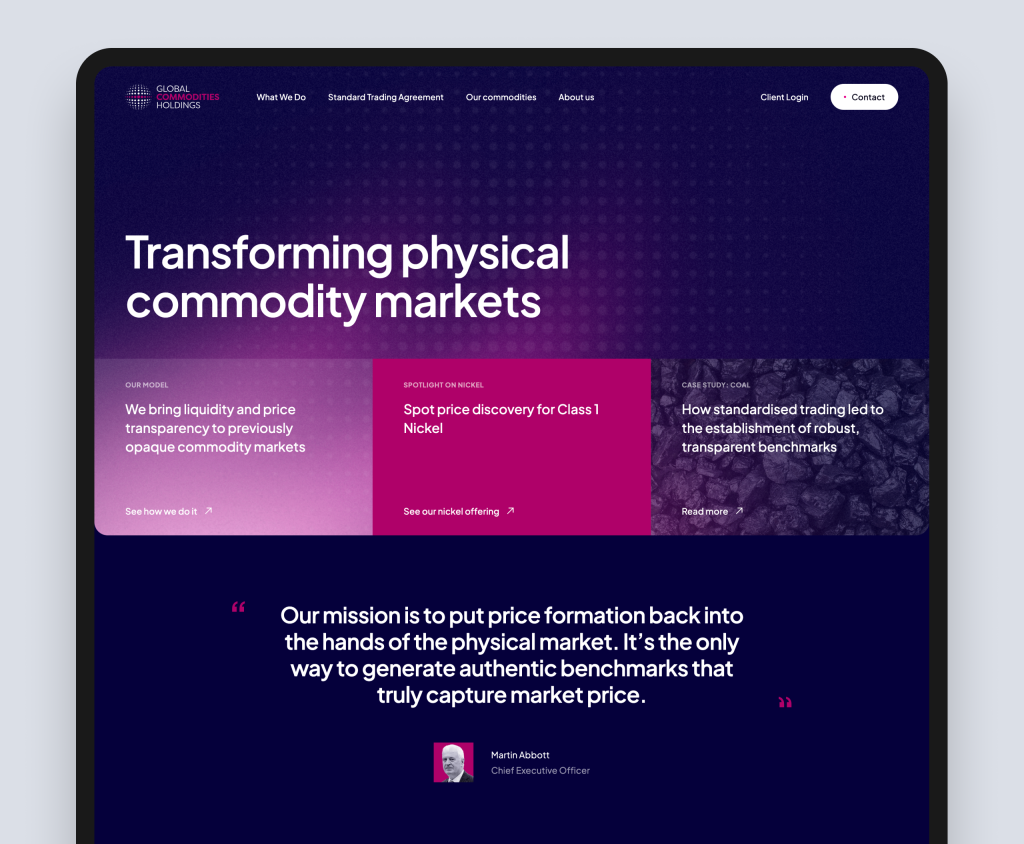
| Case study: Global Commodities Holdings (Commodities trading marketplace, WordPress, multi-vertical expansion) |
| Global Commodities Holdings operates a digital marketplace expanding from coal into metals trading. The website needed to carry the authority of an established market operator into new commodity markets. Rudo designed a clean, authoritative WordPress site with a modular architecture allowing consistent rollout across new verticals — positioning the company as a forward-thinking player in global markets while communicating the credibility of their established position. Full case study: rudo.co.uk/case-studies/global-commodities-holdings/ |
Rudo is ranked number one UK web design agency on DesignRush and top ten on Clutch. Find out more about our financial services web design service.
7. Questions to ask any agency before hiring
On regulatory knowledge
- What FCA compliance requirements do you anticipate applying to our content, and how will you build the compliance review workflow into the project timeline? A specific, knowledgeable answer indicates genuine experience. A vague or absent answer indicates the opposite.
- Have you built websites for FCA-authorised firms before? Can we speak to one of them specifically about how the compliance process worked? References from regulated financial services clients are the most reliable test of genuine sector experience.
On strategy and process
- What does your discovery phase include, and what does it produce? Look for buyer persona work, competitor analysis, commercial goal definition, and information architecture decisions — not just a brief intake meeting.
- How do you approach the placement of track record or deal history as a credibility signal? A knowledgeable answer addresses the specific commercial logic of surfacing evidenced track record prominently, not just 'making the about page stronger'.
- What does your post-launch relationship look like? Financial services websites require ongoing content management, compliance review support, and campaign development. Agencies that disappear after launch are not appropriate partners for a regulated firm.
On commercial accountability
- Can you show us financial services websites you have delivered and their commercial outcomes? Qualified enquiry volumes, organic traffic growth, campaign conversion rates — specific outcomes, not general testimonials.
- How do you measure whether a financial services website is working? Look for specific commercial metrics — qualified lead volume, enquiry quality, conversion rates by audience segment. Generic answers about traffic and bounce rate indicate a lack of commercial focus appropriate to financial services.
For a full overview of what a financial services website should deliver, read the complete guide to financial services website design.
8. Frequently asked questions
What should I look for in a financial services web design agency?
Specific financial services portfolio depth across multiple sub-sectors — not one or two projects alongside many from other industries. Proactive knowledge of FCA compliance requirements and a clear approach to building compliance review into the project workflow. A discovery and strategy process that precedes design. References from regulated financial services clients you can speak to directly about the compliance and commercial aspects of the project.
How much do financial services web design agencies charge?
Standard financial services website builds at a specialist strategy-led agency typically cost £12,000 to £25,000. More complex projects involving institutional design, compliance-heavy content, investor portal functionality, or sophisticated HubSpot configuration typically cost £25,000 to £50,000 or more. The cost premium over a generic B2B agency reflects genuine differences in regulatory knowledge, sector-specific strategic capability, and the commercial outcomes that specialist experience produces.
Does my financial services web design agency need to be FCA authorised?
No — web design agencies do not carry out regulated financial activities and do not require FCA authorisation. However, the agency must understand FCA requirements well enough to ensure that the content they produce and publish meets the obligations that apply to your firm's regulated activities. Financial promotion rules apply to the authorised firm, not to the agency — but the agency's understanding of those rules determines whether the content they produce requires extensive revision before it can be approved.
Should I choose an agency that specialises exclusively in financial services?
Not necessarily. An agency that works exclusively in financial services may have deep regulatory knowledge but narrow strategic and creative range — which can produce formulaic work that looks like every other financial services website. A strategy-led B2B agency with proven financial services experience and a broader portfolio typically brings both the sector knowledge and the fresh perspective that produces genuinely differentiated work. The key criteria are genuine sector experience and regulatory knowledge — not exclusive sector focus.
How long does a financial services website project take?
A standard financial services website project typically takes 12 to 16 weeks. Projects involving compliance-heavy content volumes, investor portal functionality, or complex HubSpot configuration take 16 to 22 weeks. The most variable factor is the compliance review workflow — for firms where all regulated content requires pre-publication approval, this should be planned explicitly from week one of the project rather than discovered during development.
Ready to work with a financial services web design agency that starts with strategy?
Rudo has built financial services websites for capital advisory firms, fintech platforms, and trading marketplaces. Book an intro call — we will review your current site, discuss your audiences and regulatory context, and give you an honest view of what it would take to build something that genuinely generates qualified enquiries.
Find out more about our financial services web design agency.
Also in this series: fintech website design, investment firm website design, wealth management website design, financial services website examples, financial services website cost.
Back to the complete guide to financial services website design.

Written by
Rudo Agency
Rudo is a strategy-led web design and development agency specialising in B2B. Based in the UK and working with clients globally, we help ambitious brands turn complex ideas into high-performing websites. Our team combines digital strategy, UX/UI design, custom development, and SEO to deliver results-focused websites that support real business growth.
