WordPress web design agency for B2B companies built to scale
WordPress is the right choice for B2B companies with complex content operations, specific integration requirements, or data and hosting governance that rules out managed platforms. We build bespoke WordPress websites that your business can own, operate, and scale — without limits or lock-in.

Bespoke builds — no page builders

#1 UK on DesignRush

Top 10 on Clutch

London, UK

B2B-only since 2020
B2B companies who chose to partner with Rudo






Why WordPress for B2B
For B2B companies beyond simple platforms
WordPress powers 43% of the web because it is flexible, extensible, and scalable for complex B2B websites.
It is the right choice when Webflow or HubSpot CMS cannot support your integrations, hosting requirements, data governance, or large-scale content operations.
WordPress requires specialist development, clean code, performance optimisation, and security hardening — but that control is why serious companies choose it.
Choose WordPress for custom integrations, self-managed hosting, full ownership, and no vendor lock-in.
43%
of all websites on the internet run on WordPress — the largest market share of any CMS by a factor of three
£0
platform licence cost — WordPress is open-source. You own the code, the data, and the platform entirely
Complete ownership — no lock-in
Your WordPress site is fully yours: code, database, media, and hosting. No platform can change pricing, remove features, or take your site down. For B2B companies, that ownership matters.

Unlimited integration flexibility
With 60,000+ plugins and a REST API, WordPress can connect to almost any system: ERPs, CRMs, data feeds, authentication, or custom APIs. Managed platforms have limits. WordPress does not.

Scale for large content operations
WordPress handles thousands of pages, custom content types, multisite networks, and multilingual sites. It is built for enterprise-scale content, not just simple marketing pages.

Hosting and data governance on your terms
Host on AWS, Azure, Google Cloud, dedicated servers, or specific regions. Control data residency, backups, security, and compliance when governance requirements cannot be compromised.

Our Work
The outcomes,
not just the websites
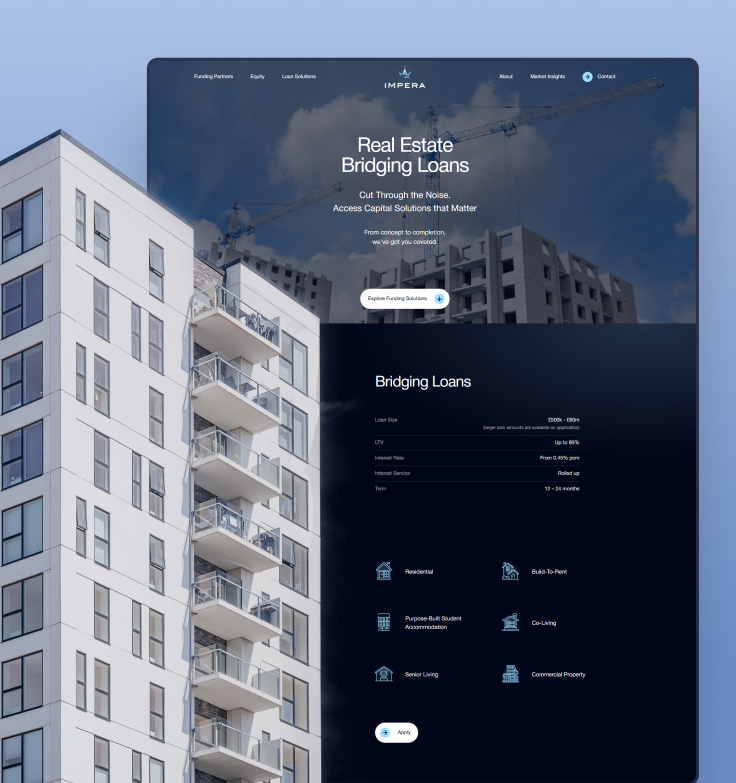
A custom WordPress website that turns a £500m+ track record into qualified real estate finance leads
Impera Finance — a London-based real estate capital advisory firm that has arranged and executed over £500 million in debt and equity funding — needed a website that reflected the firm's market reputation and gave its marketing team the technical foundations to support LinkedIn campaigns and inbound lead generation. Their existing site communicated none of the firm's authority and offered no infrastructure for digital marketing.
We built a custom WordPress theme designed for speed, SEO, and long-term scalability — paired with a suite of conversion-focused campaign landing pages and full HubSpot CRM integration for lead capture and tracking. The new site now functions as both a credibility signal for sophisticated property developers and investors, and as a working lead generation engine connected directly to Impera's commercial pipeline.

A custom WordPress build for a digital marketplace expanding from coal into multi-commodity trading
Global Commodities Holdings — operator of the long-established globalCOAL trading platform — needed a new digital home as the business expanded into nickel, lithium, and cobalt. The brief was unusually demanding: a website that distanced the new platform visually and functionally from a legacy utilitarian coal-trading site, while preserving the credibility of an established industry leader and providing a flexible framework that could scale across new commodity verticals over time.
We built a custom WordPress theme with a modular layout system designed for rollout across multiple commodity markets. The new site positions Global Commodities Holdings as a forward-thinking player in B2B trading well beyond coal, communicates the marketplace model clearly to new buyer audiences, and gives the internal team a framework they can extend as new commodities come online — without redeveloping the platform each time.
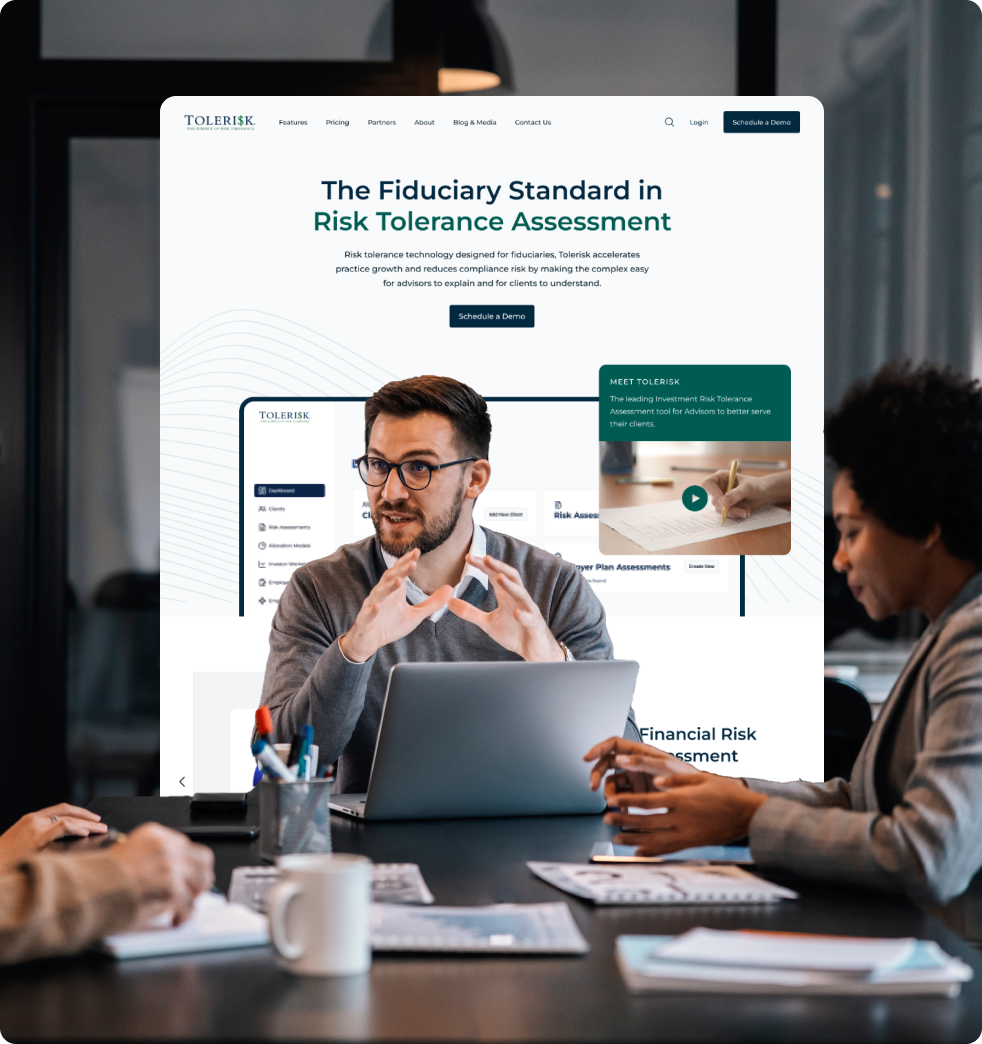
A custom WordPress marketing site delivered in six weeks for a math-intensive financial SaaS launch
Tolerisk — a math-intensive financial SaaS platform serving financial advisors — needed a complete marketing website rebuild on a six-week deadline, tied to the launch of their new application. The site had to communicate a sophisticated, data-rich product proposition to financial advisors while meeting the launch date without compromising on performance, security, or design quality.
We delivered a custom-built WordPress theme on schedule, with a refreshed style guide, full UX and UI design system, and a marketing site optimised for speed and security. The new site launched in tandem with the application release, gave Tolerisk a credible digital foundation for communicating its value proposition to the financial advisory community, and demonstrated the kind of pace and precision their commercial timeline demanded.
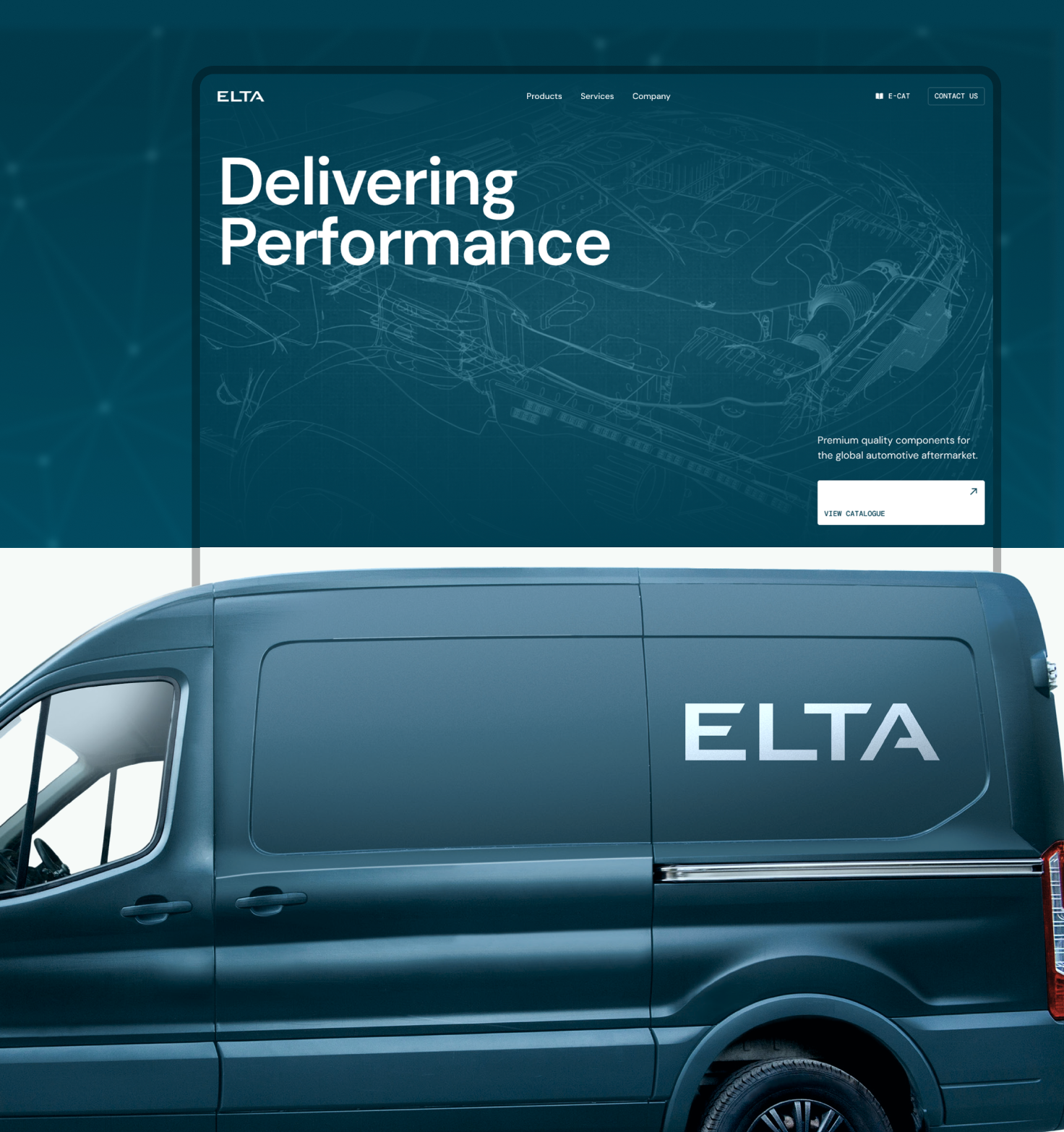
A custom WordPress build for a 30-year automotive parts distributor with thousands of SKUs across six sub-brands
ELTA Automotive — one of the UK's leading distributors of aftermarket vehicle parts, supplying motor factors, workshops and garages across Europe since 1993 — needed a complete rebuild of a site that had grown incrementally for years and could no longer do justice to the breadth of the business. The challenge was as much structural as visual: thousands of SKUs across ten+ product categories, six sub-brands including the iconic Lucas range, three distinct ASSIST service propositions, and an internal team spending significant time wrestling with the back end every time a product, bulletin or campaign needed publishing.
We rebuilt the information architecture from the ground up — treating sub-brands as first-class citizens within a consistent parent framework — and delivered a custom WordPress theme with a modular block library, unified taxonomy, and SEO templates that scale across the catalogue automatically. The marketing team can now publish new product ranges, sub-brand campaigns, bulletins and vehicle profiles without developer involvement, and buyers can finally navigate the full breadth of the business in a way the old site made impossible.
Commercial accountability
A WordPress website should generate qualified pipeline. Ours do.
Any developer can install WordPress. The question is whether the website it produces moves your commercial objectives. These are the outcomes B2B clients measure — and what we track together after launch.
Qualified pipeline
More enquiries from the right companies — arriving better informed, better matched to your ICP, and requiring less qualification time before they progress.

Sales cycle length
Prospects who have consumed your content, read your case studies, and understood your positioning before the first call arrive closer to a decision. Less educating. More progressing.

Marketing velocity
Your team can publish new content, launch campaign pages, and update the site independently — without raising a developer ticket for every change.

Tender & pitch wins
Buyers research you before they meet you. A website that communicates credibility before the pitch starts changes the commercial outcome of every competitive tender.


We measure this together after launch
We recommend a 90-day post-launch review with every client. We look at pipeline contribution, lead quality, and content performance — not just traffic and bounce rate. The conversation about what the website achieved starts the day it goes live, not the day the project closes.
How it works
A defined process. No surprises.
Every Rudo WordPress project follows the same structured sequence. Each phase has a defined output, a review point, and your sign-off before we proceed. Strategy precedes design. Design precedes development. Every decision is made against your commercial goals — not the path of least resistance.

Weeks 1–2
Strategy & Discovery
We map your audiences, define conversion goals, establish information architecture, and agree the technical approach — including hosting requirements, integration architecture, and content governance. You receive a strategy document you own regardless of whether you proceed. Choose the depth that fits your project:
Essential Discovery
2-hour workshop. Audience and goals alignment, sitemap and page priorities, tech stack recommendations, integration mapping. For teams with clear positioning who need a defined starting point.
Core Discovery
Half-day workshop. Everything in Essential plus persona definitions, competitor and UX review, key user journey mapping, and a technical architecture plan. For projects with meaningful complexity.
Full Blueprint
Half-day workshop plus extended analysis. Everything in Core, plus 2–3 detailed user journeys, full conversion and funnel review, technical specification document, and a comprehensive blueprint report. For significant commercial and technical investments.
Output
Strategy document · Audience map · Sitemap · Technical architecture plan · Conversion brief
Weeks 2–4 · Optional
Copywriting
B2B websites underperform because the copy was written by people who know the product too well to explain it simply. Three levels of involvement — choose what fits your team's capacity:
Structure & Strategy
Section-level content guidance for up to 8 pages — page goals, narrative flow, and a messaging summary. Your team writes; we provide the strategic framework so every page has a clear commercial purpose.
Hybrid Copywriting
We write 2–3 key pages in full (homepage, primary service pages, main CTAs) plus structured outlines for 5 additional pages. The most common arrangement for established B2B companies.
Full Copywriting
10–12 pages fully written, informed by stakeholder interviews. Includes 1–2 revision rounds per page. Right for companies who want copy and design developed together — which consistently produces stronger commercial results.
Output
Messaging framework · Page-by-page copy · SEO-optimised headings · CTA hierarchy
Weeks 3–5
UX & Wireframing
We design the user flows and page wireframes, validated against the conversion brief before any visual design begins. For complex WordPress projects — multi-audience architectures, large content hierarchies, or custom navigation systems — this phase is where the most commercially significant decisions are made. Changes at this stage cost hours. Changes at design cost days. Changes at development cost weeks.
Output
Wireframes for all page templates · User flow diagrams · Navigation architecture · Sign-off review
Weeks 6–9
Visual Design
High-fidelity Figma design across all templates and page types. Mobile-first. Brand-aligned. Reviewed against conversion criteria, not just aesthetic quality. For WordPress projects this phase includes designing the custom blocks, content components, and reusable patterns your editorial team will use to build new pages after launch.
Output
Full Figma design file · Desktop + mobile templates · Block/component library design · Design sign-off
Weeks 10–13
WordPress Development
We build with clean, semantic, standards-compliant code — no page builders, no bloated plugin dependencies, no technical debt handed to you on launch day. Custom theme development, custom block library, and all integrations built to spec. Performance optimisation (Core Web Vitals), security hardening, and hosting configuration are included — not sold separately. Your team can build new pages using the custom block library without touching code.
Output
Built WordPress site · Custom theme · Block library · All integrations · Performance + security configuration · QA complete
Weeks 14–16
Launch, Training & Pipeline Review
Pre-launch SEO configuration, cross-device QA, 301 redirect mapping, structured data setup, and hosting handover. Then hands-on training sessions for your team — covering the WordPress editor, the custom block library, content governance, and basic maintenance. Your team operates independently from day one.
Output
Live site · SEO configuration · Team training · Technical documentation · Handover package
Ongoing (optional)
WordPress Retainer Support
Post-launch retainers include new page and feature development, plugin and security updates, performance monitoring, content updates, SEO improvements, and campaign landing pages — at a fixed monthly cost. Some clients want full handover and complete independence. Others want an ongoing WordPress development partner at a predictable monthly cost.
Output
Ongoing WordPress development · Security + performance monitoring · Monthly reporting · Priority turnaround
Why choose Rudo
The safest choice for a complex B2B WordPress project
WordPress done badly is expensive to fix. Poor code architecture, plugin bloat, insecure configurations, and performance shortcuts that pass QA but fail in production — these are the risks of working with a generalist agency or an offshore team that treats WordPress as a commodity. Our job is to make choosing Rudo the obvious, defensible decision.
Everything in-house. No subcontractors. Ever.
Strategy, design, development, and copywriting are all delivered by the Rudo team. You will never discover your project was subcontracted to a freelancer you have never spoken to.
Clean code only — no page builders, no bloat.
We build with custom themes and custom blocks. No Divi, no Elementor, no Beaver Builder. Page builders produce technically compromised output that degrades performance and creates long-term maintenance problems. We never use them.
You own the strategy document, regardless.
The discovery phase produces a strategy and architecture document that belongs to you. If you decide not to proceed after discovery, you keep it. No lock-in at the earliest stage.
Named account lead from day one.
You will know who is running your project before you sign. The same person who is on your first call runs the strategy phase and reviews every design and development decision.
Sign-off at every phase before proceeding.
You review and approve wireframes before design starts. You review and approve design before development starts. Nothing reaches launch without your explicit sign-off at each stage.
References available from B2B clients in your sector.
We can connect you with existing clients in financial services, SaaS, recruitment, or whichever sector is relevant. Speak to someone who has been through this exact process before you commit.
We had worked with two WordPress agencies before Rudo. Both delivered sites that looked fine at launch but became increasingly difficult to manage and maintain. Rudo's approach was completely different — the code is clean, the documentation is thorough, and when we needed to add new functionality a year after launch, it slotted in without drama. That's what good WordPress development actually looks like.
Not sure yet? Book a 30-minute call with no obligation. We will review your current site, discuss your technical requirements, and tell you honestly whether WordPress is the right choice — and what a properly-built site would take.
Transparent pricing
What does a WordPress website cost?
We publish our pricing so you know if we are the right fit before committing to a conversation. All projects are scoped specifically — these are starting points, not fixed menus.
Essential
from
£17,000
For B2B companies making a first serious WordPress investment or replacing a site built on a page builder.
- Essential discovery
- Up to 12 page templates
- UX/UI design in Figma
- Custom theme (no page builders)
- Forms, CTAs & basic CRM integration
- Performance + security setup
- Marketing team training
Growth
from
£25,000
For established B2B companies with complex requirements, active marketing programmes, or integration needs beyond what managed platforms support.
- Full strategy & discovery phase
- Up to 25 page templates
- UX/UI design in Figma
- Custom theme (no page builders)
- Copywriting support (commercial pages)
- Advanced SEO configuration
- Marketing + sales team training
Enterprise
from
£40,000
For complex builds — large content operations, multisite networks, multiple audience architectures, custom integrations, or migrations from enterprise platforms. Scoped individually.
- Everything in Growth
- Complex content architecture
- Multisite or multilingual setup
- Custom integration development
- Full copywriting
- Enterprise hosting configuration
- Dedicated project team
Ongoing WordPress retainer
Post-launch support, new feature development, plugin and security updates, performance monitoring, campaign landing pages, and content updates. For businesses that need a reliable WordPress partner at a predictable monthly cost.
Meet the team

Charlotte
Head of Strategy
With over 10 years in B2B marketing, Charlotte leads with insight and precision. She shapes smart, scalable strategies that help complex brands connect, convert, and grow.

Mike
Tech Lead
Mike turns vision into reality through clean, scalable code. Whether it’s WordPress, HubSpot, or full-stack builds, he ensures our websites are fast, flexible, and future-proof.

Nick
Design Lead
Nick leads with clarity and creativity. His UX and visual design work distills complexity into experiences that feel intuitive and look world-class across every screen.

Petra
SEO Specialist
From SEO to messaging, Petra knows how to turn content into conversions. She brings energy and creativity to every campaign — and helps clients get found for all the right reasons.

Ivi
Paid Media Specialist
Ivi plans and optimises multi-channel campaigns across Google, LinkedIn, and Meta. She brings precision, performance thinking, and a results-first mindset to every paid strategy.

Oleg
UX/UI Designer
Oleg blends empathy and structure to create beautiful, conversion-focused interfaces. His designs are always rooted in strategy and built for users, not just screens.

Anna-Bet
Content Specialist
Anna-Bet crafts messaging that’s sharp, human, and aligned with your brand’s voice. From positioning to site copy, she turns big ideas into meaningful stories that stick.

Umesh
HubSpot Specialist
Umesh makes HubSpot work harder for your business. From Content Hub to CRM integration to custom modules, he ensures your marketing tools are smart, smooth, and seamlessly connected.
Our specialisation
WordPress expertise across
every B2B sector
B2B WordPress is not one discipline — it is six. Each sector brings specific architecture challenges. Complex content operations for healthcare, dual-audience design for recruitment, data governance for financial services. We have built WordPress sites for all of them.
SaaS & Technology
Complex product architectures, documentation integration, multi-audience navigation, and integration with developer tools that managed CMSs can't connect to natively.
Financial Services
Data governance requirements, specific hosting and residency obligations, FCA compliance considerations, and credibility-first design for investor and institutional audiences.
Property
Property listing integrations, deal track record architecture, investor conversion design, and PropTech platform connections that require custom API development.
Recruitment
Dual-audience architecture for clients and candidates, ATS integrations, job listing management systems, and geographic multi-site networks for national or multi-brand agencies.
Manufacturing
Product catalogue architecture with complex specification hierarchies, ERP integrations for live inventory or pricing data, and procurement buyer journey design.
Healthcare & Life Sciences
Multi-audience scientific communication, regulatory compliance considerations, clinical and commercial buyer journey separation, and GDPR-compliant data handling architectures.
What WordPress Connects To
If it has an API, WordPress can talk to it
WordPress's open architecture means your website can connect to virtually any system your business runs on — with no curated integration list and no platform permission required. We build custom integrations as part of every project that requires them.
Client outcomes
What happened to the pipeline
after launch
Process is expected. Commercial outcomes are what matter. Here is what clients report after their WordPress builds with Rudo went live.
FAQ
Questions about WordPress and working with Rudo
About the platform
What is HubSpot CMS and why is it different from WordPress or Webflow?
HubSpot CMS is the only content management system where your website and your CRM are the same platform. Every visitor interaction — page visit, form fill, content download, chatbot conversation — is automatically connected to a contact record in your HubSpot CRM, without any integration or data transfer. WordPress and Webflow are better platforms for design fidelity, content volume, and hosting flexibility, but they require integrations to connect website behaviour to your CRM — integrations that lag, break, and lose data. For B2B companies where each deal is high value and the sales cycle is long, HubSpot CMS's native data integration is a significant commercial advantage.
Is WordPress still secure?
Yes, when it is built and maintained properly. The WordPress core team releases regular security updates. The vast majority of WordPress security incidents happen not because of WordPress itself, but because of outdated plugins, misconfigured hosting, or weak passwords. We implement security hardening as part of every project: minimal plugin footprint, web application firewall configuration, file permission hardening, two-factor authentication, and a structured update regime. A properly-built WordPress site on managed hosting is a secure, robust platform.
Should we use a page builder like Elementor or Divi?
No. We do not build with page builders and actively advise against them for B2B companies making a serious digital investment. Page builders produce bloated, technically compromised output that degrades Core Web Vitals, creates long-term maintenance problems, and makes future development significantly more expensive. We build with custom themes and custom Gutenberg blocks — the result is leaner code, better performance, and a site that is genuinely maintainable over time. The editorial experience for your team is comparable to a page builder without the technical debt.
Is WordPress good for SEO?
Yes. WordPress gives you granular control over every element that affects search performance — title tags, meta descriptions, canonical URLs, structured data, XML sitemaps, redirect management, and Core Web Vitals configuration. We configure all SEO fundamentals as part of every project launch. For B2B companies with large content operations, WordPress's content management and internal linking architecture make it easier to build genuine topical authority at scale than any managed CMS platform.
Can you migrate our existing website to WordPress?
Yes. We handle migrations from other CMS platforms — including Drupal, Joomla, Sitecore, Squarespace, and other proprietary systems — as well as rebuilds of existing WordPress sites that were built on page builders or with poor code quality. The migration process includes a content audit, redirect mapping, SEO continuity planning, and a technical architecture review. Migration timeline depends on content volume and complexity — typically 2–4 weeks beyond the standard build timeline.
Working with Rudo
How much does a WordPress website cost?
Our Essential tier starts from £17,000 for up to 12 page templates with a custom theme and block library. Our Growth tier starts from £25,000 for a full project with strategy, up to 25 pages, copywriting support, and custom integrations. Our Enterprise tier starts from £40,000 for complex builds with large content operations, custom integration development, or multisite architectures. All projects are scoped specifically — these are starting points, not fixed menus.
How long does a WordPress project take?
A standard B2B WordPress build takes 12 to 16 weeks from kickoff to launch. Projects with full strategy, copywriting, complex integrations, or large content operations take 14 to 18 weeks. The most variable factor is integration complexity — custom API connections to enterprise systems require careful specification, testing, and sign-off that adds meaningful time to the development phase.
Do you use page builders?
Never. We build exclusively with custom themes and custom Gutenberg blocks. No Elementor, no Divi, no Beaver Builder. This is a firm commitment — not a preference. Page builders produce technically compromised output that is expensive to maintain and difficult to extend. Every Rudo WordPress project is built on clean, standards-compliant code that another developer can pick up and understand without reverse-engineering a builder's proprietary system.
Do you design and develop in-house, or outsource?
Everything is in-house. Strategy, UX, design, WordPress development, and copywriting are all delivered by the Rudo team. We do not subcontract any part of your project. This means you have one consistent team from kickoff to launch — no handoffs, no briefing intermediaries, no quality variation between the design and development phases.
After launch
Can our team edit the WordPress site after launch without a developer?
Yes, for content editing. We build all sites with a custom Gutenberg block library that allows your editorial team to update copy, add new sections using pre-built blocks, and publish new pages without touching code. For new page templates or new feature development, you will need a developer — but the day-to-day content management is entirely independent. We include a hands-on training session as part of every project to ensure your team is confident from day one.
Do you offer ongoing WordPress support after launch?
Yes. Post-launch retainers include new feature development, plugin and security updates, performance monitoring, content updates, campaign landing pages, and technical support. Some clients want full handover and complete independence after launch. Others want a reliable WordPress development partner at a predictable monthly cost. We discuss the right arrangement at the end of every project.
What B2B sectors do you build WordPress sites for?
We have built WordPress websites for B2B companies across SaaS and technology, financial services, recruitment, property, manufacturing, and healthcare and life sciences. Each sector brings specific technical and content challenges — ERP integrations for manufacturing, data governance for financial services, ATS integrations for recruitment. This breadth of B2B sector experience is what distinguishes Rudo from WordPress agencies that focus on smaller SME websites or ecommerce builds.
Do you work with companies outside London?
Yes. Rudo is based in London but works with B2B companies across the UK and internationally. All our projects run remotely with structured discovery sessions, weekly check-ins, and asynchronous collaboration. Our client base spans London, Manchester, Edinburgh, and internationally.
Not sure if WordPress is right for you?
These questions come from real conversations with B2B marketing directors, heads of digital, and technical leads evaluating WordPress for complex B2B projects. If yours isn't here, ask us directly.
Book a free 30-minute intro call. We will tell you honestly whether WordPress is the right platform — and what a properly-built site would cost and take.
Further reading
WordPress guides and resources
The Complete WordPress Guide for B2B
Pillar guide · 8,000 words
WordPress vs Webflow for B2B
Article · Platform comparison
How much does a WordPress website cost?
Article · UK pricing guide
WordPress vs HubSpot CMS for B2B
Article · CMS comparison
Best B2B WordPress website examples
Article · Portfolio inspiration
Migrating to WordPress — the complete guide
Article · Migration guide
Ready to build a WordPress website that can scale with your B2B business?
Book a free 30-minute intro call. We will review your current site, discuss your technical requirements, and give you an honest assessment of what a properly-built WordPress site would take — and whether it is the right answer.