Overview
Manufacturing companies are often world-class at what they do and surprisingly poor at communicating it online. The expertise, the certifications, the installed base, the technical depth: all of it exists inside the business and too little of it reaches the buyer who is doing their initial research on a website that looks like it was designed in 2012.
This matters more than it used to. B2B buying has shifted decisively online. The typical B2B buyer completes more than half of their purchase research before speaking to a salesperson. If your website does not communicate credibility, technical depth, and commercial scale within the first thirty seconds of a visit, that buyer moves on. Your sales team never knows the opportunity existed.
A well-designed manufacturing website is not a marketing cost. It is a commercial asset: a lead generation tool that works around the clock, a credibility signal that determines whether a prospective customer shortlists you, and a product resource that serves existing customers and reduces the burden on your technical team. This guide covers everything a manufacturing company needs to know to build one.
In this guide:
- Why manufacturing websites have a credibility problem
- What B2B buyers expect from a manufacturing website
- The unique challenges of manufacturing website design
- Product catalogues online: getting it right
- Platform choice for manufacturing websites
- SEO for manufacturing companies
- What a manufacturing website project involves
- How much does a manufacturing website cost?
- How to choose a manufacturing web design agency
- Frequently asked questions
This guide connects to our complete guide to B2B web design and our manufacturing web design service.
1. Why manufacturing websites have a credibility problem
Walk through the websites of most mid-market manufacturing companies and a pattern emerges: a homepage with a stock photo of a factory floor, a navigation that lists every product category in the same weight, a contact page that is the primary conversion point, and a design that communicates competence circa 2010. The company behind the site may be a market leader in their category. The website suggests otherwise.
The credibility problem in manufacturing web design has two causes. First, manufacturing companies have historically relied on relationship-based sales: referrals, trade shows, and long-standing customer relationships rather than inbound digital enquiries. The website was a brochure, not a channel. Second, many manufacturing websites were built by general-purpose agencies who did not understand the specific communication challenges of a technical B2B product: how to make complex specifications accessible, how to surface the right technical documentation at the right moment, and how to balance technical depth with commercial clarity.
The consequence is significant. A B2B buyer researching a new supplier compares your website against the best-presented option in your category. If that option is better, they receive the first call. Your company receives nothing.
| The commercial case for a better manufacturing website |
| A manufacturer that generates one additional qualified lead per month from a redesigned website, at an average contract value of 50,000, is generating 600,000 in additional pipeline annually. The investment in a well-designed website is not a branding expense. It is a pipeline investment with a calculable return. |
For the complete guide to manufacturing website design, read our manufacturing website design guide.
2. What B2B buyers expect from a manufacturing website
Understanding what a B2B manufacturing buyer is looking for when they visit your website is the foundation of effective manufacturing website design. Buyers in manufacturing are typically engineers, procurement managers, or operations directors. They are technically sophisticated, research-driven, and risk-averse. They need to verify capability before engaging.
Immediate credibility signals
Within the first ten seconds of landing on a manufacturing website, a serious buyer is assessing: does this company operate at the scale and quality level my project requires? The signals they look for: client names and sectors; certifications (ISO 9001, ISO 14001, IATF 16949, or sector-specific standards); scale indicators (number of facilities, countries of operation, years in business, production capacity); and the overall quality of the design, which functions as a proxy for the quality of the operation.
Technical product information at the right depth
Manufacturing buyers need product specifications, tolerances, materials, standards compliance, and in many cases technical data sheets and safety data sheets. The challenge is presenting this information in a way that is accessible to a first-time visitor while being sufficiently detailed for a buyer who is specifying a component. The best manufacturing websites solve this by leading with outcomes and applications at the page level, and making detailed technical information available through download or dedicated product detail pages rather than requiring the buyer to wade through specifications before understanding what the product does.
Evidence of capability, not just claims of it
Any manufacturing company can claim to deliver quality, reliability, and precision. Buyers know this and discount generic claims. What they look for instead: case studies that describe a specific problem, application, or industry; testimonials from named clients in recognisable sectors; photography of actual facilities and products rather than stock images; and certifications with visible logos and current dates.
A clear path to conversation
Manufacturing buyers rarely make a purchase without speaking to a technical or commercial representative. The website's job is not to close the sale; it is to qualify the buyer and make them confident enough to make contact. A clear, low-friction enquiry mechanism, whether a contact form, a call request, or a quote request, needs to be prominent on every relevant page without being aggressive.
3. The unique challenges of manufacturing website design
Manufacturing websites face a set of design and communication challenges that are not present in other B2B sectors. Understanding them is what separates a manufacturing web design agency with genuine sector experience from one working from a generic B2B template.
Multiple audiences with different information needs
A manufacturing company's website typically needs to serve at least three distinct audience types simultaneously: engineers who are specifying a component and need technical depth; procurement managers who are evaluating suppliers and need commercial and compliance information; and business decision-makers who are approving a new supplier relationship and need credibility signals and business-level positioning. A website that optimises for one of these audiences at the expense of the others leaves money on the table.
Complex product structures
Many manufacturing companies have product catalogues with hundreds or thousands of variants, each with specific specifications, materials, tolerances, and applications. Presenting this information in a way that is navigable for a buyer who knows what they need, searchable by specification, and accessible for a buyer who is still defining their requirements is a significant UX and architecture challenge. Getting it wrong produces a website that frustrates technical buyers and loses deals.
Technical credibility without jargon overload
The tension between technical depth and accessibility is acute in manufacturing. Write for engineers and you lose procurement and commercial audiences. Write for non-specialists and you lose the technical credibility that engineers need to see. The solution is layered content architecture: accessible positioning at the page level, technical depth available on demand through expandable sections, downloadable data sheets, and dedicated technical specification pages.
Photography that communicates precision
Stock photography of factory floors is immediately recognisable and communicates nothing about your specific capabilities. Real photography of your facility, your products, your processes, and your quality control infrastructure is one of the highest-value investments in a manufacturing website. A photograph of your cleanroom, your testing equipment, or your precision machining capability communicates in two seconds what a paragraph of copy cannot.
Regulatory and standards compliance communication
Many manufacturing sectors require specific certifications and standards compliance that buyers must verify before qualifying a supplier. ISO certifications, sector-specific standards (REACH, RoHS, FDA, IATF), and product approvals need to be prominently visible, easy to find, and accompanied by downloadable documentation where appropriate. A buyer who cannot quickly verify your compliance status will not risk shortlisting you.
4. Product catalogues online: getting it right
One of the most commercially significant challenges in manufacturing website design is presenting a large, complex product catalogue in a way that serves both technical buyers who know exactly what they need and discovery buyers who are exploring options. Done poorly, an online product catalogue creates a navigation maze that frustrates both audiences. Done well, it becomes a 24-hour technical sales resource.
Structure by application, not just by product
Most manufacturing product catalogues are structured the way the internal product team thinks about them: by product family, by material, or by production process. Buyers often think about products differently: by the application they need to solve, by the industry they operate in, or by the specification they are trying to meet. A well-designed manufacturing website offers both entry points: a product-centric navigation for buyers who know what they want, and an application or industry-based navigation for buyers who are starting from a problem rather than a product.
Search and filtering by specification
For technical buyers, the ability to search or filter products by specification, such as operating temperature range, material compatibility, pressure rating, or dimensional specification, is frequently more useful than navigating a product hierarchy. This functionality requires a properly architected product database, not just a list of pages, and is one of the areas where the choice between a custom-built CMS approach and a generic website platform has the most commercial impact.
Technical documentation: accessible but not overwhelming
Technical data sheets (TDS), safety data sheets (SDS), installation guides, and compliance certificates are essential for many manufacturing buyers. They should be easily findable from the relevant product page, downloadable in a single click, and kept current. A product page that requires a buyer to submit a form to access a data sheet creates unnecessary friction. A product page with a clearly labelled download section reduces support burden and builds buyer confidence simultaneously.
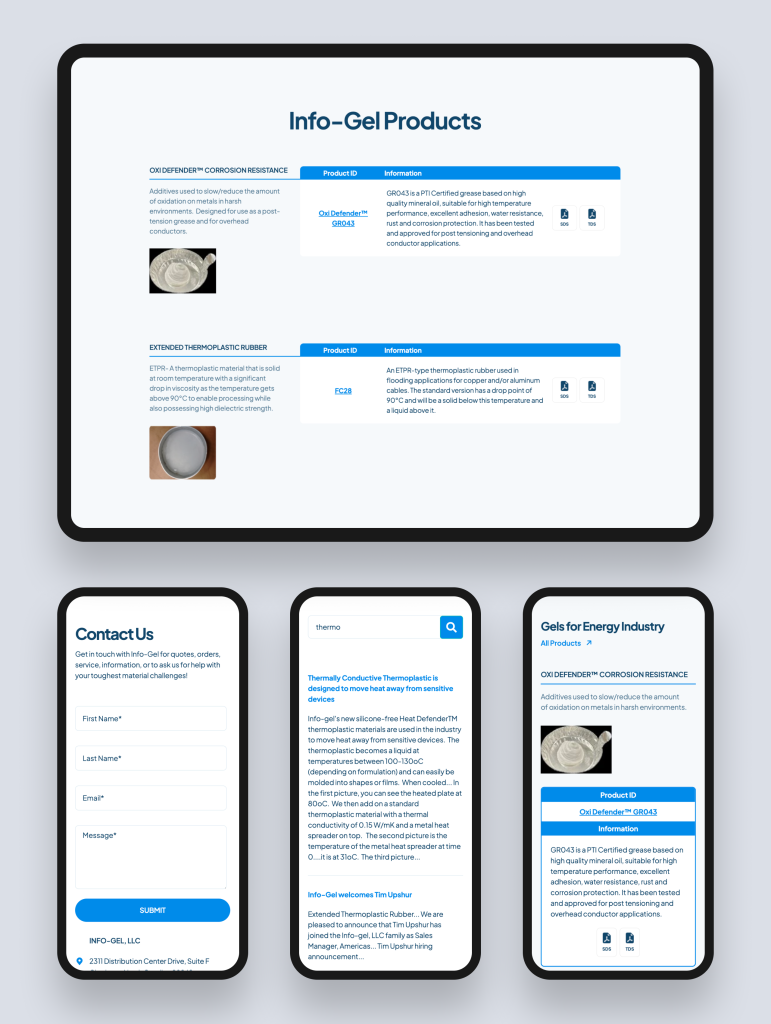
| Case study: Info-Gel (Specialty gels for cables, HubSpot CMS) |
| Info-Gel manufactures specialty gels for cables, with an extensive product catalogue requiring careful digital presentation. Their existing website lacked a cohesive structure, making it difficult for buyers to explore the product catalogue and impossible to efficiently search for specific product data sheets. Rudo designed and built a new catalogue-type website using HubSpot as the CMS, with a well-organised sitemap, intuitive navigation through the product catalogue, and robust search functionality making technical data sheets (TDS) and safety data sheets (SDS) easily accessible. The redesigned website received positive feedback from both existing clients and potential customers, establishing Info-Gel as a market leader committed to providing an unparalleled digital experience. Full case study: rudo.co.uk/case-studies/info-gel/ |
For a dedicated guide to product catalogue websites in manufacturing, read our guide to manufacturing product catalogue websites.
5. Platform choice for manufacturing websites
The right platform for a manufacturing website depends on the complexity of the content, the size of the product catalogue, the integrations required, and the technical capability available for ongoing maintenance.
WordPress: the choice for complex requirements
WordPress with a custom theme and Advanced Custom Fields (ACF PRO) is the strongest platform for manufacturing companies with complex product catalogues, multiple custom content types, or specific integration requirements. A properly built WordPress site can accommodate any product data structure, any search and filtering requirement, and any third-party integration — from ERP systems to distributor portals — without platform constraints.
The trade-off is maintenance: WordPress requires ongoing security updates, plugin management, and hosting oversight. For manufacturing companies with in-house IT capability or an agency maintenance retainer, this is manageable. For those without, it adds an operational overhead that managed platforms avoid.
HubSpot CMS: the choice for marketing-led operations
For manufacturing companies already using HubSpot CRM for managing distributor relationships, dealer networks, or direct sales pipelines, HubSpot CMS is the most commercially connected option. Every website lead flows directly into the pipeline, campaign landing pages can be built without developer involvement, and smart content can show different product information to different buyer types based on their profile.
HubSpot CMS is particularly well-suited to manufacturing companies with a marketing team running active campaigns: trade show follow-up landing pages, sector-specific product guides, and product launch pages can all be built and updated independently. The platform cost is higher than WordPress or Webflow, but the operational efficiency for an active marketing team is significant.
Webflow: the choice for design-led brands
For manufacturing companies where visual positioning is a competitive differentiator, such as premium materials suppliers, design-adjacent manufacturers, or companies competing in sectors where brand perception matters commercially, Webflow's design fidelity and marketing team velocity make it a strong option. It suits companies with moderate product catalogue complexity and no specific CRM platform requirements.
For a full platform comparison, read our guides to WordPress vs Webflow, WordPress vs HubSpot CMS, and Webflow vs HubSpot CMS.
Find out more about our manufacturing web design service and the platforms we build on.
6. SEO for manufacturing companies
Search engine optimisation for manufacturing companies operates differently from SEO in consumer or SaaS sectors. The search volumes for individual manufacturing keywords are often low, but the commercial value of ranking for them is disproportionately high. A manufacturer who ranks on the first page for a highly specific industrial keyword, such as a specific material grade, certification type, or product application, captures buyers who are actively specifying a component rather than browsing.
Technical specification keywords
Manufacturing buyers frequently search by specification rather than by product category. Searches for EPDM foam tape automotive grade, activated carbon pharmaceutical GMP, or specialty gel cable manufacturer are low volume but high intent. A manufacturing website that contains properly structured, keyword-informed content about specific grades, specifications, and applications captures this traffic.
Application and industry pages
Dedicated pages for each major application or industry your products serve, structured around the specific problems buyers in that sector face and the specifications your product meets, are one of the highest-value SEO investments for a manufacturing company. They serve both SEO and conversion: a water treatment engineer who lands on an activated carbon for water treatment page is on a page built for their specific context.
Technical documentation as an SEO asset
Technical data sheets, application guides, and white papers that live on your website, rather than behind a form gate, can rank for highly specific technical queries and attract exactly the buyers who are deep in a specification process. A data sheet that ranks for a specific product standard or test method is found by buyers at the most commercially valuable moment in their research journey.
For a detailed guide to SEO for manufacturing companies, read our SEO for manufacturers guide.
7. What a manufacturing website project involves
A manufacturing website project at Rudo follows the same strategic foundation as any B2B website project, with additional phases specific to the sector's technical communication requirements.
Discovery and strategy: weeks 1 to 2
Stakeholder interviews with commercial, technical, and marketing teams. Buyer persona development for each audience type (engineer, procurement manager, business decision-maker). Competitor website audit. Product catalogue audit: how many products, how complex is the data model, what technical documentation exists. SEO baseline analysis. For manufacturing projects, this phase often reveals significant gaps between how the company describes its products internally and how buyers search for them externally — closing this gap is one of the highest-value outcomes of the discovery phase.
Copywriting: three tiers, planned upfront
- Strategic guidance: Rudo provides page-by-page outlines; your technical team writes the copy. Adds approximately £1,500 to £3,000. Works when you have a technically capable writer who understands the product and the buyer.
- Hybrid: Rudo writes the commercial pages (homepage, key landing pages, application pages); your team writes the technical product content. Adds approximately £3,500 to £7,000. The most commonly chosen option for manufacturing clients.
- Full copywriting: Rudo writes everything, beginning with a messaging workshop. Adds approximately £6,000 to £14,000. The right choice when positioning or messaging needs a fundamental rethink alongside the redesign.
UX and wireframing: weeks 3 to 4
Information architecture for the full site, including the product catalogue structure, the application/industry navigation, and the technical documentation library. For manufacturing projects, this phase is more complex than for many other sectors because the product content structure needs to serve multiple buyer types navigating the same content in different ways.
Visual design: weeks 5 to 7
High-fidelity design in Figma across all templates. For manufacturing clients, this phase also involves briefing and art directing product and facility photography if new photography is being commissioned. The quality of photography on a manufacturing website has a disproportionate impact on perceived credibility; it is worth investing in properly.
Development: weeks 8 to 13
Custom theme or platform build. Product catalogue development with appropriate search and filtering functionality. Technical documentation library setup. CRM integration and form configuration. If the product catalogue requires database-driven search and filtering by specification, this phase is longer and more technically complex than a standard B2B website build.
Launch and handover: weeks 14 to 15
Pre-launch SEO configuration. QA across all pages, product pages, filters, search, and forms. Team training on content management, including how to add new products, update specifications, and manage technical documentation. Post-launch monitoring.
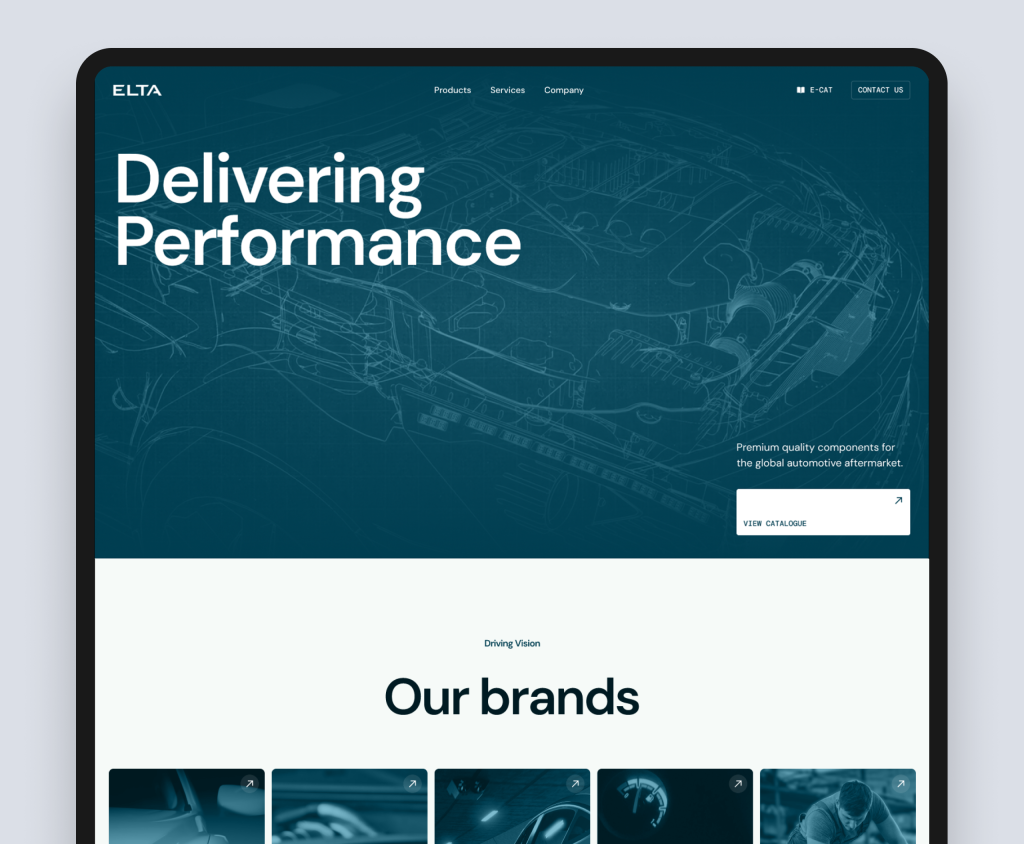
| Case study: ELTA Automotive (Automotive component distribution, UK) |
| ELTA Automotive is a UK-based, family-owned automotive component distributor and manufacturer established in 1993. Official licensee of the iconic Lucas brand for the UK and Europe, ELTA supplies motor factors and retailers globally with automotive bulbs, wiper blades, engine management components, sensors, and ignition parts across brands including VXPRO, VisionPRO, and Lucas. ISO 9001 certified. Rudo designed and built a new website that communicates ELTA's breadth of product portfolio, technical expertise, and 30-year heritage in the automotive aftermarket, while providing a clear digital platform for their growing brand portfolio and distributor relationships. |
8. How much does a manufacturing website cost?
Manufacturing website costs vary more than in most other B2B sectors because of the product catalogue complexity variable. A manufacturer with 50 products and straightforward specifications has a meaningfully different project to one with 500 products across multiple variants with complex technical data requirements.
Standard build: £12,000 to £25,000
A fully custom-designed website with discovery and strategy, up to 25 page templates, a moderate product catalogue (up to 100 products) with standard specification display, technical documentation downloads, CRM integration, pre-launch SEO configuration, and team training. Appropriate for most mid-market B2B manufacturers with straightforward catalogue requirements.
Complex build: £25,000 to £50,000
Larger sites with more complex product catalogue architecture, database-driven product search and specification filtering, multiple audience types requiring distinct content journeys, multiple language or territory variants, or significant technical documentation library development. Most established mid-market manufacturers with genuine product complexity fall in this range.
Enterprise build: £50,000 and above
Very large product catalogues with complex specification filtering and search, integration with ERP or PIM (Product Information Management) systems, multi-site deployments across brands or regions, or bespoke functionality such as product configurators or quotation tools. Scoped individually.
Ongoing costs
Beyond the initial build, manufacturing websites require ongoing maintenance (£500 to £1,500 per month if outsourced), hosting (£50 to £200 per month for managed hosting), and content updates as products, specifications, and certifications change. A product catalogue that goes out of date is a credibility liability; budget for ongoing content stewardship from day one.
For a detailed breakdown of manufacturing website costs, read our manufacturing website cost guide.
9. How to choose a manufacturing web design agency
Manufacturing websites have specific requirements that general-purpose web design agencies frequently underestimate. The choice of agency matters more in manufacturing than in most other sectors.
Questions that reveal genuine manufacturing experience
- Have they built product catalogue websites before? Ask to see examples of manufacturing or industrial product catalogue sites they have delivered. Review the quality of the product page architecture, the filtering and search functionality, and how technical documentation is handled. A general B2B agency that has never built a catalogue site will underestimate the complexity.
- How do they approach technical content for non-specialist audiences? The most common failure in manufacturing web design is either too much jargon (loses commercial audiences) or too little technical depth (loses engineers). Ask specifically how they balance technical credibility with commercial accessibility.
- Do they understand your sector's compliance requirements? Certifications, standards compliance, and regulatory documentation handling are different in every manufacturing sector. An agency that has worked in your sector understands what needs to be communicated and how; one that has not will need to learn on your project.
- What is their approach to photography? Real facility and product photography is one of the highest-value investments in a manufacturing website. Ask whether they have experience briefing and art directing manufacturing photography, or whether they default to stock imagery.
- Can they demonstrate SEO knowledge for manufacturing? Ask specifically about their approach to technical specification keywords, application-based content strategy, and how they would approach optimising a product catalogue for search. Generic SEO knowledge is not sufficient for manufacturing's specific keyword landscape.
For a full checklist of questions to ask any B2B web design agency, read how to choose a B2B web design agency.
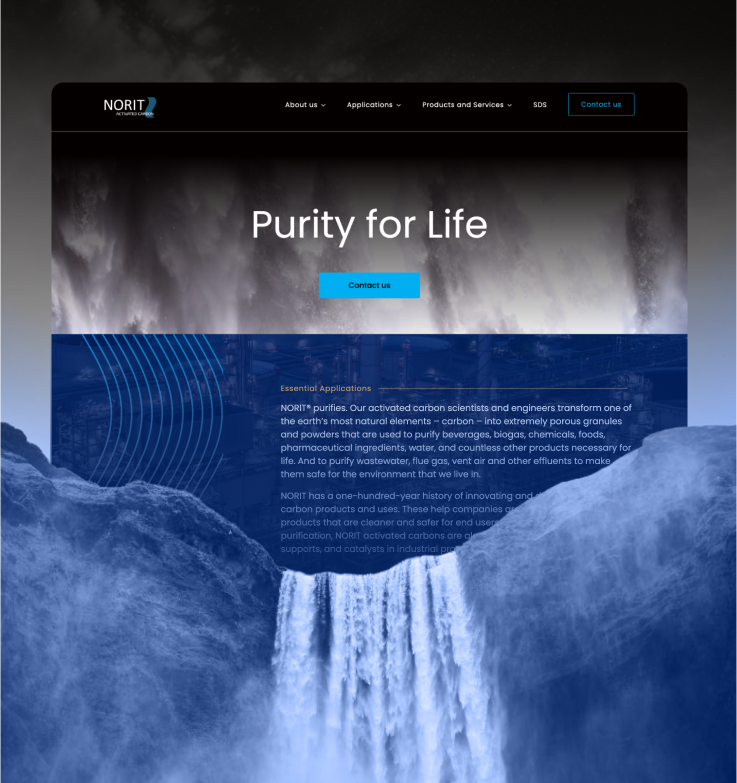
| Case study: Norit (Activated carbon manufacturing, global) |
| Norit is one of the world's largest producers of activated carbon, with over a century of history in manufacturing and product development. Operating ten plants across seven countries on three continents, Norit produces more than 400 grades of activated carbon used for purification across water, food and beverage, pharmaceutical, chemical, and industrial applications. Rudo worked with Norit to create a digital presence that communicates the scale, technical authority, and product breadth of a global manufacturing leader to highly technical buyer audiences across multiple industries and geographies. |
For a full guide to manufacturing website examples, read our manufacturing website examples guide.
Manufacturing sectors we work in
Rudo has designed and built websites for manufacturing companies across a wide range of industrial sectors. Our experience includes chemical manufacturing, specialty materials, automotive components, precision engineering, and process industries.
Ready to build a manufacturing website that generates enquiries?
Rudo is a London-based B2B web design agency with genuine experience in manufacturing and industrial sectors. We design and build websites that communicate technical credibility to sophisticated buyers, present complex product catalogues clearly, and generate qualified enquiries around the clock.
Ranked number one in the UK on DesignRush and top ten on Clutch. Every manufacturing project starts with a thorough understanding of your products, your buyers, and your commercial objectives before any design work begins.
Book a no-obligation intro call.
We will discuss your products, your buyers, and what a website built specifically for your manufacturing business should do — and give you an honest view of what that would cost and involve.
Find out more about our manufacturing web design service.
10. Frequently asked questions
What makes a good manufacturing website?
A good manufacturing website communicates technical credibility to sophisticated buyers quickly, presents product specifications and technical documentation clearly, provides evidence of capability through real photography, client names, and certifications, and makes it easy for buyers to make contact when they are ready. It serves multiple buyer types simultaneously: engineers who need technical depth, procurement managers who need compliance information, and business decision-makers who need credibility signals.
How much does a manufacturing website cost in the UK?
A standard manufacturing website build typically costs £12,000 to £25,000 for a mid-market company with a moderate product catalogue. More complex builds, involving database-driven product search, complex specification filtering, or ERP integration, typically cost £25,000 to £50,000. Enterprise deployments cost £50,000 and above. Ongoing hosting and maintenance adds £500 to £2,000 per month.
For a detailed breakdown, read our manufacturing website cost guide.
What CMS should a manufacturing company use?
WordPress is the strongest choice for manufacturing companies with complex product catalogues, specific integration requirements, or very large content operations. HubSpot CMS is the best choice for companies already using HubSpot CRM who want native pipeline integration and marketing team independence. Webflow is appropriate for design-led manufacturers with moderate catalogue complexity and no specific CRM platform requirements.
How do you present a large product catalogue on a manufacturing website?
A well-designed manufacturing product catalogue offers multiple navigation paths: by product family for buyers who know what they want, by application or industry for buyers who are starting from a problem, and by specification for technical buyers filtering by performance parameters. Technical data sheets and safety data sheets should be accessible from product pages in a single click. The structure should be built on a proper CMS data model, not on a list of static pages, to allow search and filtering by specification.
For a dedicated guide, read our manufacturing product catalogue website guide.
How does SEO work for manufacturing companies?
Manufacturing SEO focuses on technical specification keywords, application-based content, and long-tail industrial queries that are low volume but high commercial intent. A manufacturer who ranks for a specific material grade, product standard, or application type captures buyers who are actively specifying rather than browsing. Dedicated application and industry pages, properly structured product pages with specification content, and technical documentation that lives on the website rather than behind a gate are the highest-value SEO investments for most manufacturing companies.
For a detailed guide, read our SEO for manufacturers guide.
How long does a manufacturing website project take?
A standard manufacturing website project typically takes 12 to 15 weeks. Projects with complex product catalogue architecture, database-driven specification filtering, or ERP integration take 16 to 22 weeks. The most variable factors are product data availability and quality (incomplete or inconsistent product data adds significant time to the catalogue build phase) and photography (if new facility and product photography is being commissioned, this needs to be planned in parallel with the design phase).
What should be on a manufacturing company's homepage?
A manufacturing homepage should establish credibility within ten seconds: lead with a clear statement of what you make and who you make it for, then immediately provide credibility signals (client names, certifications, scale indicators). Follow with a clear entry point to the product catalogue, an application or industry navigation for buyers approaching from a problem, and social proof in the form of specific outcomes for named clients. A contact or enquiry mechanism should be visible without scrolling.
About Rudo
Rudo is a strategy-led B2B web design agency based in London. We design and build websites for manufacturing and industrial companies that communicate technical credibility, present complex product information clearly, and generate qualified enquiries. Ranked number one UK web design agency on DesignRush and top ten on Clutch.
Find out more about our manufacturing web design service.

Written by
Rudo Agency
Rudo is a strategy-led web design and development agency specialising in B2B. Based in the UK and working with clients globally, we help ambitious brands turn complex ideas into high-performing websites. Our team combines digital strategy, UX/UI design, custom development, and SEO to deliver results-focused websites that support real business growth.
