Overview
A recruitment agency website has to do something that most B2B websites do not: serve two fundamentally different audiences simultaneously, from the same digital presence, with content and journeys that feel tailored to each. Clients evaluating whether to trust a recruiter with a critical hire. Candidates evaluating whether to trust a recruiter with their career. Both visiting the same website. Both needing to feel it was built for them.
This dual-audience challenge is the defining design problem of recruitment agency web design. Get it wrong and the site serves neither audience well. Get it right and the website becomes a commercial asset that generates client enquiries, attracts quality candidates, and communicates the specific sector expertise that separates a specialist recruiter from the generalist field.
This guide covers everything a UK recruitment agency needs to know about building a website that performs this job well.
In this guide:
- Why recruitment agency website design is a distinct challenge
- The two audiences every recruitment website must serve
- Communicating specialist sector expertise
- The candidate experience
- Client conversion architecture
- Job listings and vacancy management
- Platform choice for recruitment agencies
- Content strategy for recruitment agencies
- What a recruitment website project involves
- How much does a recruitment agency website cost?
- Recruitment sectors we work in
- Frequently asked questions
Find out more about our recruitment web design service.
1. Why recruitment agency website design is a distinct challenge
Recruitment agencies operate in one of the most competitive B2B service markets in the UK. The barriers to entry are low, the number of competing agencies in most sectors is high, and the primary differentiators — sector expertise, candidate quality, consultant relationships, and speed of delivery — are all intangible. They cannot be photographed or demonstrated. They have to be communicated.
The website is the primary medium through which a recruitment agency communicates these intangibles to clients and candidates who are evaluating them before making contact. A website that communicates genuine sector depth, a clearly defined specialist focus, and evidence of successful placements tells clients something meaningful about what this agency can do. One that looks like every other generalist recruiter tells them nothing.
The trust deficit in recruitment
Recruitment has a well-documented trust problem. Clients have been overpromised and underdelivered by agencies who claimed sector expertise they did not have. Candidates have been misrepresented to employers, sent to irrelevant roles, and ignored after placement. This means that a new client or candidate visiting a recruitment agency website starts from a position of scepticism rather than neutrality. The website has to work harder than most B2B sites to earn basic credibility, let alone genuine trust.
The design and content decisions that address this trust deficit — specific sector case studies, named consultants with genuine backgrounds, client testimonials with real outcomes, transparent process descriptions — are not decoration. They are the substance of what the website needs to communicate.
| In recruitment, the website is not just a marketing tool. It is a trust-building instrument. Every page and every section should be evaluated against the question: does this make a sceptical client or candidate more confident in this agency? |
2. The two audiences every recruitment website must serve
Clients: businesses hiring through the agency
Hiring managers, HR directors, talent acquisition leads, and business owners looking for a recruitment partner. They are evaluating the agency against two criteria: can they actually source the specific talent we need, and can we trust them to represent our business well to candidates? The signals they look for: sector specialisation (do they genuinely understand our market?), placement track record (have they placed people like the ones we need?), named clients in recognisable companies, and the quality of the consultant they will work with.
Client content on a recruitment website should answer these questions specifically. Generic claims of 'exceptional candidates' and 'tailored recruitment solutions' are discounted by experienced hiring managers. Named placements, specific sectors served, and consultant biographies with verifiable backgrounds carry actual commercial weight.
Candidates: professionals considering the agency
Professionals evaluating whether to register with an agency, submit their CV for a specific role, or engage a recruiter in a career move. They have a different set of questions: does this agency understand my market and my career stage? Do they have access to the kinds of roles I want? Will they actually call me back? The signals they look for: genuine sector knowledge communicated through content, real job listings rather than placeholder vacancies, consultant profiles that feel like real people rather than corporate headshots, and evidence that previous candidates have had good experiences.
Candidate content does not need to be entirely separate from client content — but the pathways, the language, and the specific proof points need to be calibrated for each audience. A homepage that leads with client-focused language and treats the candidate journey as secondary will lose the quality candidates that attract quality clients.
Serving both without splitting the site
The instinct of many recruitment agencies is to split the website cleanly into a client section and a candidate section. This can work, but it creates a binary that many visitors do not fit — a business owner who is also looking for a new role themselves, for instance, or a senior HR professional who is simultaneously a client and a candidate in different contexts. A better approach is a unified homepage that acknowledges both audiences explicitly in the hero section, then branches naturally into client and candidate journeys from a single navigation structure.
3. Communicating specialist sector expertise
Specialist sector expertise is the most important commercial differentiator available to a recruitment agency. It is also the most commonly communicated poorly on agency websites. The gap between claiming sector expertise and demonstrating it is the gap between a website that converts clients and one that does not.
Claiming vs demonstrating
Claiming expertise: 'We are specialist recruiters in the technology sector with deep market knowledge and a strong candidate network.' Demonstrating expertise: 'We have placed 140 software engineers across Series A to Series C technology companies in the UK in the past 18 months, including engineering leads at fintech, cybersecurity, and developer tooling businesses.' The second is specific, falsifiable, and commercially meaningful. The first is indistinguishable from a hundred competitors.
Sector pages that actually work
Most recruitment agency sector pages are thin: a paragraph describing the sector, a list of job titles the agency recruits for, and a contact form. A sector page that works does more: it demonstrates specific market knowledge (current hiring trends, salary benchmarks, candidate supply dynamics in that sector), references specific placements or client types within the sector, and features the consultant who specialises in that sector with their specific background and track record.
Consultant profiles as a differentiator
In recruitment, clients and candidates often choose the consultant as much as the agency. A named consultant with a specific sector background, a verifiable employment history, and a clear description of the types of roles and companies they work with is a meaningful differentiator. Consultant profile pages that communicate genuine sector depth — not just a headshot and a few bullet points — convert significantly better in high-value recruitment markets.
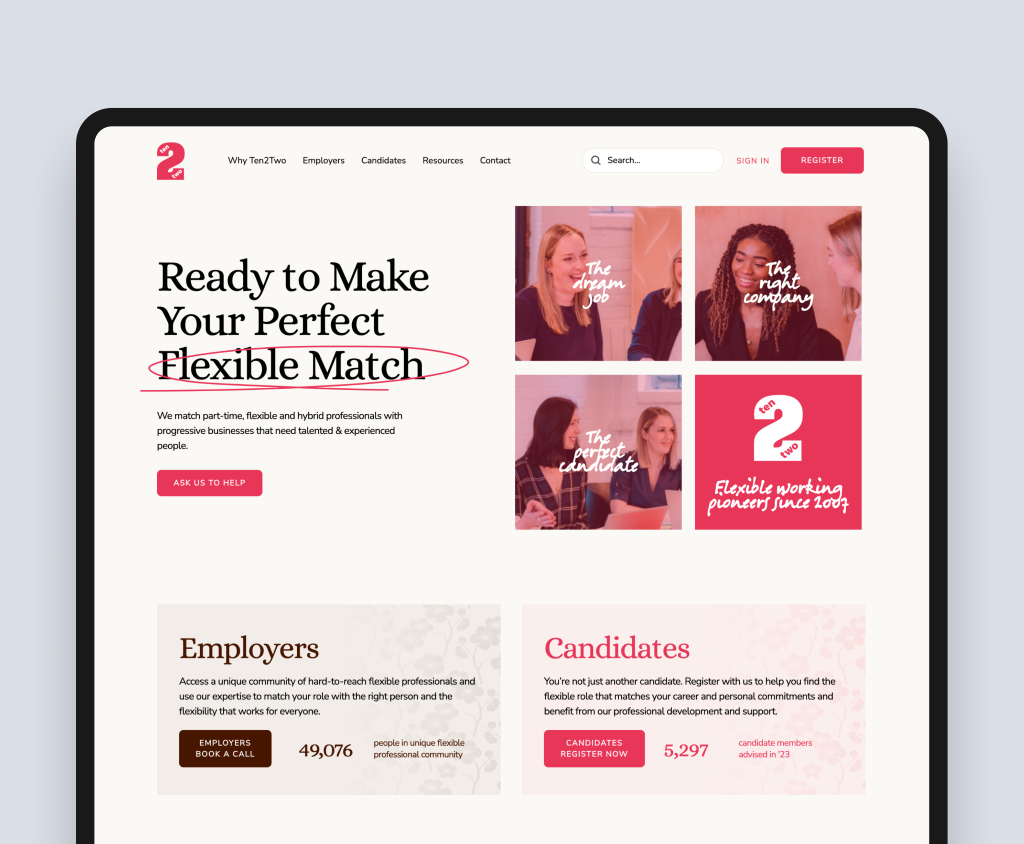
| Case study: Ten2Two (Flexible and part-time recruitment agency, HubSpot CMS) |
| Ten2Two is a UK-based recruitment agency specialising in matching part-time, flexible, and hybrid professionals with progressive businesses. Their rebrand created an opportunity to rebuild their digital presence to reflect a refreshed brand identity and communicate their specialist positioning more effectively to both employers and candidates. Rudo led the full redesign and rebuild on HubSpot CMS, creating a user-centric site with clear pathways for both client and candidate audiences. The improved navigation and information architecture made it easy for employers to understand Ten2Two's unique flexible working proposition and for candidates to explore opportunities. The result, in the words of Director Deborah O'Sullivan: 'A shiny new HubSpot CMS website that looks clean, professional, and, more importantly, is beginning to drive enquiries.' Full case study: rudo.co.uk/case-studies/ten2two/ |
4. The candidate experience
The quality of candidates a recruitment agency attracts is directly related to the quality of the candidate experience on its website. A site that makes it difficult for candidates to understand what the agency does, find relevant roles, or make contact will attract lower-quality candidates who are less selective about where they register — and lose the high-quality candidates who have options.
Job listings: the most visited pages on most recruitment sites
On most recruitment agency websites, the job listings pages attract more traffic than any other section. Yet they are frequently the least well-designed pages on the site. Generic search interfaces, poorly written job descriptions, and listings that serve as placeholders rather than genuine opportunities undermine the credibility the rest of the site has worked to establish.
High-performing job listing pages on recruitment sites have: a clear search and filter function (by sector, location, salary range, and job type); job descriptions that go beyond the client's brief to communicate what it is actually like to work in this role and at this company; salary transparency where possible; and a frictionless application mechanism that does not require registration before a CV can be submitted.
The candidate registration journey
For agencies that work primarily from their own candidate database, the candidate registration journey is the most commercially important conversion flow on the site. It should be short, specific, and frictionless — asking for the information needed to have a useful first conversation rather than attempting to collect a full candidate profile at registration. CV upload, contact details, sector preference, and availability are usually sufficient. Everything else can be gathered in the first conversation.
Content that earns candidate trust
Candidates who are evaluating whether to register with an agency will look for evidence that the agency understands their market and has a genuine pipeline of relevant roles. Blog content covering salary benchmarks in their sector, career development guides for their level, and commentary on current hiring trends in their market signals that this is an agency with real sector knowledge rather than one that has simply listed a few job titles.
5. Client conversion architecture
For most recruitment agencies, the most commercially valuable conversion on their website is not a candidate CV submission — it is a client enquiry. A single retained search mandate or an exclusive vacancy with a good fee is worth more than dozens of candidate registrations. The website's client conversion architecture should reflect this value.
What clients need to see before they make contact
A hiring manager evaluating a recruitment agency will typically want to verify: that the agency has genuine experience in their sector; that they have placed people at a comparable level and in comparable organisations; that the consultants they will work with have credible sector backgrounds; and that other businesses have had good experiences with the agency. The website needs to provide this evidence before the enquiry, not require the client to request it in a call.
The enquiry mechanism
A client ready to make contact should be able to do so with minimum friction. A well-framed enquiry form that asks for sector, level of hire, and a brief description of the requirement allows the agency to arrive at the first conversation with context. A generic contact form that asks only for name and email forces a slow qualification process and communicates that the agency is not yet thinking about the client's specific need.
Thought leadership for client acquisition
Market intelligence content — salary benchmarking reports, hiring trend analyses, talent supply commentaries in specific sectors — is one of the highest-value client acquisition tools available to specialist recruitment agencies. Clients who download a salary benchmarking report for their sector are highly qualified prospects who have identified themselves by the act of downloading. This content should be gated behind a light registration form connected directly to the CRM.
6. Job listings and vacancy management
The technical approach to job listings on a recruitment agency website has more commercial impact than most agencies realise. There are three main options, each with distinct tradeoffs.
CMS-native job listings
Job vacancies managed directly within the website's CMS (WordPress, HubSpot, or Webflow). Most appropriate for agencies with a moderate number of active vacancies (under 100) and an in-house team that can maintain listings directly. Gives the most control over design and SEO. Requires discipline to keep listings current — outdated vacancies are a credibility liability.
Integrated job boards
Integration with a specialist recruitment platform (Bullhorn, Firefish, JobAdder, Vincere) that feeds live vacancies from the CRM directly onto the website. Most appropriate for agencies with high vacancy volumes or consultants managing their own candidate pipelines. Reduces manual listing maintenance. Requires careful design work to ensure the job board integration does not undermine the quality of the overall site design.
Third-party embedding
Embedding job listings from Indeed, LinkedIn, or a specialist job board into the website. The least preferred option from a UX and brand perspective — the embedded experience is typically generic and does not reflect the agency's positioning. Only appropriate as a temporary solution during a website rebuild or for agencies with very limited technical resources.
For a full breakdown of platform options and integrations, read our guide to choosing a recruitment web design agency.
7. Platform choice for recruitment agencies
HubSpot CMS
The strongest choice for recruitment agencies with an active business development function — using content marketing, LinkedIn campaigns, and email sequences to generate client enquiries. HubSpot CRM integration means every website visitor, content download, and form submission connects directly to the commercial team's contact database. Smart content can serve different messaging to returning clients versus first-time visitors. Campaign landing pages can be built by the marketing team without developer involvement.
HubSpot CMS is particularly well-suited to specialist or executive recruitment agencies where a single client relationship can be worth tens of thousands in fees — making the investment in a CRM-connected website commercially justified. Ten2Two, Rudo's specialist flexible working recruitment client, chose HubSpot CMS for precisely this integration between website activity and business development pipeline.
For more on HubSpot CMS, read our complete HubSpot CMS guide.
Webflow
The strongest choice for recruitment agencies where design quality is a primary differentiator and the marketing team needs speed and independence without complex CRM requirements. Webflow's design fidelity allows a recruitment brand to look genuinely distinctive rather than generic. Updates can be made by non-technical team members without developer involvement. Appropriate for agencies with moderate vacancy volumes that can be managed through native CMS job listing functionality.
Service Innovation Group, Rudo's field sales staffing client, chose Webflow for the design velocity and content management flexibility it provides to a fast-moving commercial team.
For more on Webflow, read our complete Webflow guide.
WordPress
The strongest choice for recruitment agencies with complex technical requirements — integration with specialist recruitment CRM platforms, high vacancy volumes requiring database-driven search and filtering, or specific compliance and data handling requirements. WordPress's open architecture accommodates any integration without platform constraints.
For more on WordPress, read our complete WordPress guide.
8. Content strategy for recruitment agencies
Recruitment agencies that invest consistently in high-quality sector content build two commercial assets simultaneously: organic search visibility that attracts clients and candidates at the research stage, and on-site content that converts that traffic by demonstrating genuine market knowledge.
Salary benchmarking guides
Sector-specific salary benchmarking content is among the highest-traffic and highest-converting content available to a specialist recruiter. Hiring managers and HR professionals search for salary benchmarks constantly. A recruiter who publishes genuinely useful, sector-specific salary data for their specialist area will rank for those queries and capture highly qualified client prospects at the moment they are actively planning a hire.
Hiring market commentaries
Regular commentary on the hiring conditions in a specialist sector — candidate supply, fee trends, time-to-hire benchmarks, the impact of specific market events on hiring activity — positions the agency as a genuine market analyst rather than a transactional vendor. Clients who read this content develop a view of the agency as a knowledgeable partner before they have spoken to anyone.
Career guidance for candidates
Interview preparation guides, CV advice specific to the sector, career development content for the candidate levels the agency specialises in. This content attracts organic traffic from candidates who are actively considering a career move, positions the agency as genuinely helpful rather than purely transactional, and creates opportunities to capture candidate registrations from people who are not yet actively job-searching but are planning ahead.
9. What a recruitment agency website project involves
Discovery and strategy: weeks 1 to 2
Stakeholder interviews with business development, consultant, and marketing leads. Audience analysis for both client and candidate types — the sectors served, the levels hired, and the specific credibility signals each audience looks for. Competitor review of agency websites in the same sector specialism. Commercial goal definition: what should the new website generate in terms of client enquiries, candidate registrations, and content downloads in the first 12 months?
Copywriting: three tiers
- Strategic guidance (£1,500 to £3,000): Rudo team provides page-by-page copy outlines. Your team writes final copy. Works when you have a consultant or marketing team member who understands the market deeply and can write compellingly about it.
- Hybrid (£3,500 to £7,000): Rudo team writes the commercial-facing pages — homepage, sector pages, about — while your team writes job listing templates, consultant profiles, and blog content. The most commonly chosen option for recruitment agencies.
- Full copywriting (£6,000 to £14,000): Rudo team writes everything from a messaging workshop. The right choice for agencies repositioning, entering new sectors, or without internal writing resource.
UX and design: weeks 3 to 7
Information architecture for the full site including both client and candidate journeys. Wireframes for all templates. Job listing design and search/filter UX. Consultant profile page design. High-fidelity design in Figma across all templates and states.
Development: weeks 8 to 12
CMS build on chosen platform. Job listing functionality — either CMS-native or CRM integration. Search and filter implementation. CRM integration with appropriate data handling for GDPR compliance (particularly important for candidate data). Form design and submission handling.
Launch and handover: weeks 13 to 14
Pre-launch SEO configuration. QA. Team training covering both the consultant-facing content management workflow and the marketing team's campaign landing page and content publishing workflows. Redirect mapping for any changed URLs.
10. How much does a recruitment agency website cost?
Standard build: £10,000 to £22,000
A fully custom-designed recruitment agency website with discovery and strategy, up to 20 page templates, dual-audience navigation, consultant profile pages, sector pages, job listing functionality (CMS-native or basic CRM feed integration), CRM connection, pre-launch SEO, and team training. Appropriate for growing specialist agencies making a first serious digital investment or upgrading a dated site.
Full-featured build: £22,000 to £40,000
Larger sites with more complex CRM integration, sophisticated job search and filter functionality, campaign landing page infrastructure, HubSpot smart content configuration, gated content with lead capture, or multiple audience segments requiring distinct content architectures. Most established specialist agencies with active marketing programmes fall in this range.
Enterprise: £40,000 and above
Multi-brand or multi-geography deployments, complex ATS/CRM integration with custom-built job search infrastructure, or bespoke functionality such as candidate self-service portals or client reporting dashboards.
Ongoing costs
Platform costs: HubSpot CMS from approximately £320 per month, Webflow from £39 per month, WordPress hosting from £50 to £200 per month. Content maintenance: salary benchmarking guides and market commentaries require regular updates to remain commercially useful. Job listing management: the ongoing overhead of keeping vacancy listings current.
For a full cost breakdown, read our guide to recruitment website cost.
11. Recruitment sectors we work in
Rudo has designed and built websites for recruitment agencies across flexible and part-time staffing and field sales workforce solutions. Our two published recruitment case studies demonstrate the range of the sector.
| Case study: Ten2Two (Flexible and part-time recruitment specialist, HubSpot CMS) |
| Ten2Two matches part-time, flexible, and hybrid professionals with progressive businesses across the UK. Their rebrand created the opportunity to redesign and rebuild their digital presence on HubSpot CMS — communicating their specialist flexible working proposition clearly to employers and creating a genuinely engaging candidate journey. The result, in the words of Director Deborah O'Sullivan, was a clean, professional website that is beginning to drive enquiries. Full case study: rudo.co.uk/case-studies/ten2two/ |
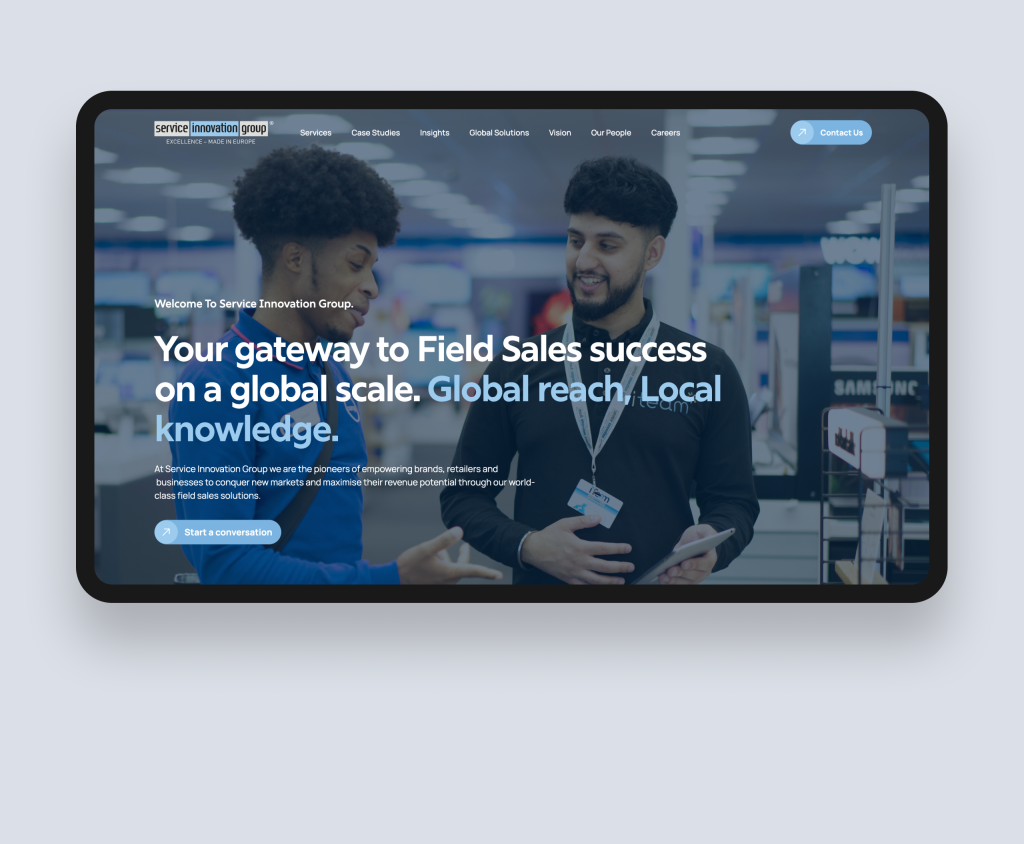
| Case study: Service Innovation Group (Europe's leading field sales agency, Webflow) |
| Service Innovation Group specialises in providing outsourced field sales solutions — empowering brands, retailers, and businesses to enter new markets through its skilled professional network. Following a rebrand, they needed a website that communicated their diverse service offerings clearly to distinct client audiences across different industries and geographies. Rudo designed and built a new Webflow site with a strategic sitemap, user-centric wireframes for distinct audience journeys, and a clean UI that empowered the SIG team with seamless content management capability. Full case study: rudo.co.uk/case-studies/service-innovation-group/ |
We also design and build websites for B2B companies in financial services, technology and SaaS, manufacturing, property, and healthcare.
Book a no-obligation intro call.
We will review your current site, understand your go-to-market goals, and give you an honest view of whether Rudo is a good fit
12. Frequently asked questions
What should a recruitment agency website include?
A recruitment agency website should include: a homepage that addresses both client and candidate audiences explicitly with clear pathways for each; sector pages that demonstrate specific market expertise rather than simply listing job titles; named consultant profiles with genuine sector backgrounds; client testimonials with specific outcomes; a job listings section with functional search and filtering; gated content for client lead generation (salary guides, market reports); candidate registration and application mechanisms; and a clear enquiry mechanism for new business conversations.
How do you design a recruitment website for two audiences?
The best approach is a unified homepage that acknowledges both audiences from the hero section, then branches into distinct content journeys through navigation and internal linking. Avoid splitting the site into entirely separate client and candidate sections — many visitors occupy both roles and a binary split creates friction. Instead, use audience-specific language and proof points on shared pages, and create dedicated sections (sector pages for clients, job listings and career guides for candidates) that serve each audience in depth without creating a site-within-a-site structure.
What platform is best for a recruitment agency website?
HubSpot CMS for agencies with active business development functions who need native CRM integration between website engagement and consultant pipeline management. Webflow for agencies where design quality is a differentiator and the team needs speed and independence without complex CRM requirements. WordPress for agencies with complex CRM integration requirements or high vacancy volumes requiring database-driven search infrastructure. The platform decision should be led by the agency's commercial model and the technical requirements of the job listing and CRM integration.
How much does a recruitment agency website cost in the UK?
A standard recruitment agency website with dual-audience navigation, consultant profiles, sector pages, job listing functionality, and CRM integration typically costs £10,000 to £22,000. More complex builds with sophisticated CRM integration, HubSpot smart content, or gated content infrastructure typically cost £22,000 to £40,000. Multi-brand or multi-geography deployments cost £40,000 and above.
What cluster articles are in this guide?
This pillar connects to five supporting guides: how to design a recruitment website, executive search website design, recruitment website examples, recruitment website cost, and how to choose a recruitment web design agency.
About Rudo
Rudo is a strategy-led B2B web design agency based in London. We design and build websites for recruitment agencies across specialist and executive search, flexible staffing, and outsourced workforce solutions. Ranked number one UK web design agency on DesignRush and top ten on Clutch.
Find out more about our recruitment web design service.

Written by
Rudo Agency
Rudo is a strategy-led web design and development agency specialising in B2B. Based in the UK and working with clients globally, we help ambitious brands turn complex ideas into high-performing websites. Our team combines digital strategy, UX/UI design, custom development, and SEO to deliver results-focused websites that support real business growth.
