Overview
Property finance is one of the most demanding commercial environments in which a website has to operate. A developer seeking £3 million in bridging finance, an investor looking to refinance a portfolio of buy-to-let properties, or a business evaluating a £15 million development facility — these are sophisticated, financially literate borrowers making significant decisions with real consequences. They are not impulse buyers. They do not shortlist based on aesthetics.
They shortlist based on evidence. Evidence of deals completed at the relevant scale and complexity. Evidence of lender relationships that can actually deliver the required product. Evidence that the team has the expertise to structure and execute. And evidence that the company is financially stable and professionally run.
A property finance website that does not surface this evidence clearly — that buries track record on an about page, hides the team behind corporate anonymity, or describes services in terms so general they could apply to any competitor — is losing deals before the borrower ever makes contact. This guide covers the specific design and strategic decisions that determine whether a property finance website generates qualified enquiries or simply occupies a URL.
In this article:
- Why property finance companies face a distinct web design challenge
- The property finance market: borrowers and what they need from a website
- Credibility architecture for property finance
- Designing for the deal journey
- Campaign landing pages and digital lead generation
- Platform choice for property finance companies
- Case study: Impera Finance
- Content strategy for property finance
- Frequently asked questions
This article is part of the complete guide to web design for property companies.
Find out more about our property web design service.
1. Why property finance companies face a distinct web design challenge
Property finance sits at a specific intersection that creates a particularly demanding web design challenge. It is financial services — which carries FCA regulation, compliance obligations, and the scrutiny of sophisticated professional borrowers conducting genuine due diligence. And it is property — which carries the additional complexity of deal-specific expertise requirements, lender relationship depth, and the sector's well-documented history of intermediaries who overpromised and underdelivered.
Borrowers in property finance are not comparing products on a price comparison site. They are evaluating partners who will sit alongside them through a complex, time-sensitive transaction where the wrong choice costs money and delays completions. The website has to make the case that this firm is the right partner — not through claims, but through evidence.
The three things borrowers are actually evaluating
- Can they do the deal? Track record at the relevant scale and complexity. Named deals or deal sizes and structures. Lender relationships that can actually source the required product. This is the most important evaluation criterion and the one most property finance websites address most poorly.
- Are they reliable? Stability signals: years in operation, team tenure, professional accreditations (NACFB, FIBA, RICS where applicable), FCA authorisation, and — for brokers — the breadth and depth of their lender panel.
- Will they be straightforward to work with? Process transparency. How does the initial conversation work? What information is needed at each stage? What are the realistic timescales? A website that explains the process clearly reduces the anxiety that prevents borrowers from making contact and makes the first conversation more productive.
| The invisible shortlisting problem |
| A developer who needs to move quickly on a bridging facility will typically research two or three firms before making contact with any of them. If your website does not communicate track record, lender relationships, and process transparency clearly, you are removed from the shortlist before your phone rings. The shortlisting happens invisibly. The only way to be on it is to give the borrower the evidence they need to include you. |
2. The property finance market: borrowers and what they need from a website
Property finance encompasses several distinct borrower types, each approaching the market with different requirements, different timescales, and different levels of financial sophistication. A website that serves all of them from a single undifferentiated content journey will serve none of them particularly well.
Property developers seeking development finance
Experienced professionals evaluating lenders or brokers for a specific development project. Already familiar with the product landscape. Looking for: evidence of comparable deals completed (site size, GDV range, asset class); lender panel quality and breadth; speed to term sheet and indicative costs; and any specialist expertise in their specific project type (residential, mixed-use, permitted development). Time is often a constraint — they need to assess quickly whether this firm can help with this project.
Property investors seeking bridging finance
May range from experienced portfolio investors to relatively new buyers using bridging for the first time. Looking for: clear explanation of how bridging works and what it costs; indicative rates and LTV parameters; speed of decision and completion; and evidence of experience with their specific scenario (auction purchase, permitted development, below-market-value purchase). First-time bridge users need more education; experienced investors need more product specificity.
Property investors seeking buy-to-let or portfolio refinancing
Longer timescale, less time-sensitive than bridging. Looking for: lender relationships with specialist BTL lenders who can handle complex portfolio structures; experience with HMOs, MUFBs, limited company ownership, and other structures common in professional landlord portfolios; and evidence of having secured competitive terms for borrowers with similar portfolio profiles.
High-net-worth and institutional borrowers
Evaluating capital advisories or debt advisories for larger, more complex structured transactions. Looking for: institutional-quality positioning; evidence of relationships with the senior debt, mezzanine, and equity providers relevant to their transaction; named team members with recognisable backgrounds; and deal case studies at the relevant scale. The design register expected by this audience is closer to a merchant bank than a mortgage broker.
For guidance on designing for multiple financial audiences simultaneously, read our complete guide to web design for property companies.
3. Credibility architecture for property finance
Credibility architecture in property finance is the deliberate placement of specific evidence — not claims — at the moments in the borrower's evaluation journey where confidence is most needed. It is not a list of credentials on an about page. It is evidence integrated into every commercially significant page of the site.
Track record: the primary commercial asset
The deal history of a property finance firm or broker is the product. It is what differentiates a firm that can deliver from one that says it can. Track record should be presented as primary content — not a secondary consideration supporting service descriptions.
For regulated firms, how this is presented requires care. Indicative deal data (loan amounts, LTV ratios, asset classes, timescales) presented without specific client identification can communicate capability without triggering financial promotion rules. Named deals where client consent is available are more powerful still. The compliance team should be involved in determining what can be published; the agency should be involved in making sure what can be published is presented as compellingly as possible.
Lender panel depth and quality
For brokers and packagers, the quality and breadth of the lender panel is a primary differentiator. Borrowers evaluating brokers want to know whether this broker has genuine relationships with the lenders who can solve their specific problem. Naming lender partners (where permitted and appropriate), describing the range of the panel (number of lenders, products covered, specialist market access), and demonstrating that the firm's panel includes the lenders relevant to the borrower's scenario all build confidence that the broker can actually source what is needed.
Team visibility and individual credentials
In property finance, the individuals behind the transaction matter. A senior broker's track record, sector specialism, and professional background are a meaningful part of what borrowers are buying. Team profiles that communicate relevant experience — specific deal types, specific markets, years in the sector, previous roles at recognisable firms — are more persuasive than generic biographical statements. Named individuals with detailed profiles convert significantly better than an anonymous corporate entity in this market.
Regulatory and professional credentials
FCA authorisation (and the specific permission categories relevant to the firm's activities), NACFB membership, FIBA membership, RICS registration where applicable, and any specialist accreditations should be prominent and verifiable. An FCA-authorised firm should display its FCA number clearly and ensure it resolves correctly on the FCA register. A borrower who can verify regulatory status in thirty seconds is more confident than one who had to search for it.
| In property finance, the website is where the shortlisting happens. A borrower who finds your FCA number, reads your deal case studies, and understands your lender panel before they call is a qualified, motivated prospect. A borrower who cannot find this information on your website calls someone else. |
4. Designing for the deal journey
Property finance transactions are not impulse decisions. From initial research to completed facility, the process can take weeks to months depending on complexity and product type. The website needs to accommodate borrowers at every stage of this journey — from initial awareness through to confident enquiry.
Awareness: content that captures initial research
Borrowers beginning their research for a specific finance requirement use product and scenario-based searches: bridging finance for auction purchase, development finance for residential scheme, portfolio remortgage for limited company. Content that ranks for these specific queries captures borrowers at the moment they are defining their requirements — before they have shortlisted any firms.
This content does not need to be a complete guide to every aspect of property finance. It needs to be specific enough to be useful to a borrower with a defined scenario and structured in a way that naturally leads them toward the firm's service pages.
Evaluation: service pages that differentiate
Service pages for property finance companies should answer the questions a borrower has when evaluating whether this firm can help with their specific requirement: what types of transactions does the firm handle, at what scale, in what timescale, with what lenders, and at what indicative cost? Generic service descriptions that could apply to any firm in the market do not support differentiation. Specific service pages that describe the firm's actual capability — by product type, by deal size range, by typical client profile — do.
Conversion: enquiry design for a considered decision
Property finance enquiries are considered decisions. A borrower who is ready to make contact has typically done significant research. The enquiry mechanism should acknowledge this: a well-framed contact form that asks for enough information to qualify the enquiry (product type, indicative loan requirement, property type and location, timescale) without being so long it discourages completion. A firm that can arrive at the first conversation with context converts that conversation more effectively than one that starts from scratch.
For firms with specific product-led propositions — a bridging lender with a clear rate card, a development finance broker with a fast indicative terms service — a product-specific enquiry form on a dedicated service page consistently outperforms a generic contact form on a contact page.
Nurture: content for the long decision cycle
Not every borrower who visits a property finance website is ready to transact this week. A developer at the early stages of a project may be researching finance options six to twelve months before they need to draw down. A property investor considering portfolio expansion may evaluate options over a longer period before committing. Content that remains useful over this research period — market commentaries, product guides, regulatory updates — keeps the firm visible and builds familiarity during the period before the borrower is ready to act.
5. Campaign landing pages and digital lead generation
LinkedIn is the primary digital acquisition channel for most property finance companies targeting property professionals. A developer, investor, or asset manager who is actively working in property is almost certainly on LinkedIn. The combination of professional targeting by job title, company size, and seniority with the credibility signalling of a well-positioned firm page makes LinkedIn one of the most efficient channels available for property finance lead generation.
The website must be built to support this campaign activity from day one — not treated as a separate project after the main site launches.
What campaign landing pages need to do
A campaign landing page for a property finance company is a focused conversion environment: the traffic arrives with a specific context (an ad targeted at property developers, or an ad promoting a specific bridging product), and the page needs to serve that context without the distraction of full site navigation. The page should reinforce the ad's message, provide just enough credibility evidence to convert, explain the next step clearly, and present a frictionless enquiry mechanism.
The most effective property finance landing pages include: a specific headline that matches the ad's promise, one or two credibility signals relevant to the advertised product (indicative rate, recent deal in the same category, lender panel reference), a short form collecting the minimum information needed to have a productive first conversation, and a clear statement of what happens after the form is submitted.
CRM integration from launch day
Every landing page submission needs to flow into the CRM with full attribution: which campaign, which ad, which targeting, which page. Property finance deals are long and complex. A developer who submitted an enquiry form in January for a project completing in September represents months of potential relationship building between initial contact and mandate. Without CRM tracking from the first touchpoint, this relationship history is lost and the commercial attribution of digital activity is impossible.
| Case study: Impera Finance (Real estate capital advisory, £500m+ in funding arranged, WordPress + HubSpot) |
| Impera Finance is a London-based real estate finance advisory that has arranged and executed more than £500 million in funding across debt and equity transactions. Their extensive lender network and deal track record positioned them strongly in the market — but their previous website communicated neither their reputation nor their analytical depth to the sophisticated property developers and investors who evaluate capital advisories online. The site provided no technical foundation for digital marketing and no infrastructure for lead generation campaigns. Rudo designed and built a new custom WordPress website that led with Impera's track record as the primary credibility anchor, built a full UX and UI design system communicating institutional authority, and created a suite of conversion-focused campaign landing pages specifically for LinkedIn campaigns targeting property developers by deal type and size. HubSpot CRM was integrated natively with form routing by enquiry type and full campaign attribution. Within three months of launch, Impera saw a 35% increase in visitor engagement, a 25% boost in page views per session, and 20% growth in organic traffic. The campaign landing page infrastructure became an active commercial tool generating qualified developer enquiries at a measurable cost per lead. Full case study: rudo.co.uk/case-studies/impera-finance/ |

6. Platform choice for property finance companies
The platform decision for a property finance website is shaped primarily by the nature and volume of campaign activity and the CRM the firm uses to manage relationships.
HubSpot CMS
The strongest choice for property finance companies running active LinkedIn and Google campaigns who need native pipeline integration between website enquiries and the commercial team's deal flow. Campaign landing pages are built and updated without developer involvement. Smart content delivers different messaging to returning visitors based on their profile and previous engagement. Every form submission enters the pipeline with full attribution — essential for a sector where deal timescales make tracking first touchpoints commercially critical.
For firms already using HubSpot CRM for deal flow management, HubSpot CMS is the obvious choice: the website and the pipeline operate as a single connected system rather than two tools exchanging data.
WordPress
The strongest choice for property finance companies with complex content requirements — large deal case study libraries, multiple product lines with distinct service pages, integration with bespoke CRM or deal management systems, or specific compliance workflow requirements. WordPress's open architecture can accommodate any content model and any integration without platform constraints.
For capital advisories with sophisticated content operations — market commentaries, transaction case studies, regulatory updates — WordPress's content architecture and editorial flexibility make it the most capable long-term platform.
Webflow
Appropriate for property finance firms where visual positioning is a primary differentiator and the campaign and CRM requirements are moderate. Strong design fidelity at competitive build cost. Less appropriate for firms with complex CRM integration requirements or large content operations.
For a detailed platform comparison, read our guides to HubSpot CMS for B2B, WordPress for B2B, and Webflow for B2B.
7. Case study: Impera Finance
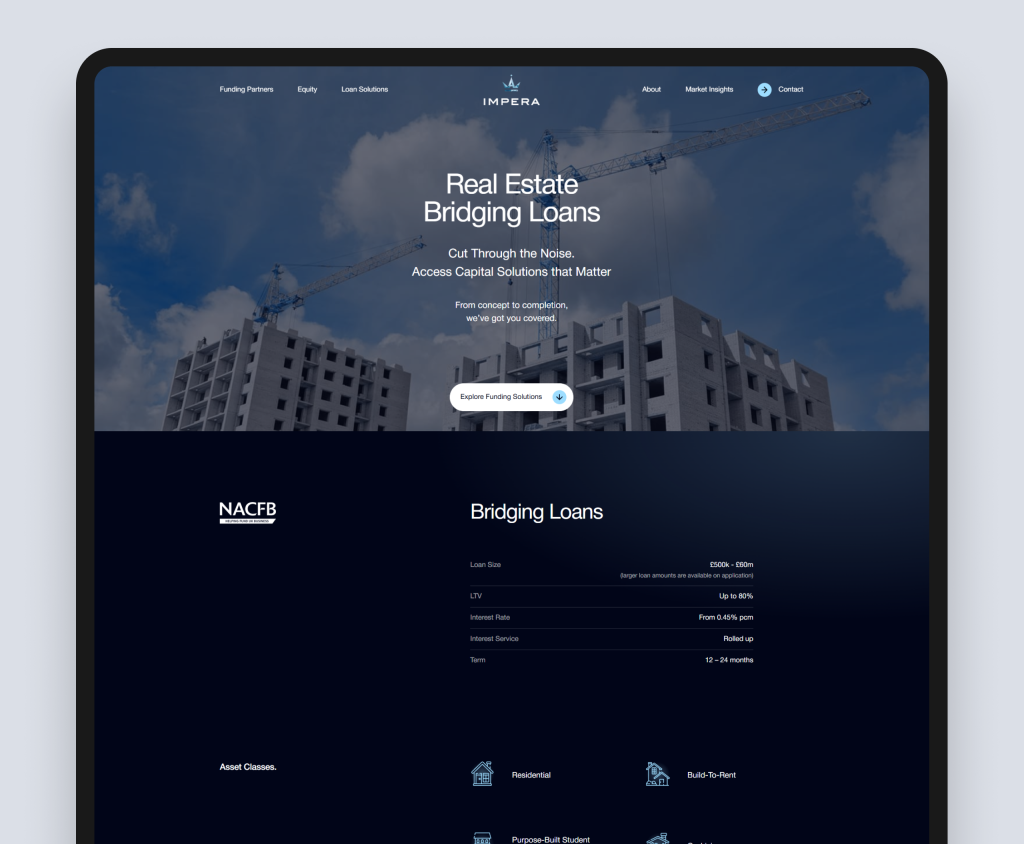
Impera Finance is a London-based real estate finance advisory that has arranged and executed more than £500 million in funding across debt and equity transactions. They operate across a wide range of property finance products — senior debt, mezzanine, equity, and stretched senior — for developers and investors across the UK residential and commercial markets.
The challenge
Impera's market positioning was strong: deep lender relationships, a proven track record at scale, and a team with significant transactional experience. Their previous website communicated none of this. The design did not reflect the institutional quality of the operation. The track record was not surfaced as a commercial asset. There was no infrastructure for digital marketing campaigns or for tracking and attributing the leads that campaigns would generate.
The business needed a website that could do three things simultaneously: communicate the firm's credibility to sophisticated developers and investors evaluating advisory relationships, generate qualified enquiries through LinkedIn campaign activity, and provide the marketing and commercial team with the attribution data needed to understand what was working.
The solution
Rudo began with a discovery phase that included stakeholder interviews to understand Impera's client types, deal flow, and the specific credibility signals their market looks for when evaluating a capital advisory. The information architecture was structured around the firm's track record as the primary commercial asset: the £500m+ figure positioned prominently as an above-fold credibility anchor, supported by deal type references, lender network depth, and team credentials.
The design system communicated institutional authority: a restrained palette, precise typography, high-quality photography of the team, and a visual language calibrated to the expectations of professional property developers and institutional investors. The system was built to feel like the website of a firm that operates at the level it claims to operate at.
A custom WordPress theme was built for technical performance and SEO readiness. A suite of campaign landing pages was designed and built alongside the main site — each targeting a specific developer profile or deal type and optimised for that audience's conversion path. HubSpot CRM was integrated natively, with form routing by enquiry type and full campaign attribution so the commercial team could track every lead from first digital touchpoint to completed mandate.
The results
Within three months of launch, Impera Finance saw a 35% increase in visitor engagement, a 25% boost in page views per session, and 20% growth in organic traffic. The campaign landing page infrastructure became an active commercial tool, with LinkedIn campaigns generating qualified developer enquiries at measurable cost per lead. The HubSpot integration gave the commercial team full visibility into the source and behaviour of every inbound enquiry for the first time.
Read the full case study: Impera Finance case study.
8. Content strategy for property finance
Property finance companies that invest consistently in high-quality content build two commercial assets simultaneously: organic search visibility that drives qualified borrower traffic, and on-site content that converts that traffic by demonstrating the expertise and analytical capability behind the firm.
Product guides and scenario explainers
Borrowers researching property finance often begin with product and scenario queries: how does bridging finance work, what is the difference between senior debt and mezzanine, what LTV is available for development finance on a residential scheme. Well-structured guides that answer these questions clearly rank organically for high-intent queries and serve as the first demonstration of the firm's expertise to a borrower who is at the beginning of their evaluation process.
These guides are particularly valuable for property finance companies because they do double duty: they attract organic traffic from borrowers who are actively researching, and they pre-educate those borrowers before the first conversation — reducing the time the commercial team spends on basic product education and increasing the quality of initial conversations.
Market commentary and rate updates
The property finance market moves. Base rate changes, lender appetite shifts, regulatory updates, and changing LTV parameters across different product categories are all commercially relevant to the borrowers a property finance company serves. Regular market commentary — positioning the firm's team as analysts of the market they operate in rather than just participants in it — builds credibility and drives return visits from borrowers who find the commentary useful.
Deal case studies
Specific deal case studies — the borrower profile, the challenge, the structure, the lender, the timescale, the outcome — are among the most commercially powerful content assets available to a property finance company. They demonstrate that the claimed capability is real, that the lender relationships are genuine, and that the team can execute on complex requirements. Where regulatory and client confidentiality requirements allow publication, they should be published. Where they do not, deal data can still be presented at sufficient specificity to communicate real capability without identifying the borrower.
SEO for property finance
Property finance keywords are typically low volume but very high commercial intent. A borrower searching for development finance broker for residential scheme in London is extremely close to needing to speak to someone. Ranking for these specific, scenario-based queries requires content that matches the query with genuine depth — not thin service pages that mention the keyword but do not answer the borrower's actual question.
For a broader content strategy framework, read our guide to WordPress for content-heavy B2B websites.
Ready to build a property finance website?
Rudo designs and builds property finance websites for capital advisories, bridging lenders, development finance brokers, and buy-to-let specialists. We understand the credibility requirements of the property finance market, the compliance context, and the campaign infrastructure needed to generate qualified leads at scale. Book an intro call to discuss your borrower audiences and what your website needs to do.
9. Frequently asked questions
What should a property finance company website include?
A property finance website should prominently feature: a specific deal track record with real volume figures rather than generic claims; named lender relationships or panel depth indicators; team profiles with individual experience and credentials; clear regulatory information (FCA authorisation number and permissions, NACFB or FIBA membership where applicable); product-specific service pages that explain what the firm does and for whom; scenario-based content that captures borrowers at the research stage; campaign landing page infrastructure for digital marketing activity; and CRM integration that tracks every enquiry from first touchpoint to completed deal.
How is a property finance website different from a general financial services website?
Property finance borrowers are typically experienced property professionals — developers, investors, or asset managers — who are evaluating firms on very specific criteria: deal track record at the relevant scale, lender relationships, and execution capability. The design register needs to be institutional enough to credibly serve this audience. Generic financial services design — retail banking aesthetics, consumer-facing simplicity — does not work. The content needs to be specific enough to demonstrate genuine product knowledge: LTV parameters, deal timescales, lender panel specifics, and structural options.
Does a property finance website need FCA compliance review?
For FCA-authorised firms, any website content that constitutes a financial promotion must be approved by an FCA-authorised person in accordance with COBS 4. This applies to content describing regulated credit products and investment products. The definition of what constitutes a financial promotion is broader than many firms initially assume. Compliance review should be built into the content production workflow from the start of the project, not treated as a post-launch consideration. A good property finance web design agency will flag this requirement and build the compliance review step into the project timeline.
What platform is best for a property finance company website?
HubSpot CMS for firms running active LinkedIn and Google campaigns who need native pipeline integration and campaign landing page flexibility. WordPress for firms with complex content operations, bespoke CRM integration requirements, or specific compliance workflow needs. Webflow for design-led firms with moderate campaign and content requirements. The decision should be led by the firm's marketing team's operational requirements and the CRM already in place, not by the website build cost alone.
How important is LinkedIn for property finance lead generation?
Very important for most property finance companies. LinkedIn's professional targeting allows precise audience definition by job title (property developer, asset manager, property investor), company size, and geography. Combined with a website that has been built to convert that traffic — dedicated campaign landing pages, CRM-integrated enquiry forms, and product-specific conversion paths — LinkedIn can generate a consistent flow of qualified borrower enquiries at a measurable cost per lead. The website and the LinkedIn campaign need to be designed together, not separately.
How much does a property finance company website cost?
A standard property finance website build typically costs 12,000 to 25,000. Projects involving more complex campaign landing page infrastructure, HubSpot CMS configuration with smart content and workflow automation, or large content operations typically cost 25,000 to 40,000. The investment is justified by the commercial value of the lead generation infrastructure: a property finance firm that generates one additional qualified developer enquiry per month from digital channels, at typical deal sizes, is generating significant additional pipeline from the website investment.
Find out more about our property web design service.
Also in this series: property investment website design, PropTech website design, property website design examples, property developer website design, and how to choose a property web design agency.
Back to the complete guide to web design for property companies.
