Overview
Designing a recruitment website that works commercially requires making a series of specific decisions that most recruitment agencies get wrong: how to serve a client and a candidate audience from a single homepage without diluting the message for either; how to communicate genuine sector expertise rather than just claiming it; and how to convert the different types of visitors that a recruitment agency attracts — from job seekers browsing listings to hiring managers evaluating a new agency partner.
This guide covers each of those decisions practically, with specific recommendations rather than generic principles.
In this article:
- The dual-audience problem — and how to solve it
- Homepage design for recruitment agencies
- Sector pages that communicate genuine expertise
- Consultant profile pages
- Designing the candidate journey
- Client conversion design
- Technical design considerations
- Frequently asked questions
This article is part of the complete guide to recruitment agency website design.
Find out more about our recruitment web design service.
1. The dual-audience problem — and how to solve it
The fundamental design challenge of a recruitment website is that it needs to serve two audiences with different needs, different decision criteria, and different information requirements from the same digital presence. Handle it poorly and you create a site that feels generic to both. Handle it well and both audiences feel the site was built for them.
What not to do
The most common mistake is a homepage hero that either addresses one audience and ignores the other, or tries to address both with language so generic it resonates with neither. 'We connect great people with great companies' sounds balanced but tells neither the hiring manager nor the job seeker anything specific about whether this agency can help them.
What works
A homepage hero that makes the agency's specialist positioning immediately clear — what sectors, what levels, what geography — followed by an explicit audience split: two clear entry points, one for clients and one for candidates, positioned above the fold. The language in each entry point uses the vocabulary of that audience: 'find talent in [sector]' for clients, 'find your next [sector] role' for candidates. Both feel addressed without forcing a compromise that weakens both messages.
Below the hero, the homepage should alternate between sections that speak primarily to clients (placement track record, client testimonials, sector depth) and sections that speak primarily to candidates (featured roles, career development content, consultant profiles). Neither audience has to scroll past irrelevant content to find what matters to them.
| The dual-audience test |
| Show your homepage to a hiring manager and a job seeker separately. Ask each: within ten seconds, did you feel this site was relevant to you? If the hiring manager says yes but the job seeker says no, the homepage is client-only in practice. If both say no, the generic messaging is failing both audiences. The goal is both saying yes within the first scroll. |
2. Homepage design for recruitment agencies
The hero section
- Specialist positioning in the headline. 'Technology recruitment specialists' or 'Part-time and flexible recruitment for progressive businesses' tells both audiences immediately whether they are in the right place. Generic positioning loses both.
- Two explicit CTAs above the fold. One for clients (find talent / discuss a vacancy) and one for candidates (find roles / register). Make the primary one the higher commercial priority for your agency, but make both visible.
- A specific credibility signal. Years in operation, number of placements, named client sectors, or a specific outcome. One concrete signal is worth more than a list of adjectives.
Social proof positioning
Client testimonials belong near the top of the homepage — before the candidate sections, in most cases, because they serve both audiences simultaneously. A hiring manager is reassured by seeing that other businesses have used this agency successfully. A quality candidate is reassured by seeing that this agency works with the kinds of companies they want to join. A single named testimonial from a recognisable client, placed directly below the hero, does significant commercial work.
Featured roles
A featured roles section on the homepage serves candidates and signals to clients that the agency has an active pipeline. Three to six current, real roles with salary, sector, and location visible communicate that the agency has live mandates without requiring the visitor to navigate to the full job listings. Do not include placeholder or closed roles — a featured roles section with outdated listings communicates the opposite of what it is meant to.
3. Sector pages that communicate genuine expertise
The sector page is where most recruitment agency websites fall shortest. The typical sector page is three paragraphs of generic sector description, a list of job titles the agency recruits for, and a contact form. This communicates nothing that a visitor did not already know and does nothing to build confidence in the agency's specific expertise.
What a high-performing sector page includes
- A specific market overview. Current hiring conditions in this sector — where demand is high, where candidate supply is constrained, which skills are hardest to find. Written from genuine market knowledge, not from a Wikipedia summary of the sector.
- Placement track record. Specific examples — anonymised where necessary — of the types of roles placed, the levels of seniority, and the organisations they were placed into. 'We have placed over 60 software engineers at UK Series A and Series B technology companies in the past two years' is specific and credible. 'We have extensive experience in technology recruitment' is not.
- Named consultant with verifiable background. The consultant who specialises in this sector, with their specific background — where they have worked, how long they have been recruiting in this market, and the specific types of searches they conduct. A real person with a real background is a differentiator in a market where most sector pages are anonymous.
- Salary benchmarking data or a downloadable guide. Sector-specific salary data converts visiting hiring managers into registered contacts. It is genuinely useful, it demonstrates market knowledge, and it creates an opportunity to capture an email address against a high-value content asset.
- Featured current roles in this sector. Three to five live vacancies relevant to candidates visiting this sector page, with a clear path to the full job listings filtered by this sector.
4. Consultant profile pages
Consultant profile pages are among the most commercially powerful pages on a recruitment website and among the most frequently underinvested. In recruitment, the relationship with the consultant is often the primary reason a client returns or a candidate registers. A consultant profile page that communicates who that person is — their background, their sector knowledge, their approach — enables clients and candidates to self-select before they have spoken to anyone.
What a consultant profile should include
- Specific career history. Where they have worked, in what roles, for how long. A consultant who previously worked as a finance director before moving into finance recruitment brings something genuinely different to their work. Make that visible.
- Sector specialism stated clearly. The specific types of roles and organisations they recruit for. 'I specialise in placing mid-to-senior marketing professionals at B2B technology companies across the UK' is a specific statement that allows a hiring manager to evaluate relevance immediately.
- Personal approach and values. What do they believe about recruitment? How do they work with clients and candidates? A consultant who can articulate a genuine perspective on their work is more credible and more memorable than one who cannot.
- Current featured vacancies. Roles this consultant is actively working on, visible directly from their profile page. This reinforces that they have live mandates and gives candidates a direct path to relevant opportunities.
- Direct contact details. Not a generic contact form — their email address and LinkedIn profile. In recruitment, making it easy to contact a specific person converts significantly better than routing enquiries through a general form.
5. Designing the candidate journey
Job search and filtering
The job search interface is the most technically important element of the candidate journey. It should allow filtering by sector, location, salary range, job type (permanent, contract, part-time, flexible), and seniority level. Results should be sortable by date posted and relevance. Each listing should be clearly dated — candidates know when agencies are recycling old vacancies and it damages trust immediately.
Application design
The application mechanism should be as frictionless as possible. CV upload plus contact details is sufficient for a first application. Requiring candidates to create a full account, complete an extensive profile, or answer screening questions before submitting a CV loses high-quality candidates who have options and are evaluating multiple agencies simultaneously. The principle: capture enough information to have a useful first conversation, and gather the rest in that conversation.
Candidate registration for agencies without a specific vacancy
For candidates who want to register their interest rather than apply for a specific role, the registration journey should explain clearly what happens next — how quickly they can expect to hear from a consultant, what the initial conversation will involve, and how the agency's process works. Uncertainty about what happens after registration is a significant reason quality candidates do not complete it.
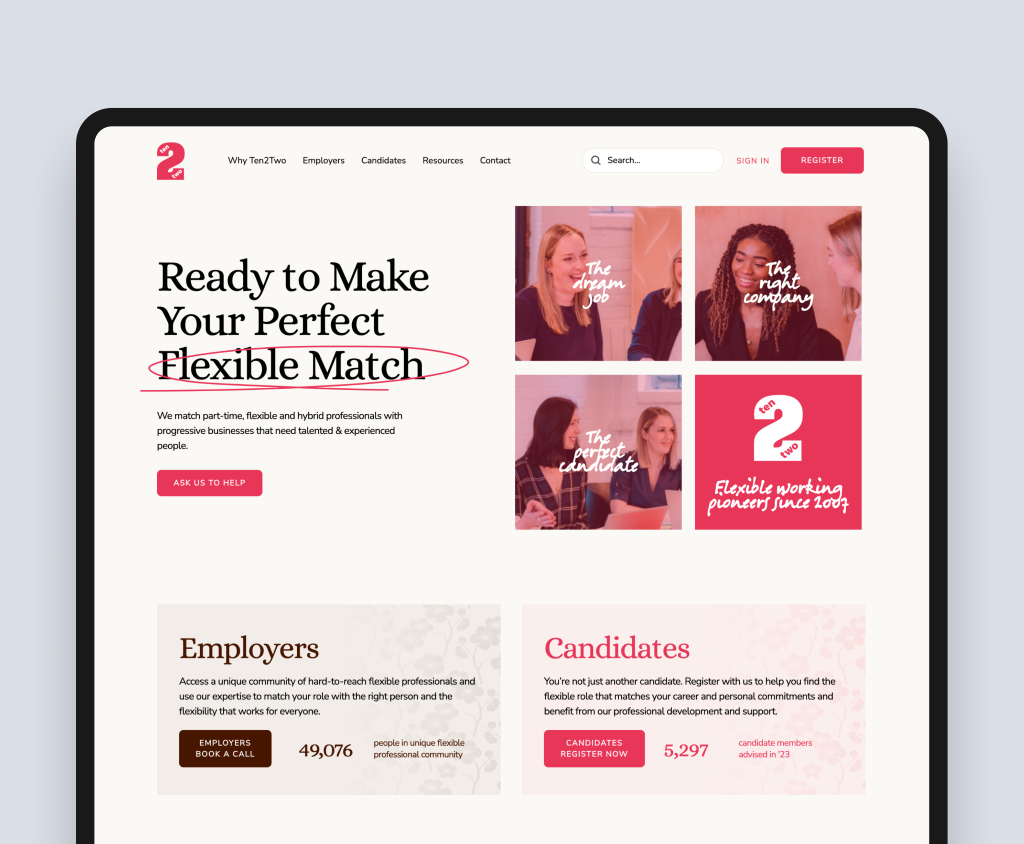
| Case study: Ten2Two (Flexible and part-time recruitment specialist, HubSpot CMS) |
| Ten2Two's specialist proposition — matching part-time and flexible professionals with progressive employers — created a specific candidate journey design challenge: candidates needed to understand immediately that Ten2Two was different from a standard recruitment agency and that their flexible working preference was a feature, not a complication. The HubSpot CMS site Rudo built structured the candidate journey around this differentiation from the first touchpoint, with clear pathways for candidates seeking part-time, job-share, hybrid, and flexible roles and messaging that treated flexible working as a career asset rather than a compromise. The result was a candidate experience that resonated specifically with the high-quality, experienced professionals Ten2Two places. Full case study: rudo.co.uk/case-studies/ten2two/ |
6. Client conversion design
The enquiry form
A recruitment agency client enquiry form should ask for enough information to qualify the enquiry without creating enough friction to deter it. Sector, level of hire (senior, mid, junior), indicative timeline, and a brief description of the requirement is typically the right balance. Avoid asking for budget at this stage — many hiring managers do not know their budget or are reluctant to disclose it before a relationship has been established.
Evidence at the conversion point
Social proof placed directly adjacent to the client enquiry form — a named testimonial from a client in a recognisable company, or a specific placement outcome — converts at a meaningfully higher rate than the same form without it. The hiring manager who is about to submit an enquiry is at the highest-hesitation moment of the client journey. Specific evidence of outcomes for comparable clients provides the reassurance that converts hesitation into action.
Gated content for lead capture
Salary benchmarking guides, hiring trend reports, and market analyses gated behind a light email registration form are among the most effective client lead generation mechanisms available to a specialist recruitment agency. The visitor who downloads a salary benchmarking guide for the sector they are hiring in has self-identified as an active hiring manager. The download event should trigger an automated CRM workflow that flags this contact for consultant follow-up within 24 hours.
7. Technical design considerations
GDPR and candidate data
Recruitment agencies collect significant volumes of personal data from candidates — CVs, employment history, salary information, contact details. The website's data collection mechanisms, storage practices, and candidate consent workflows must comply with GDPR. Privacy notices must be clear and specific. Candidate data must be stored securely and deleted in accordance with the agency's retention policy. A candidate who registers on a website and subsequently receives unsolicited marketing communications from the agency will not return.
Mobile performance
A significant proportion of candidate traffic to recruitment websites arrives on mobile devices — particularly traffic from job listing aggregators and LinkedIn. A recruitment website that loads slowly or displays poorly on mobile loses a disproportionate share of its highest-intent candidate traffic. Core Web Vitals, Google's performance framework, affects both search rankings and user experience on mobile.
ATS and CRM integration
Candidate applications and registrations submitted through the website should flow directly into the agency's ATS (Applicant Tracking System) or CRM — Bullhorn, Firefish, Vincere, JobAdder — without requiring manual re-entry. A disconnected system creates both a data quality problem and a response time problem: candidates who apply through a website that is not integrated with the agency's CRM often wait significantly longer for a first response than those who apply through the platform directly.
Ready to build a recruitment website that works for both clients and candidates?
Rudo designs and builds recruitment agency websites that communicate genuine sector expertise, serve both client and candidate audiences effectively, and generate qualified new business enquiries. Book an intro call to discuss your agency and your markets.
8. Frequently asked questions
How should a recruitment agency website be structured?
A recruitment website should have: a unified homepage that addresses both client and candidate audiences with explicit entry points for each; sector pages that demonstrate specific market expertise; named consultant profiles with verifiable backgrounds; a job listings section with functional search and filtering; a client-facing section with evidence of placements, client testimonials, and a frictionless enquiry mechanism; and a candidate-facing section with career guidance content and a frictionless registration and application mechanism.
How long does a recruitment website take to build?
A standard recruitment agency website build typically takes 10 to 14 weeks. Projects involving complex CRM or ATS integration, sophisticated job search infrastructure, or multiple audience segments take 14 to 18 weeks. The most variable factor is the copywriting — particularly the sector pages and consultant profiles, which require genuine sector knowledge and are often the most time-consuming content to produce.
Should a recruitment website show salary information on job listings?
Yes, wherever possible. Salary transparency on job listings increases application rates, improves the quality of applications, and reduces the time consultants spend on early-stage screening conversations. Candidates who apply without knowing the salary often disengage quickly when they learn it. Many candidates will simply skip listings without salary information entirely. The recruitment agencies most reluctant to publish salaries are often working to hide rates that are below market — which is not a credibility-building strategy.
What is the most important page on a recruitment website?
For most recruitment agencies, the sector pages collectively drive more commercial value than any other section of the site. They attract the highest-intent organic traffic (hiring managers searching for specialist recruiters in their sector), communicate the agency's specific expertise most directly, and convert visiting clients into enquiries. Investing in genuinely expert sector pages — with real market knowledge, specific placement evidence, and named consultants — delivers more commercial return than any equivalent investment in homepage design.
Find out more about our recruitment web design service.
Also in this series: how to design a recruitment website, executive search website design, recruitment website examples, recruitment website cost.
Back to the complete guide to recruitment agency website design.

Written by
Rudo Agency
Rudo is a strategy-led web design and development agency specialising in B2B. Based in the UK and working with clients globally, we help ambitious brands turn complex ideas into high-performing websites. Our team combines digital strategy, UX/UI design, custom development, and SEO to deliver results-focused websites that support real business growth.
