Overview
Understanding what makes a B2B healthcare website work commercially is easiest through real examples — the specific challenge a company faced, the design and strategic decisions made in response, and the outcomes those decisions produced. A portfolio screenshot shows you what a site looks like; understanding the reasoning behind the decisions tells you what to think about for your own project.
This guide draws on Rudo's B2B healthcare portfolio, using the Psomagen multiomics project as the primary case study and extracting the principles that apply across the broader B2B healthcare and life sciences sector.
In this article:
- What makes a high-performing B2B healthcare website
- Psomagen: multiomics contract research services
- Lessons and principles from the Psomagen build
- Applying these lessons to your healthcare website
This article is part of the complete guide to healthcare website design.
Find out more about our healthcare web design service.
1. What makes a high-performing B2B healthcare website
The criteria that matter in B2B healthcare website design are more specific than in most other B2B sectors — because the audiences are more specialised, the evaluation standards are higher, and the commercial consequences of failing to communicate credibility are more immediate.
- Multi-audience content architecture. Scientific, clinical, procurement, and commercial audiences have different information needs, different vocabularies, and different decision criteria. A high-performing healthcare website serves all of them without forcing any to navigate through content designed for someone else.
- Technical depth without technical exclusivity. Scientific and clinical buyers need genuine technical depth. Commercial and procurement buyers need accessible summaries. Layered content architecture — accessible at the page level, deep on demand — serves both without compromising either.
- Specific, verifiable credentials. Quality certifications, regulatory approvals, and compliance credentials presented with downloadable documentation. Credentials that cannot be verified quickly are less persuasive than credentials that can be accessed in a single click.
- Case references and client validation. Scientific audiences, clinical buyers, and procurement teams all look for evidence that the company has delivered for clients in comparable contexts. Case studies should be as specific as possible: institution type, research area or clinical setting, challenge, approach, and measurable outcome.
- CMS independence for the content team. B2B healthcare content requires regular updates — new application notes, publication references, pipeline milestones, regulatory changes. A website that creates developer dependency for content updates is a liability in a sector where scientific and commercial information moves quickly.
2. Psomagen: multiomics contract research services
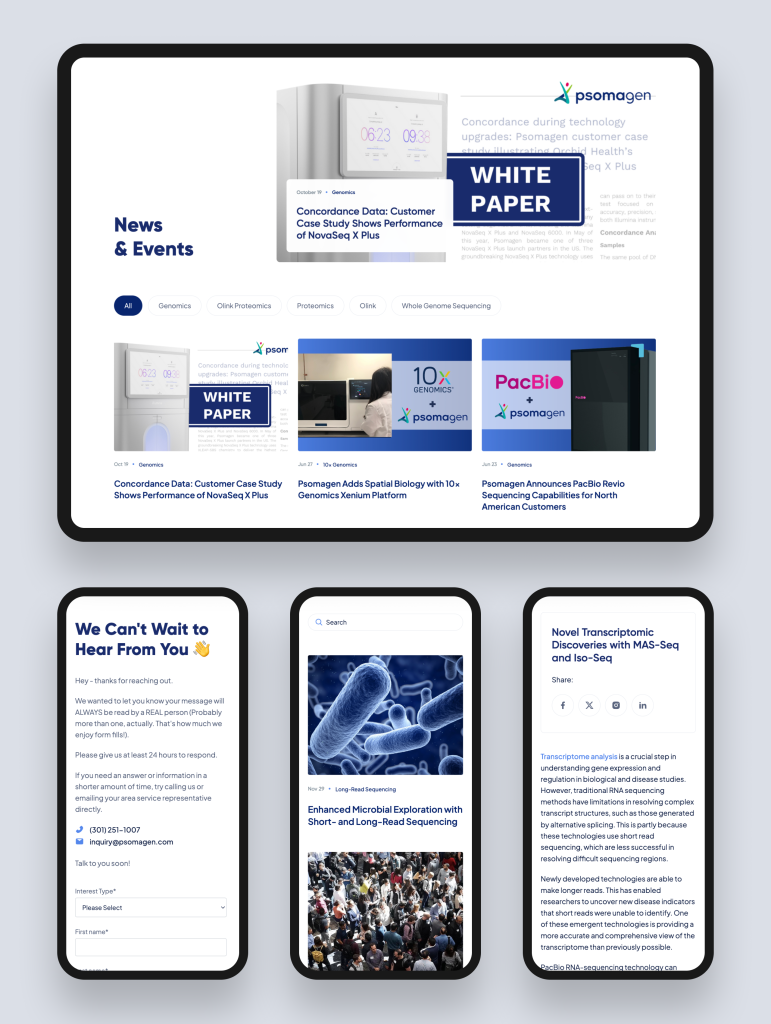
The client and their challenge
Psomagen is a leading contract research services provider in the field of multiomics — delivering precision-driven genomics, transcriptomics, proteomics, and metabolomics research services to scientists and clinicians globally. Their service portfolio spans next-generation sequencing, microbiome analysis, single-cell sequencing, spatial transcriptomics, and integrated multiomics approaches — a technically diverse range of services serving two distinct professional audiences with very different information requirements.
Research scientists specifying outsourced analytical services need detailed methodology information, platform specifications, quality control parameters, turnaround time data, and sample type compatibility. Clinicians and clinical researchers seeking applied diagnostic or translational research services need information presented at a different level of abstraction — the clinical applications of the technology, the turnaround time for clinically relevant results, and the regulatory status of the service in their clinical context.
The existing Psomagen website failed to serve either audience effectively. The service portfolio was not organised in a way that allowed either scientists or clinicians to navigate efficiently to the services relevant to their specific needs. The copy did not distinguish between the information priorities of each audience. The result was a site that generated generic traffic but failed to convert the highly qualified professional visitors it was attracting.
The strategic decisions
The project began with a strategic sitemap — the most important deliverable for a company with a complex, multi-audience service architecture. The sitemap established how Psomagen's diverse service portfolio would be organised for intuitive navigation by both scientists and clinicians, how the audience distinction would be surfaced in the navigation structure, and how the depth of technical content would be layered to serve both audiences from the same page architecture.
The content strategy produced targeted copy for each major page — calibrated specifically to the information priorities and vocabulary of each audience type. Pages serving scientists led with the methodological depth and technical specification they need to evaluate a service. Pages serving clinicians led with the clinical application and outcome relevance before providing the methodological context.
The platform decision
HubSpot CMS was chosen for two reasons. First, the content management capability it provides the Psomagen team — the ability to add new application notes, update service pages, and publish market-facing content without requiring developer involvement. Second, the marketing automation infrastructure it enables — allowing Psomagen to build audience-specific content campaigns and track engagement by visitor type in a CRM that connects website activity to business development conversations.
The design approach
The wireframing phase established clear user flows for each audience type before any visual design began. This ensured that the information architecture was validated against the needs of both scientific and clinical visitors before the visual layer was added. The UI design created a clean, visually appealing interface appropriate for a precision science company — professional without being inaccessible, technically credible without being visually cold.
The outcome
The rebuilt website exceeded client expectations. Scientists and clinicians could navigate efficiently to the services most relevant to their specific research or clinical needs. The clear and targeted copy created a personalised connection to the content for each professional audience type. The HubSpot CMS gave the Psomagen team the content management independence to keep the site current with their expanding service portfolio. Positive feedback from both scientists and clinicians confirmed that the site successfully communicated Psomagen's precision-driven approach to both professional audiences it serves.
Read the full case study: Psomagen case study.
3. Lessons and principles from the Psomagen build
Start with the sitemap, not the design
For any B2B healthcare company with a complex service or product portfolio serving multiple professional audiences, the sitemap is the most commercially important deliverable of the entire project. Getting the navigation structure and content organisation right before design begins prevents the most expensive mistakes in complex healthcare website projects — reworking a well-designed site that is poorly structured costs significantly more than getting the structure right from the start.
Write for each audience explicitly
Generic copy that attempts to serve all audiences simultaneously typically serves none of them effectively. The decision to produce targeted copy for each audience — scientists and clinicians in the Psomagen case — is a commercial investment that pays back in conversion rate rather than simply in professional quality. A scientist who finds technical depth at the right level in the first paragraph of a service page is more likely to proceed to an enquiry than one who finds generic positioning that tells them nothing they could not have learned from a competitor's site.
Choose the platform for the team, not for the build
The HubSpot CMS decision for Psomagen was driven by what the Psomagen team needed to do after launch — not by what was easiest or cheapest to build. A platform choice driven by the team's operational requirements rather than the agency's development preferences produces a website that continues to serve its commercial purpose after the initial build, rather than becoming a static liability.
Validate structure before investing in design
The wireframing phase at Psomagen established the user flows for each audience type before high-fidelity design began. This validation step ensures that the visual design investment is made against a structure that has been tested against the actual information needs of the target audiences — rather than against a structure that looks plausible but fails under the pressure of real visitor behaviour.
4. Applying these lessons to your healthcare website
The principles that made the Psomagen website effective are not specific to multiomics or contract research. They apply to any B2B healthcare company — a health technology business serving clinical and IT audiences, a biotech company serving investor and scientific partner audiences, a medical device company serving clinical and procurement audiences — that needs to communicate technical authority to sophisticated professional buyers while remaining commercially accessible to the non-specialist stakeholders in the same purchase decision.
For guidance specific to your healthcare sub-sector, read our dedicated guides to: life sciences website design, healthcare technology website design, biotech website design.
Ready to build a B2B healthcare website that serves scientific and clinical buyers effectively?
Rudo designs and builds websites for B2B healthcare and life sciences companies. We understand the multi-audience challenge, the technical communication requirements, and the credibility standards specific to the sector. Book an intro call to discuss your company and your commercial objectives.
Find out more about our healthcare web design service.
Also in this series: healthcare website design examples, how to choose healthcare website design agency.

Written by
Rudo Agency
Rudo is a strategy-led web design and development agency specialising in B2B. Based in the UK and working with clients globally, we help ambitious brands turn complex ideas into high-performing websites. Our team combines digital strategy, UX/UI design, custom development, and SEO to deliver results-focused websites that support real business growth.
