Overview
Life sciences companies — contract research organisations, genomics services providers, bioanalytical laboratories, multiomics platforms, and specialist analytical services businesses — serve some of the most technically sophisticated buyers in any commercial market. Research scientists conducting supplier evaluation are trained to assess evidence critically. They will detect unsupported claims, identify gaps in methodology disclosure, and dismiss a provider that cannot demonstrate genuine technical depth in the areas they are specifying.
A life sciences website that meets this standard consistently — specific methodology information, validated performance data, real case references, and downloadable technical documentation — converts these highly qualified buyers at a significantly higher rate than one relying on generic capability claims. This guide covers how to build that standard into the design and content of a life sciences website.
In this article:
- What makes life sciences website design different
- The life sciences buyer: who they are and what they need
- Presenting a complex service portfolio clearly
- Technical content that converts scientific buyers
- Quality and regulatory credentials architecture
- Case study: Psomagen
- Platform choice for life sciences companies
- Frequently asked questions
This article is part of the complete guide to healthcare website design.
Find out more about our healthcare web design service.
1. What makes life sciences website design different
The evaluation standard is peer-review
Scientific buyers in the life sciences evaluate commercial websites using the same critical framework they apply to published research. They look for: is the claim specific and falsifiable, or generic and unverifiable? Is performance data presented with appropriate methodology context, or stated without supporting evidence? Are quality and compliance credentials actual and verifiable, or simply asserted? A website that cannot meet this standard will be identified and dismissed by a trained scientist faster than by almost any other class of professional buyer.
The portfolio is complex and the terminology is specialised
Most life sciences companies have service or product portfolios of significant complexity — multiple analytical platforms, multiple application areas, multiple industry verticals served. Presenting this complexity in a way that allows a scientist to rapidly identify the services relevant to their specific project, without forcing them to navigate through irrelevant content, is a significant information architecture challenge.
Multiple audiences with very different evaluation criteria
A CRO or research services company is evaluated by scientists assessing technical capability and by procurement or business leads assessing commercial and compliance factors. These audiences have different vocabularies, different priorities, and different reading behaviours. A website that serves both with appropriate content at the right depth — without forcing the scientist to wade through commercial summaries or the procurement lead to navigate through methodology detail — requires deliberate and careful content architecture.
2. The life sciences buyer: who they are and what they need
The principal investigator or senior scientist
Specifying outsourced research services for a specific project. Needs: the specific analytical methods available, platform specifications (instrument models, throughput parameters, read depths for sequencing services), quality control standards, bioinformatics capabilities where applicable, turnaround times, sample type compatibility, and pricing structure. Will evaluate competitor providers on the same criteria. The website must provide this information at sufficient technical depth to support a genuine evaluation — not surface-level descriptions that force a call before any meaningful comparison is possible.
The laboratory manager or project scientist
Coordinating a research project and evaluating service providers on operational criteria. Needs: sample submission requirements, sample tracking and reporting processes, data delivery formats and timelines, project management communication standards, and the experience of working with comparable sample types or project scales. Case references describing comparable projects in similar research contexts are particularly persuasive for this buyer.
The procurement or contracts lead
Evaluating the supplier from a commercial and compliance perspective alongside the scientific evaluation. Needs: ISO certifications and quality management credentials, regulatory compliance documentation relevant to the research context (GLP, GMP, GCP where applicable), financial stability signals, indemnity and liability terms, and the experience of working with comparable institutions. This audience needs the commercial and compliance information to be findable without having to navigate through technical scientific content.
3. Presenting a complex service portfolio clearly
Structure by application and research area, not just by technology
Most life sciences companies organise their service catalogue by technology or platform — which is how they think about their capabilities internally. Their buyers often approach the market from a different direction: they have a research question or a sample type, and they need to find the service that can answer it. A navigation structure that offers both entry points — by technology for buyers who know what they need, and by research application or disease area for buyers who are starting from a question — serves both buyer types without forcing either to work against their natural search behaviour.
Service pages with genuine technical depth
Each service page should include: a clear description of what the service delivers and what research questions it addresses; the specific platforms and methods used; throughput and turnaround time parameters; quality control standards and accreditations relevant to this service; sample type compatibility; data delivery formats; and a pathway to technical consultation or project enquiry. A service page that provides this information allows a scientist to make a meaningful initial evaluation of fit without requiring a preliminary call.
Technical documentation accessible without friction
Application notes, sample submission guides, data format specifications, and quality certificates should be accessible from relevant service pages without requiring registration or a contact form submission. Placing technical documentation behind a gate that requires personal information before access creates friction for exactly the buyers most likely to convert — scientists who are deep in a specific evaluation and need detailed information to proceed. This documentation can be gated selectively for higher-value assets like white papers or methodology guides while keeping standard technical documents freely accessible.
| Case study: Psomagen (Multiomics contract research services, HubSpot CMS) |
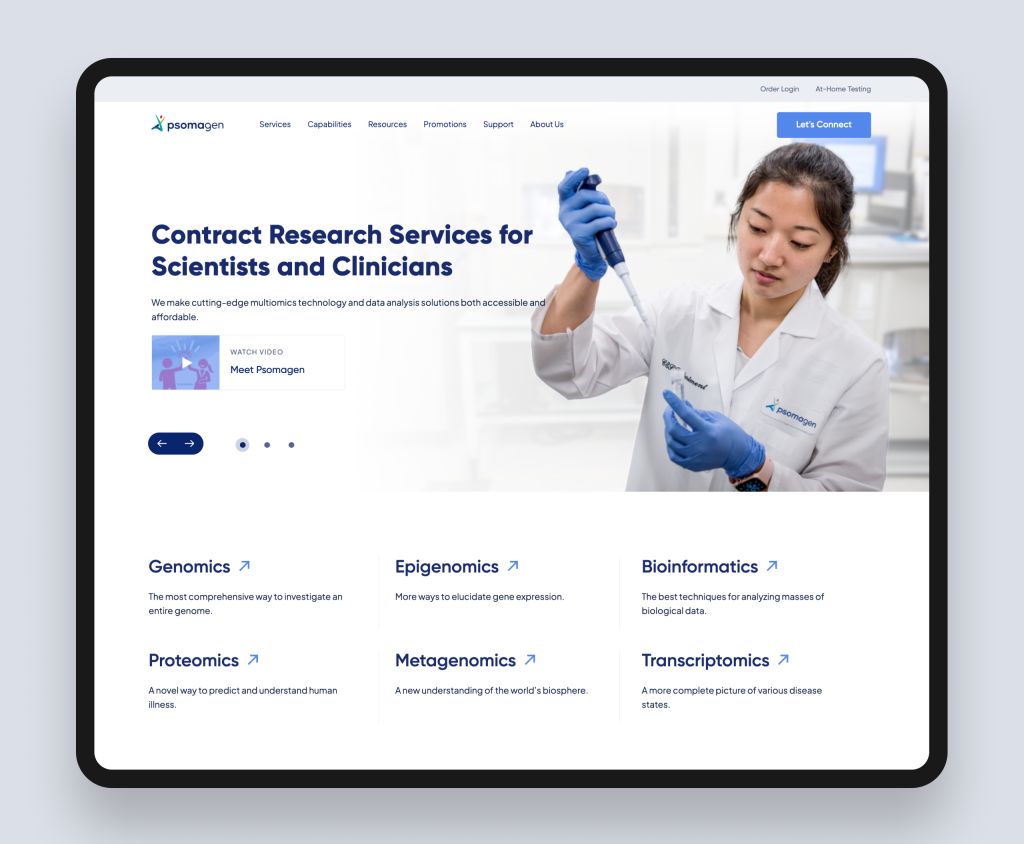
| Psomagen is a leading contract research services provider in the field of multiomics, delivering precision-driven research solutions for scientists and clinicians globally. Their existing website failed to communicate the breadth of their service portfolio clearly to two highly distinct professional audiences — research scientists specifying analytical services, and clinicians seeking applied diagnostic solutions. Rudo led a full website redesign and rebuild on HubSpot CMS, producing a strategic sitemap that organised the service architecture for intuitive navigation by both audiences, targeted copy for each major page, wireframes establishing clear user flows, and a clean UI design that served each audience without technical jargon overload. HubSpot CMS empowered the Psomagen team with straightforward content management and opened the pathway to leveraging HubSpot's marketing capabilities for audience-specific campaigns. The result was a website that exceeded client expectations and received positive feedback from both scientists and clinicians. Full case study: rudo.co.uk/case-studies/psomagen/ |
4. Technical content that converts scientific buyers
Application notes
Application notes — detailed descriptions of how a specific method has been applied to a particular research problem, with methodology detail, results, and discussion — are the highest-value content format for most life sciences websites. They demonstrate technical capability in a specific research context, provide the kind of specific evidence scientists look for when evaluating a service provider, and rank organically for the specific method, application, and sample type queries that researchers use when identifying potential providers.
Publication references
Peer-reviewed publications citing the company's services or products are the most powerful credibility signal available to a life sciences company. A publications database listing papers that have used the CRO's sequencing services, the reagent supplier's products, or the diagnostic company's platforms — with searchable filters by year, research area, institution, and journal — communicates scientific validation that no marketing content can replicate. If a company's services have contributed to published research, this should be a prominent feature of the website, not a footnote.
Validated performance data
Performance metrics — sensitivity, specificity, reproducibility, throughput, turnaround time, data quality parameters — should be presented with the methodology context needed to interpret them: the sample types tested, the experimental conditions, the comparison methods used, and where applicable the publication or internal validation report that supports the data. Numbers without context are less persuasive to a scientific audience than numbers with full transparency about how they were obtained.
5. Quality and regulatory credentials architecture
Quality and regulatory credentials in the life sciences are not simply reassuring — they are frequently mandatory prerequisites for supplier qualification. A pharmaceutical company outsourcing analytical services cannot work with a CRO that is not GMP or GLP accredited for the relevant activity type. A hospital trust procuring diagnostic services cannot use a laboratory that does not hold the appropriate UKAS accreditation. The absence of visible, verifiable credentials is not merely an oversight — it is a disqualifying factor.
Where credentials should appear
Homepage, about page, relevant service pages, and any page where a procurement audience might land from a search or a direct link. Each credential should include: the specific standard or accreditation, the accrediting or issuing body, the scope of the accreditation (what activities or services it covers), the current certificate date, and a downloadable certificate where the accrediting body permits. A prospect who can download the actual certificate has one fewer reason to request it by email or phone.
Making credentials searchable and navigable
For companies with multiple accreditations across multiple service areas or laboratory sites, a structured credentials page or a filterable accreditation database allows procurement leads to find the specific credentials relevant to their evaluation quickly. A long, unstructured list of certificates is less useful than a structured presentation that makes the scope and applicability of each accreditation clear.
6. Case study: Psomagen
Psomagen is a leading contract research services provider in the field of multiomics, delivering precision-driven genomics, transcriptomics, proteomics, and metabolomics services to scientists and clinicians globally. Their portfolio spans next-generation sequencing, microbiome analysis, single-cell sequencing, and multiomics integration services — a complex and technically diverse service offering serving two distinct professional audiences with very different information needs.
The challenge
The existing Psomagen website failed to communicate the breadth of their service portfolio clearly to either audience. Scientists could not efficiently navigate to the specific services relevant to their project. Clinicians found the research-focused content difficult to connect to their applied diagnostic interests. The lack of a cohesive structure hindered navigation and limited the website's effectiveness as a tool for generating qualified project enquiries.
The approach
Rudo began with a strategic sitemap designed to organise Psomagen's service content in a way that allowed intuitive navigation by both scientists and clinicians. Collaborating closely with the Psomagen team, updated and targeted copy was produced for each major page — calibrated to communicate technical depth to scientific readers while remaining accessible to clinical audiences approaching from a different professional context. Wireframes established the user flow for each audience type. The UI design created a clean, visually appealing interface that served the different aesthetic expectations of scientific and clinical audiences.
HubSpot CMS was chosen for its versatile content management capability and for the marketing automation pathways it opened — enabling Psomagen to segment their audience and serve audience-specific content and campaigns from the same platform that managed their website.
The outcome
The rebuilt website exceeded client expectations. Improved navigation guided scientists and clinicians to the specific services relevant to their needs efficiently. Clear and targeted copy created a personalised connection to the content for each audience. Positive feedback from both scientists and clinicians confirmed that the site felt designed for their specific professional context.
Read the full case study: Psomagen case study.
7. Platform choice for life sciences companies
- HubSpot CMS: For life sciences companies with active content marketing programmes — application note libraries, webinar campaigns, conference follow-up sequences — who need native CRM integration between scientific content engagement and commercial pipeline management. Particularly strong for CROs and research services companies building inbound lead generation through technical content. Psomagen chose HubSpot CMS for precisely these reasons.
- WordPress: For life sciences companies with complex content architectures — large publication databases, multiple service lines with distinct audience requirements, integration with LIMS or scientific databases, or specific data governance requirements around hosting location and access control.
- Webflow: For biotech or life sciences tool companies where brand distinction is commercially important and the content operation is moderate. Good design fidelity at lower ongoing overhead than HubSpot CMS.
Ready to build a life sciences website that earns the confidence of scientific and clinical buyers?
Rudo designs and builds websites for life sciences companies, CROs, and research services providers. We understand the technical communication requirements, the quality credentials architecture, and the multi-audience challenge specific to the life sciences sector. Book an intro call to discuss your services and your audiences.
8. Frequently asked questions
What should a life sciences company website include?
Service pages with genuine technical depth — specific platforms, methodologies, throughput parameters, and sample type compatibility; freely accessible technical documentation including application notes, sample submission guides, and data format specifications; quality and regulatory credentials with downloadable certificates; a publications database citing work completed using the company's services; validated performance data presented with full methodology context; and audience-specific pathways for scientists, clinicians, and procurement leads.
How should a CRO present its service portfolio online?
Offer two navigation entry points: by technology or service type for buyers who know what they need, and by research application or disease area for buyers starting from a research question. Each service page should provide enough technical detail for a scientist to make a meaningful initial evaluation of fit without requiring a preliminary call. Technical documentation should be freely accessible from service pages rather than gated behind registration forms.
How important are publication references for a CRO website?
Extremely. Peer-reviewed publications citing a CRO's services are the highest possible credibility signal for a scientific audience — they represent external, independent validation of the service quality and technical capability. A searchable publication database showing the research that has been conducted using the company's services communicates something that no marketing content can replicate. If a CRO's services have contributed to published research, this should be a prominent feature of the website.
What platform is best for a life sciences website?
HubSpot CMS for companies with active inbound content strategies and CRM integration requirements. WordPress for companies with complex content architectures or specific hosting and data governance requirements. Webflow for companies where design differentiation is a commercial priority and content complexity is moderate. The platform decision should be led by the company's content operation and commercial model rather than by build cost.
Find out more about our healthcare web design service.
Also in this series: life sciences website design, healthcare technology website design, biotech website design, healthcare website design examples.

Written by
Rudo Agency
Rudo is a strategy-led web design and development agency specialising in B2B. Based in the UK and working with clients globally, we help ambitious brands turn complex ideas into high-performing websites. Our team combines digital strategy, UX/UI design, custom development, and SEO to deliver results-focused websites that support real business growth.
