Overview
Choosing a web design agency for a B2B healthcare or life sciences company is a consequential decision. The audiences these companies serve — research scientists, clinicians, procurement teams, investors, and commercial partners — evaluate websites with a level of technical scrutiny that most agency experience does not prepare for. An agency that has not built B2B healthcare websites will not know how to present clinical evidence credibly, how to structure a complex service or product portfolio for scientific navigation, how to handle regulatory promotional claims appropriately, or how to serve the multiple professional audience types that characterise healthcare procurement decisions.
This guide provides a practical framework for evaluating agencies against the criteria that actually matter for a B2B healthcare website project.
In this article:
- Why agency choice matters in B2B healthcare
- The types of agency B2B healthcare companies encounter
- What genuine B2B healthcare expertise looks like
- The questions that reveal real expertise
- Red flags to watch for
- Where Rudo fits
- Frequently asked questions
This article is part of the complete guide to healthcare website design.
Find out more about our healthcare web design service.
1. Why agency choice matters in B2B healthcare
A B2B healthcare website that fails to communicate technical credibility to a scientific or clinical audience is not just a missed opportunity — it is an active commercial liability. A CRO whose website makes vague capability claims without methodology detail loses qualified researchers to competitors whose websites provide the technical depth needed for genuine evaluation. A health technology company whose website does not surface the clinical evidence required for NHS procurement qualification is effectively absent from a significant portion of its potential market.
The commercial cost of these failures is asymmetric. The difference in build cost between a generalist agency and a specialist one is typically 5,000 to 15,000. The commercial difference between a website that converts qualified scientific or clinical buyers and one that does not — measured in contracts won, partnerships initiated, and procurement qualifications passed — is frequently much larger over a typical 3-to-5-year website lifespan.
| In B2B healthcare, the website is evaluated by the same professionals who conduct systematic literature reviews and supplier qualification audits. The agency you choose to build it needs to understand what those professionals are looking for — and how to present it. |
2. The types of agency B2B healthcare companies encounter
| Agency type | What they do well | Where they fall short for B2B healthcare |
| Generalist B2B agency | Conversion design, CMS builds, brand strategy | No scientific communication expertise; cannot evaluate technical claim accuracy; unfamiliar with regulatory constraints |
| Patient-facing healthcare agency | Patient UX, NHS digital standards, accessible design | Designed for patient audiences, not scientific/clinical B2B buyers; different credibility standards |
| Specialist life sciences agency | Deep sector knowledge, scientific copy capability, regulatory awareness | May have narrow technology capability; sometimes focused on pharma/device rather than CRO or health tech |
| SaaS/tech agency with health clients | Strong product design and conversion architecture | Often applies consumer tech aesthetics without understanding clinical credibility requirements |
| Strategy-led B2B agency with healthcare experience | Full strategic, design, content, and technical capability with proven B2B healthcare results | Fewer in number; typically higher investment than generalist alternatives |
Patient-facing healthcare agencies deserve particular attention in this evaluation. They have real healthcare experience and may appear in searches for healthcare web design. But patient-facing website design — optimised for accessibility, health literacy, and the emotional needs of people navigating a healthcare journey — is a fundamentally different discipline from B2B healthcare website design optimised for the information needs of research scientists, clinical evaluators, and procurement professionals. The skills do not transfer as directly as the shared sector label suggests.
3. What genuine B2B healthcare expertise looks like
Portfolio with B2B scientific or clinical audiences
An agency with genuine B2B healthcare expertise should have completed projects serving scientific, clinical, or healthcare professional audiences — not just patient-facing health websites. Evaluate their portfolio directly: do the service or product pages provide genuine technical depth, or are they thin descriptions that could apply to any company? Are quality and regulatory credentials presented specifically and verifiably, or simply mentioned? Do the websites visibly serve multiple professional audience types, or do they address only the most obvious stakeholder?
Scientific communication capability
The ability to write accurately and accessibly about complex scientific or clinical topics — without oversimplifying for specialist audiences or losing non-specialist audiences in jargon — is a specific and relatively rare skill. An agency with genuine B2B healthcare experience will have copywriters or will work with scientific communication specialists who can produce technically accurate content that serves both scientist and non-scientist readers. An agency without this capability will either produce technically shallow content or will require your scientific team to write all the copy, which typically produces delayed and inconsistent results.
Regulatory awareness
A genuine B2B healthcare web design agency will raise regulatory promotional requirements proactively — what claims can be made, what evidence must accompany them, and how the compliance review workflow should be structured in the project timeline. For medical device and IVD promotion, MHRA regulations are specific and material. For pharmaceutical promotion, ABPI Code of Practice applies. An agency that does not raise these requirements at all has not built B2B healthcare websites at a professional level.
4. The questions that reveal real expertise
How do you approach content architecture for multiple scientific and clinical audience types?
A knowledgeable answer describes a specific structural approach: how the sitemap is designed to serve different professional audience types, how layered content architecture provides technical depth on demand without forcing non-specialist audiences through it, and how the navigation makes audience-specific pathways explicit without creating a site-within-a-site structure. A vague answer about 'tailoring the content to different users' without structural specificity indicates limited experience with the actual challenge.
How do you handle regulatory promotional requirements for healthcare content?
A knowledgeable answer describes the specific regulations applicable to the company's product or service type, the compliance review workflow that needs to be built into the content production process, and how regulated content is distinguished from non-regulated content in the CMS workflow. An agency that does not raise this question at all has not built B2B healthcare websites at the level of regulatory seriousness the sector requires.
How do you present technical performance data and clinical evidence on a website?
A knowledgeable answer describes the balance between providing technical depth for specialist audiences and maintaining accessibility for non-specialist audiences, and the specific approaches used to achieve this — expandable technical sections, downloadable data sheets, summary statistics alongside full methodology references. A generic answer about 'making the content clear and compelling' without technical specificity indicates limited experience with the scientific communication challenge.
What is your discovery process for a B2B healthcare client?
A knowledgeable answer includes: audience analysis for each distinct professional type (scientists, clinicians, procurement, investors), regulatory review of what claims the site needs to make and what evidence must accompany them, content audit of existing technical documentation and publication references, and competitive review of how comparable companies in the same sub-sector communicate. An agency that jumps from brief to design without a structured discovery phase will produce a generic output regardless of their claimed sector experience.
5. Red flags to watch for
- Portfolio with only patient-facing healthcare work. Patient-facing and B2B healthcare are different design disciplines. An agency that presents patient portals and NHS consumer health websites as evidence of B2B healthcare expertise is making a category error that will show in the work.
- No mention of regulatory requirements for promotional content. For any company marketing medical devices, IVDs, or pharmaceutical products, this is a material compliance consideration. An agency that does not raise it has not built at a professional level in the regulated healthcare sector.
- Service pages that could apply to any company. If the B2B healthcare websites in an agency's portfolio have generic service descriptions without technical depth, their own work is evidence of the output they will produce for you.
- No scientific communication capability in-house. If the agency has no internal scientific copywriters and no established relationship with specialist scientific communications professionals, the technical content will either be shallow or will fall entirely on your scientific team — typically with significant delay and quality variability.
- Platform recommendation without operational context. An agency that recommends a platform based on their own development preferences rather than on the client's marketing model, content operation, and regulatory workflow requirements is not thinking about what the website needs to do after launch.
6. Where Rudo fits
Rudo is a strategy-led B2B web design agency with specific experience in the B2B healthcare and life sciences sector. Our approach combines the scientific communication capability required for audiences of trained researchers and clinicians with the strategic and commercial design thinking needed to convert those audiences into qualified project enquiries.
Strategy before design, always
Every Rudo B2B healthcare project begins with a discovery phase that includes audience analysis for each professional type, regulatory review of the claims the site needs to make and the evidence that must accompany them, content audit of existing technical assets, and explicit planning of the compliance review workflow. Design work begins only when this foundation is in place.
Scientific communication capability
Rudo works with specialist scientific and medical writers for technical content in the B2B healthcare sector — ensuring that service and product pages communicate with the technical accuracy required for scientist and clinician audiences, while remaining accessible to the procurement and commercial audiences who are part of the same purchase decision.
Proven in B2B healthcare
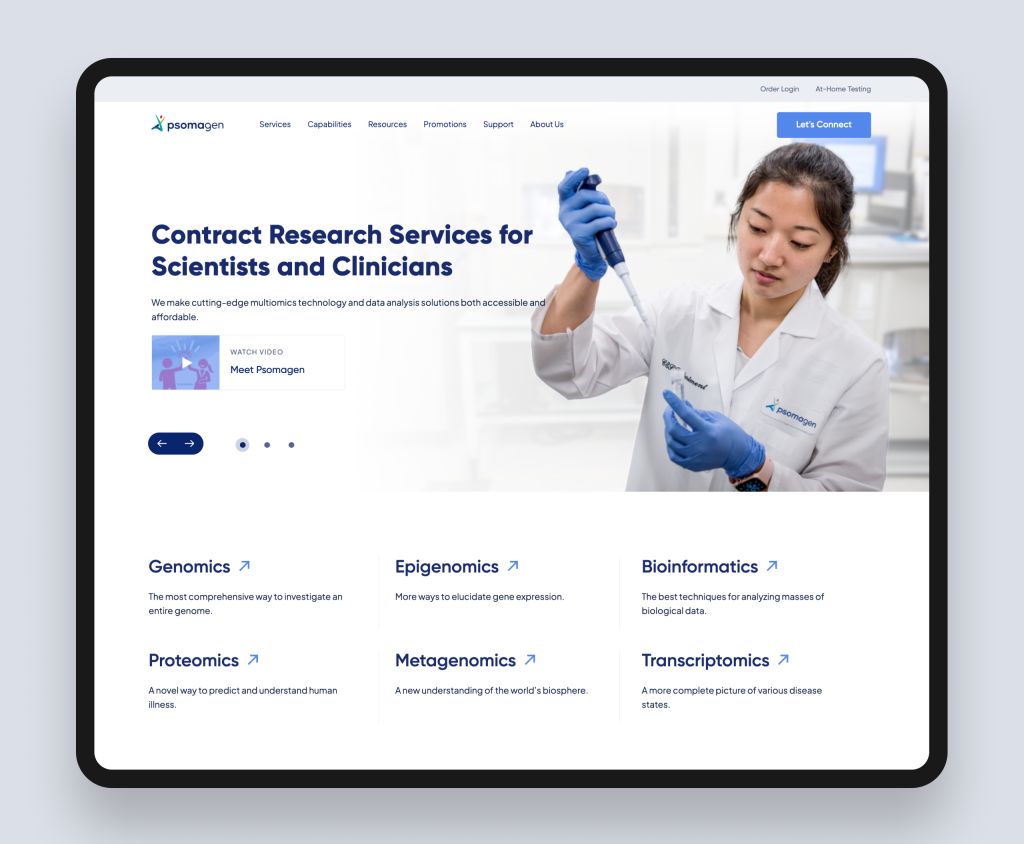
| Case study: Psomagen (Multiomics contract research services, HubSpot CMS) |
| Psomagen is a leading contract research services provider in the field of multiomics, delivering precision-driven research solutions for scientists and clinicians globally. Their existing website failed to communicate the breadth of their service portfolio clearly to two highly distinct professional audiences — research scientists specifying analytical services, and clinicians seeking applied diagnostic solutions. Rudo led a full website redesign and rebuild on HubSpot CMS, producing a strategic sitemap that organised the service architecture for intuitive navigation by both audiences, targeted copy for each major page, wireframes establishing clear user flows, and a clean UI design that served each audience without technical jargon overload. HubSpot CMS empowered the Psomagen team with straightforward content management and opened the pathway to leveraging HubSpot's marketing capabilities for audience-specific campaigns. The result was a website that exceeded client expectations and received positive feedback from both scientists and clinicians. Full case study: rudo.co.uk/case-studies/psomagen/ |
Find out more about our healthcare web design service.
Ready to work with a B2B healthcare web design agency that understands scientific audiences?
Rudo has built B2B healthcare websites for multiomics contract research providers, health technology companies, and life sciences businesses. Book an intro call and we will review your current site, discuss your professional audiences and regulatory context, and give you an honest view of what it would take to build something that genuinely generates qualified enquiries.
7. Frequently asked questions
What should I look for in a B2B healthcare web design agency?
A portfolio with B2B scientific or clinical audience work that you can evaluate directly for technical content depth, quality credentials presentation, and multi-audience architecture. Proactive awareness of regulatory promotional requirements relevant to your product or service type. A discovery process that includes regulatory review, audience analysis, and content audit before design begins. Scientific communication capability — either in-house or through established specialist relationships. References from B2B healthcare clients you can speak to about the scientific communication and regulatory elements of the project.
Should I use a specialist healthcare agency or a generalist B2B agency?
A specialist patient-facing healthcare agency has relevant regulatory awareness but may not have the B2B scientific communication experience your professional audiences require. A generalist B2B agency has strong conversion design and platform capability but may not understand the scientific credibility requirements or regulatory constraints. A strategy-led B2B agency with proven B2B healthcare experience combines both sets of capabilities. The key criterion is demonstrated experience serving professional scientific and clinical audiences — not simply healthcare experience in a patient-facing context.
How much does a B2B healthcare website cost?
A standard B2B healthcare website build for a life sciences or health technology company typically costs £12,000 to £25,000. More complex builds involving multiple professional audience architectures, HubSpot CMS configuration with scientific content automation, large technical documentation libraries, or complex regulatory approval workflows typically cost £25,000 to £50,000. The platform decision, the volume of technical content requiring scientific writing support, and the regulatory complexity of the claims being made are the variables that have the most impact on total project cost.
How long does a B2B healthcare website project take?
A standard B2B healthcare website project typically takes 12 to 16 weeks. Projects involving complex multi-audience architectures, large technical documentation libraries, or significant regulatory review overhead typically take 16 to 22 weeks. The most variable factor is the compliance review workflow — for companies where all promotional content requires pre-publication approval, building this explicitly into the project timeline prevents it from becoming a launch blocker.
Find out more about our healthcare web design service.
Also in this series: life sciences website design, healthcare technology website design, biotech website design, healthcare website design examples.

Written by
Rudo Agency
Rudo is a strategy-led web design and development agency specialising in B2B. Based in the UK and working with clients globally, we help ambitious brands turn complex ideas into high-performing websites. Our team combines digital strategy, UX/UI design, custom development, and SEO to deliver results-focused websites that support real business growth.
