Overview
Healthcare technology companies sit at an unusual intersection: they are technology businesses — with the product clarity, conversion architecture, and marketing velocity requirements of a SaaS company — operating in healthcare, where clinical evidence standards, regulatory compliance, and the cautiousness of clinical buyers set a very different bar from most technology markets. A health tech website that looks like a generic SaaS site will not earn the clinical credibility it needs. One that prioritises clinical gravitas over product clarity will not convert the technology and procurement evaluators who are part of the same purchase decision.
This guide covers how to build a health tech website that meets both sets of expectations simultaneously.
In this article:
- The health tech website design challenge
- Three audiences every health tech website must serve
- Communicating clinical evidence clearly
- Product pages that convert clinical buyers
- Regulatory and compliance design
- Conversion architecture for long clinical procurement cycles
- Platform choice for health tech companies
- Frequently asked questions
This article is part of the complete guide to healthcare website design.
Find out more about our healthcare web design service.
1. The health tech website design challenge
Healthcare technology procurement decisions typically involve three distinct stakeholder types evaluating the same product from entirely different perspectives. The clinician needs to know that the product works clinically and that it will not disrupt established care pathways. The IT lead needs to know that the product integrates with existing systems, meets security and data governance requirements, and can be deployed without excessive IT overhead. The procurement or finance lead needs to know that the commercial terms are reasonable, the supplier is financially stable, and the implementation and ongoing costs are manageable.
A health tech website that addresses only one or two of these audiences — typically the clinical audience, because it is the most obviously specialist — fails to serve the full buying group. In healthcare procurement, a clinician who is enthusiastic about a product but whose IT lead cannot verify the integration requirements or whose procurement team cannot find the commercial information they need will not result in a sale.
| The multi-stakeholder procurement reality |
| Research consistently shows that B2B technology purchases in healthcare involve an average of six to eight stakeholders. A website that is designed for the clinical champion without serving the IT evaluator, the procurement lead, the information governance team, and the finance director is designed for one out of six to eight people in the buying process. |
2. Three audiences every health tech website must serve
Clinical stakeholders: evidence and outcome focus
Clinicians evaluating a health technology product — whether a clinical decision support system, a diagnostic platform, a patient monitoring tool, or an electronic health record module — need to see clinical evidence. Published studies, clinical validation data, regulatory approvals, and references from comparable clinical settings in comparable patient populations. They also need to understand how the product fits into existing clinical workflows — not just what it does in isolation, but how it changes the day-to-day experience of the clinical team using it.
IT and technical stakeholders: integration and security focus
IT leads, informatics teams, and technical architects evaluating a health technology product need: integration specifications (HL7 FHIR, DICOM, API documentation, EHR compatibility); security and data governance credentials (ISO 27001, Cyber Essentials Plus, NHS DSPT compliance, GDPR compliance); hosting and deployment options (cloud, on-premise, hybrid); and implementation timeline and support requirements. These stakeholders will not proceed without this information — and they will not search for it if it is not clearly navigable from the product pages.
Procurement and finance stakeholders: commercial and compliance focus
Procurement teams and finance leads evaluating a health technology supplier need: evidence of financial stability and business continuity; the contract and commercial terms structure; reference sites at comparable institutions; case studies demonstrating implementation outcomes; compliance with relevant procurement frameworks (NHS procurement frameworks, G-Cloud for cloud-based products); and the total cost of ownership including implementation, training, and ongoing support.
3. Communicating clinical evidence clearly
What counts as clinical evidence in health tech
Clinical evidence for a health technology product ranges from peer-reviewed clinical studies demonstrating patient outcome improvements, through regulatory approval documentation (UKCA marking, CE marking, FDA clearance where applicable), to real-world evidence from implementation sites describing workflow improvements, efficiency gains, or error reduction. The strength and type of evidence required varies by product type and risk class — a Class IIb medical device faces a higher evidence bar than a Class I administrative tool — but all health technology products benefit from presenting whatever clinical evidence exists, at the appropriate level of specificity.
Presenting evidence accessibly for non-clinical stakeholders
Clinical evidence is the primary language of the clinical buyer and a foreign language for procurement and finance stakeholders. The same evidence needs to be presented at different levels of detail for different audiences: a technical summary of the clinical study for the clinician, a plain-language outcome statement for the procurement lead, and a financial translation (cost per patient, efficiency saving per clinical session, reduction in adverse events with associated cost) for the finance lead. Layered content presentation — starting with the accessible summary and providing the technical depth on demand — serves all three without compromising any.
Regulatory approval as a commercial signal
UKCA marking, CE marking, FDA clearance, and MHRA registration are not just compliance requirements — they are commercial signals that the product has been reviewed to the appropriate regulatory standard. For clinical and procurement buyers who are managing risk on behalf of their institution, regulatory approval reduces the perceived risk of adoption. It should be prominent, specific (noting the exact approval, the applicable classification, and the intended use), and verifiable.
4. Product pages that convert clinical buyers
Lead with the clinical problem, not the product features
Health technology products solve specific clinical problems: reducing diagnostic errors, shortening time to treatment, improving medication safety, enabling remote patient monitoring. Product pages that lead with the clinical problem — and demonstrate clearly and specifically how the product addresses it — convert clinical buyers more effectively than pages that lead with feature lists. The clinician's primary question is not 'what does this product do?' but 'does this product solve my specific clinical challenge?'
Case studies from comparable clinical settings
A clinician evaluating a clinical decision support system for a secondary care cardiology department is most influenced by evidence from a comparable department at a comparable institution. Case studies should be as specific as possible: institution type, clinical setting, patient volume, clinical challenge, implementation approach, and measurable outcome. Where institutional confidentiality prevents full identification, describing the institution type, scale, and clinical setting is more useful than anonymising completely.
Implementation pathway transparency
Clinical buyers are frequently deterred from adoption by uncertainty about the implementation process — how long it will take, what disruption it will cause, what training is required, and what ongoing support will look like. A clear, honest implementation pathway description — including typical timelines, the institutional inputs required, the training programme, and the post-go-live support model — reduces this anxiety and converts buyers who might otherwise defer a decision indefinitely.
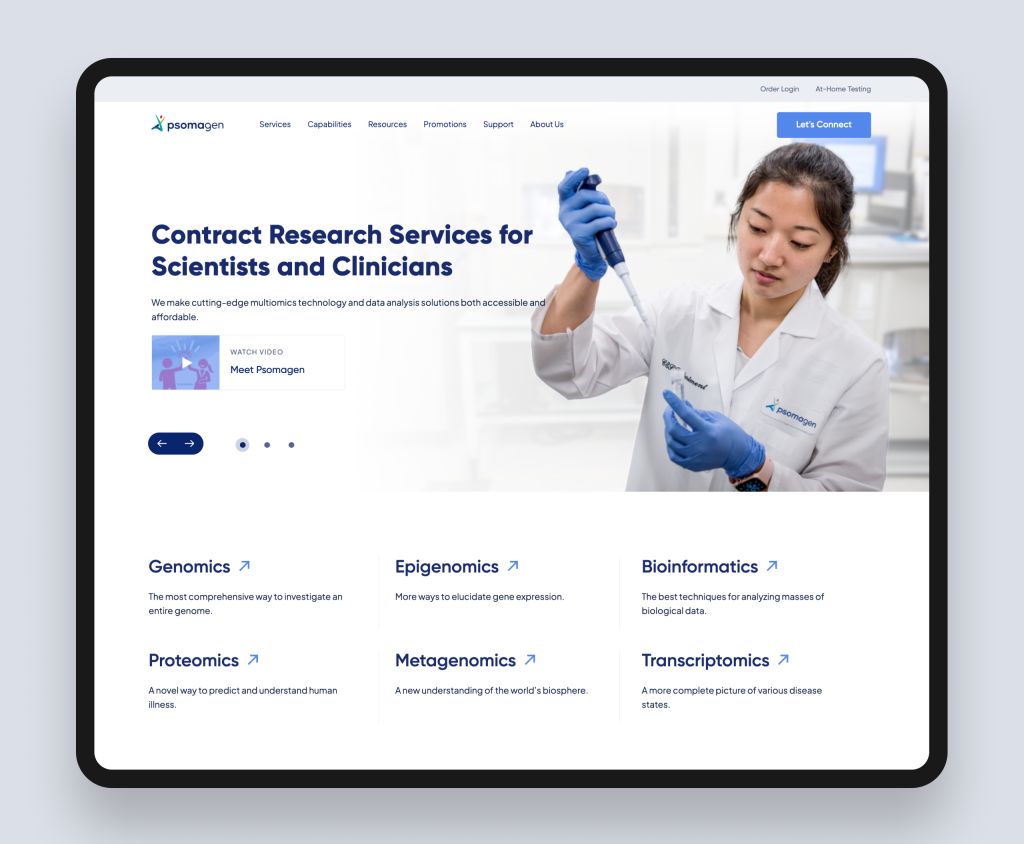
| Case study: Psomagen (Multiomics contract research services, HubSpot CMS) |
| Psomagen is a leading contract research services provider in the field of multiomics, delivering precision-driven research solutions for scientists and clinicians globally. Their existing website failed to communicate the breadth of their service portfolio clearly to two highly distinct professional audiences — research scientists specifying analytical services, and clinicians seeking applied diagnostic solutions. Rudo led a full website redesign and rebuild on HubSpot CMS, producing a strategic sitemap that organised the service architecture for intuitive navigation by both audiences, targeted copy for each major page, wireframes establishing clear user flows, and a clean UI design that served each audience without technical jargon overload. HubSpot CMS empowered the Psomagen team with straightforward content management and opened the pathway to leveraging HubSpot's marketing capabilities for audience-specific campaigns. The result was a website that exceeded client expectations and received positive feedback from both scientists and clinicians. Full case study: rudo.co.uk/case-studies/psomagen/ |
5. Regulatory and compliance design
Health technology companies face a more complex regulatory landscape than most other B2B technology businesses. The specific requirements depend on the product type, the intended use, the applicable regulatory framework (UK, EU, US, or multiple), and the clinical risk class. The website's content, claims, and promotional materials all fall within the scope of the applicable regulations.
Medical device promotion requirements
For companies marketing medical devices or IVDs, promotional claims on the website must reflect the device's approved intended use and be supported by appropriate clinical evidence. Overstated claims — particularly clinical outcome claims that go beyond what has been validated — create regulatory risk and undermine credibility with the clinical buyers who are most capable of identifying them. A regulatory review step for all product pages is a commercial as well as a compliance requirement.
NHS and public sector procurement compliance
Health technology companies selling into NHS and public sector organisations need to demonstrate compliance with relevant procurement frameworks and data governance standards. NHS Digital's Data Security and Protection Toolkit (DSPT), G-Cloud registration for cloud-based products, and compliance with NHS procurement frameworks should be visible and verifiable on the website. Procurement leads in NHS organisations will check for these credentials as part of their supplier qualification process.
Information governance and data security
For products handling patient data, identifiable clinical information, or health records, information governance credentials are a mandatory evaluation criterion. ISO 27001, Cyber Essentials Plus, NHS DSPT compliance, and GDPR compliance documentation should be visible, specific, and downloadable. The data processing agreement and data flow mapping should be available on request from a clearly signposted location on the website.
6. Conversion architecture for long clinical procurement cycles
Healthcare technology procurement cycles are long — frequently six to eighteen months from initial product identification to contract signature. The website must accommodate buyers at every stage of this extended journey, from initial awareness through to final procurement sign-off.
Content for each stage of the procurement cycle
- Awareness: Blog content, webinars, and conference presentations that establish the clinical problem and introduce the product category. Attracts buyers who are beginning to define their requirements.
- Evaluation: Product pages, clinical evidence summaries, case studies, and technical specifications. Serves buyers who are actively comparing solutions.
- Validation: Reference site lists, detailed implementation case studies, regulatory documentation, and information governance credentials. Serves buyers who have shortlisted the product and need to validate their decision internally.
- Procurement: Commercial information, framework references, procurement team FAQs, and a clear route to a commercial conversation. Serves procurement leads who are managing the contracting process.
Demo and pilot pathways
For most health technology products, the primary conversion goal is a product demonstration or a pilot agreement — not a direct sale. The website's conversion architecture should reflect this: a clear pathway from product page to demo request, with a form that asks for enough clinical context (institution type, clinical setting, current challenge) to allow the product team to prepare a relevant and credible demonstration.
7. Platform choice for health tech companies
- HubSpot CMS: For health technology companies with multiple stakeholder audiences and active content marketing programmes who need native CRM integration between website engagement and sales pipeline management. Smart content can serve different product information to clinical versus IT versus procurement visitors. Campaign landing pages for clinical conferences, webinar registrations, and product launches can be built by the marketing team without developer involvement.
- WordPress: For health technology companies with complex product portfolios, large clinical evidence libraries, or specific integration requirements with healthcare information systems.
- Webflow: For early-stage digital health companies and health technology startups where visual positioning is a primary differentiator and the content operation and CRM requirements are moderate.
Ready to build a healthcare technology website that serves clinical, IT, and procurement buyers?
Rudo designs and builds websites for health technology companies that balance clinical evidence communication with product clarity and multi-stakeholder conversion architecture. Book an intro call to discuss your product and your buyer audiences.
8. Frequently asked questions
What should a healthcare technology website include?
Clinical evidence presented at the appropriate depth for clinical audiences; regulatory approvals and information governance credentials prominently surfaced; integration specifications and security documentation for IT evaluators; case studies from comparable clinical settings; implementation pathway transparency; procurement framework compliance information; and audience-specific navigation pathways that allow clinicians, IT leads, and procurement teams to find what they need without navigating through content designed for someone else.
How do you design a health tech website for multiple stakeholder types?
Layered content architecture: accessible clinical outcome statements at the page level, with technical integration specifications, security credentials, and procurement information in dedicated sections that IT and procurement audiences can navigate to directly. Audience-specific navigation paths — 'for clinical teams', 'for IT and informatics', 'for procurement' — allow each stakeholder to self-select the content most relevant to their evaluation without requiring the site to duplicate content for each audience.
How important is NHS DSPT compliance for a health tech website?
For companies selling to NHS organisations, DSPT compliance is a mandatory supplier qualification criterion that procurement teams check as a standard part of their evaluation. It should be clearly visible on the website, alongside any other relevant data governance credentials. Making it easy for a procurement lead to find and verify DSPT compliance reduces the time required to complete supplier qualification and removes a potential blocker from the procurement process.
Find out more about our healthcare web design service.
Also in this series: life sciences website design, healthcare technology website design, biotech website design, healthcare website design examples.

Written by
Rudo Agency
Rudo is a strategy-led web design and development agency specialising in B2B. Based in the UK and working with clients globally, we help ambitious brands turn complex ideas into high-performing websites. Our team combines digital strategy, UX/UI design, custom development, and SEO to deliver results-focused websites that support real business growth.
