Overview
Biotech and pharmaceutical company websites serve an unusually diverse set of audiences — research scientists evaluating products or services, potential commercial and licensing partners, institutional investors conducting due diligence, potential employees evaluating the company's scientific ambition, and patient advocacy groups seeking information about a company's therapeutic programmes. Serving all of these audiences coherently from a single digital presence requires both a clear strategic hierarchy of communication priorities and a deliberately layered content architecture that gives each audience what they need without burying it behind content designed for someone else.
This guide covers the specific design and content decisions that make biotech and pharmaceutical company websites commercially and scientifically effective.
In this article:
- What biotech website design needs to achieve
- The biotech audience landscape
- Pipeline and product portfolio presentation
- Scientific authority design
- Investor and partner-facing content
- Platform choice for biotech companies
- Frequently asked questions
This article is part of the complete guide to healthcare website design.
Find out more about our healthcare web design service.
1. What biotech website design needs to achieve
The commercial objectives of a biotech website vary significantly by stage of development and business model. An early-stage discovery biotech primarily needs to attract investors, scientific talent, and potential licensing or collaboration partners. A clinical-stage company needs to communicate pipeline progress, regulatory milestone achievements, and clinical evidence to investors, patient advocacy groups, and potential commercial partners. A commercial-stage pharmaceutical company needs to serve professional buyers of its products alongside all of the above.
The website design strategy should start from a clear hierarchy of these objectives: which audience is the primary commercial priority, what information do they need to find quickly, and how do the secondary audiences' needs layer beneath and alongside that primary purpose?
The credibility threshold in biotech
Biotech is a sector where credibility is established or destroyed quickly. A biotech company whose website overstates the clinical development stage of a programme, misrepresents the regulatory status of a product, or makes therapeutic claims unsupported by published evidence will be identified immediately by the scientific and investor audiences who have the expertise to evaluate these claims. The credibility threshold is high, and crossing it in the wrong direction has consequences that extend well beyond the website.
2. The biotech audience landscape
Scientific and research partners
Research scientists at pharmaceutical companies, academic institutions, or other biotechs evaluating a licensing opportunity, a collaboration agreement, or the purchase of a research tool or reagent. They need: scientific publications and preprints; platform or technology specifications; validation data; application areas and examples; and intellectual property status where relevant.
Investors and financial stakeholders
Institutional investors, venture capital firms, and private equity conducting due diligence on an investment opportunity. They need: the management team's backgrounds and track record; the company's financial position and funding history; the pipeline and its development status; the competitive landscape; regulatory milestones achieved and anticipated; and the commercial opportunity.
Commercial and licensing partners
Pharmaceutical companies, diagnostics companies, or medical device manufacturers evaluating a licensing, co-development, or commercialisation partnership. They need: the technology's commercial applications; the IP position; the regulatory pathway; the data package; and the management team's experience of partnership management and commercialisation.
Scientific talent
Scientists and engineers evaluating the company as a potential employer. They need: the scientific ambition and quality of the programme; the laboratory capabilities and technology access; the team's scientific credentials; the company's funding position and trajectory; and the culture and working environment. A company that communicates genuine scientific rigour and intellectual ambition attracts a different calibre of scientific talent than one whose website is indistinguishable from its competitors.
3. Pipeline and product portfolio presentation
The pipeline table
For clinical-stage biotechs, the pipeline table is one of the most important pages on the website. It communicates the breadth and stage of the company's therapeutic programmes at a glance — to investors, partners, and analysts who need to assess the company's value and risk profile quickly. A well-designed pipeline table includes: programme name and therapeutic area; target or mechanism of action; development stage (discovery, preclinical, Phase 1, 2, 3); indication; and any regulatory designations (breakthrough therapy, fast track, orphan drug). It should be updated promptly when milestones are achieved — an out-of-date pipeline table is a credibility liability.
Programme pages with scientific depth
Each pipeline programme should have a dedicated page that provides the scientific rationale, the clinical hypothesis, the data that has driven the programme forward, and the next development milestones. This content serves both the scientific partner who needs to assess the biology and the investor who needs to understand the clinical and commercial logic. The scientific content should be genuinely substantive — a one-paragraph description of each programme tells neither the scientist nor the investor anything useful.
Product portfolio for commercial-stage companies
Commercial-stage pharmaceutical or biotech companies presenting a product portfolio face the additional challenge of making regulated promotional claims accurately while communicating the commercial value of the portfolio clearly. Product pages should reflect the approved label and indication, present efficacy and safety data from the approval-enabling studies, and link to prescribing information and patient materials where appropriate.
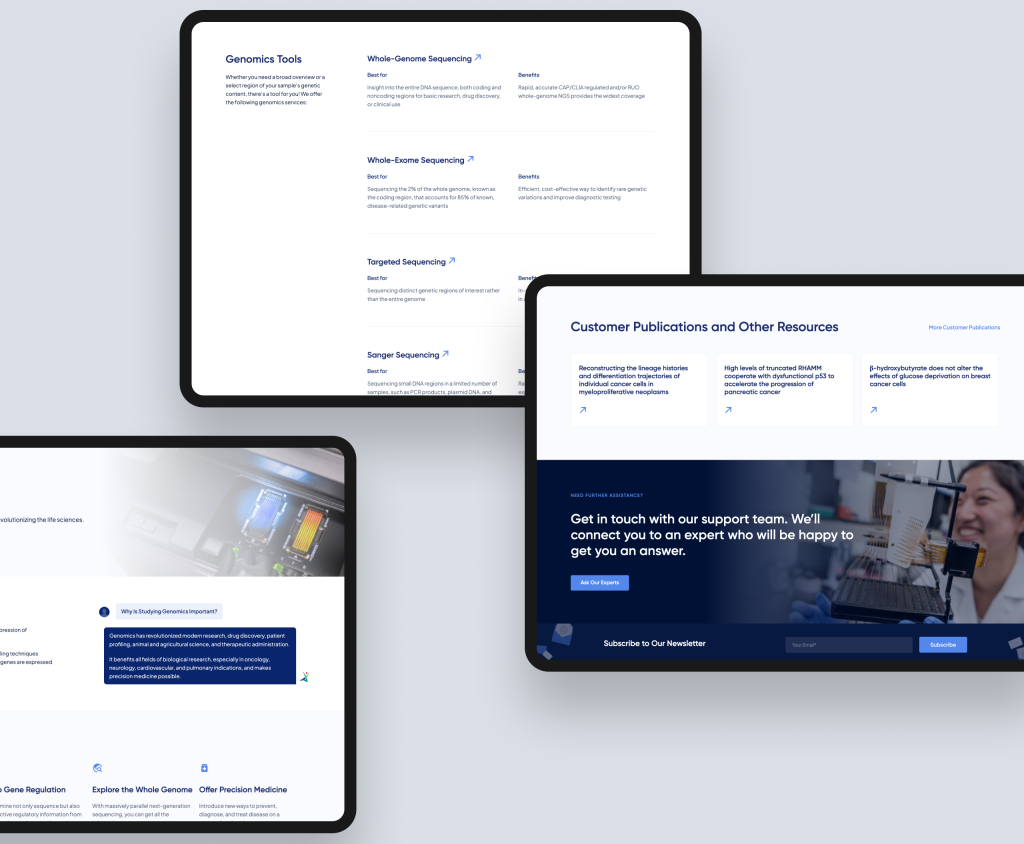
| Case study: Psomagen (Multiomics contract research services, HubSpot CMS) |
| Psomagen is a leading contract research services provider in the field of multiomics, delivering precision-driven research solutions for scientists and clinicians globally. Their existing website failed to communicate the breadth of their service portfolio clearly to two highly distinct professional audiences — research scientists specifying analytical services, and clinicians seeking applied diagnostic solutions. Rudo led a full website redesign and rebuild on HubSpot CMS, producing a strategic sitemap that organised the service architecture for intuitive navigation by both audiences, targeted copy for each major page, wireframes establishing clear user flows, and a clean UI design that served each audience without technical jargon overload. HubSpot CMS empowered the Psomagen team with straightforward content management and opened the pathway to leveraging HubSpot's marketing capabilities for audience-specific campaigns. The result was a website that exceeded client expectations and received positive feedback from both scientists and clinicians. Full case study: rudo.co.uk/case-studies/psomagen/ |
4. Scientific authority design
The visual register of a credible biotech
Biotech websites have a distinctive visual language that has evolved around the specific credibility requirements of the sector: restrained colour palettes dominated by deep blues, clean whites, and scientific greens or teals; precise, legible typography; generous use of whitespace; high-quality photography of real laboratories and real scientists at work; and data visualisations that communicate scientific precision. This design language communicates operational quality and scientific rigour before any content is read.
Photography: real laboratories, real science
Stock photography of generic laboratory settings — pipettes in gloved hands, microscopes with no visible samples, generic protein structure renders — communicates nothing specific about a biotech company's actual capabilities. Real photography of the company's actual laboratory, actual equipment, actual scientists, and actual scientific processes communicates specificity and authenticity. For early-stage companies without extensive laboratory infrastructure, high-quality photography of the founders and scientific team in a relevant working environment is more credible than generic stock imagery.
Scientific team profiles
The scientific team is a primary credibility signal for a biotech company at most stages of development. Named individuals with verifiable backgrounds at recognisable institutions, genuine publication records, and specific scientific expertise communicate that the company's scientific programme is being led by people with the credentials to execute it. Anonymised or generic team profiles undermine the credibility that the scientific content is working to build.
5. Investor and partner-facing content
Investor relations content
For publicly listed biotechs, investor relations content on the website must comply with the applicable securities regulations — LSE, AIM, or NASDAQ rules on disclosure, fair presentation, and material non-public information. For private companies, investor-facing content needs to balance the communication requirements of a sophisticated investor audience against the commercial sensitivity of pipeline and partnership information.
Investor relations pages should include: the most recent investor presentations; press releases covering regulatory and clinical milestones; financial results and filings; the share register and major shareholder information (for listed companies); analyst coverage; and a clear pathway to investor enquiries. For clinical-stage companies, a clear and current pipeline summary is one of the most referenced pages for investor audiences.
Partnership and licensing content
Dedicated content for potential commercial partners — pharmaceutical companies, diagnostics companies, or medical device manufacturers evaluating a licensing or co-development opportunity — should describe the technology's commercial applications, the IP position, the data package available for due diligence, and the company's experience and appetite for partnership structures. A partnership page that is specific about what types of collaboration the company is seeking, and what a potential partner can expect from the initial conversation, converts significantly better than a generic 'contact us for partnership discussions' approach.
6. Platform choice for biotech companies
- WordPress: The most commonly chosen platform for biotech companies with complex content architectures — multiple pipeline programmes each with their own data package, publication databases, regulatory document libraries, and investor relations content. WordPress's open architecture accommodates any content model without platform constraints and provides the hosting flexibility that some biotech companies require for data governance reasons.
- HubSpot CMS: For biotech companies with active conference and event marketing programmes, scientific content strategies designed to generate partner and investor enquiries, and a requirement for CRM integration between website engagement and business development pipeline management. Particularly appropriate for commercial-stage biotechs with active inbound marketing.
- Webflow: For early-stage biotechs where brand distinction is important for talent attraction and investor positioning, and the content requirements are relatively straightforward. Webflow's design fidelity allows a biotech brand to look distinctive and credible without the platform overhead of more complex options.
Ready to build a biotech website that communicates scientific authority and generates partner and investor enquiries?
Rudo designs and builds websites for biotech and pharmaceutical companies across early-stage discovery, clinical development, and commercialisation. We understand the scientific communication requirements and the multi-audience challenge specific to the life sciences sector. Book an intro call to discuss your company and your priorities.
7. Frequently asked questions
What should a biotech company website include?
Scientific team profiles with verifiable backgrounds; a pipeline or portfolio overview with programme-level detail pages; scientific publications and data; technology or platform description with the scientific rationale; investor relations content appropriate to the company's stage and listing status; partnership and licensing content describing the company's collaboration appetite; regulatory and quality credentials relevant to the company's activities; and audience-specific navigation for scientific, investor, and partner audiences.
How should a clinical-stage biotech present its pipeline?
A clearly designed pipeline table visible on the homepage or a dedicated pipeline page, showing each programme's name, therapeutic area, mechanism of action, development stage, and indication. Each programme should have a dedicated page with the scientific rationale, the clinical hypothesis, the key data, and the next development milestones. The pipeline table should be updated promptly when milestones are achieved — an out-of-date pipeline communicates either stagnation or inattention to the investor and partner audiences who reference it most frequently.
How do biotech websites handle investor relations content?
Investor relations content on a biotech website should include the most recent investor presentations, press releases covering significant milestones, financial results and filings for listed companies, pipeline summaries, and a clear pathway for investor enquiries. For listed companies, all publicly disclosed information should be available on the website and any financial or clinical data must be handled in accordance with the applicable securities regulations governing fair disclosure.
What is the most important page on a biotech website?
For clinical-stage and commercial-stage biotechs, the pipeline or portfolio page is typically referenced most frequently by the investor and partner audiences that the website needs to serve. For early-stage discovery biotechs, the scientific team page and the technology or platform description are often the most commercially important, because investor and partner decisions at this stage are heavily influenced by the quality and credibility of the founding science and the scientific team.
Find out more about our healthcare web design service.
Also in this series: life sciences website design, healthcare technology website design, biotech website design, healthcare website design examples.

Written by
Rudo Agency
Rudo is a strategy-led web design and development agency specialising in B2B. Based in the UK and working with clients globally, we help ambitious brands turn complex ideas into high-performing websites. Our team combines digital strategy, UX/UI design, custom development, and SEO to deliver results-focused websites that support real business growth.
