Overview
The most instructive way to understand what makes a manufacturing website work commercially is to look at real examples: the specific challenges each company faced, the decisions made in response, and the commercial outcomes those decisions produced. Generic before-and-after showcases tell you what a site looks like. Understanding the reasoning behind the design and architectural decisions tells you what you should think about for your own project.
This guide draws on three manufacturing website projects from Rudo's portfolio, covering specialty chemicals, automotive components, and industrial materials, to show what high-performing B2B manufacturing websites actually do.
In this article:
- What separates high-performing manufacturing websites
- Info-Gel: specialty gels for cables
- ELTA Automotive: automotive component distribution
- Norit: activated carbon manufacturing
- What the best manufacturing websites have in common
This article is part of the complete guide to manufacturing website design.
Find out more about our manufacturing web design service.
1. What separates high-performing manufacturing websites
Our evaluation criteria for a genuinely high-performing manufacturing website go well beyond visual design:
- Communicates technical credibility within ten seconds of arrival — through specific claims, real photography, and visible certifications
- Serves multiple buyer types simultaneously — engineers need specification depth, procurement managers need compliance evidence, business decision-makers need credibility signals
- Makes the product catalogue navigable for both the buyer who knows what they want and the buyer who is starting from a problem
- Provides technical documentation — data sheets, safety data sheets, application guides — that is freely accessible, clearly dated, and kept current
- Gives the internal team the ability to maintain and expand the catalogue without developer involvement
- Generates qualified enquiries, not just traffic — through conversion architecture suited to a long manufacturing sales cycle
With those criteria in mind, here is what strong manufacturing websites look like in practice.
2. Info-Gel: specialty gels for cables
The client and the challenge
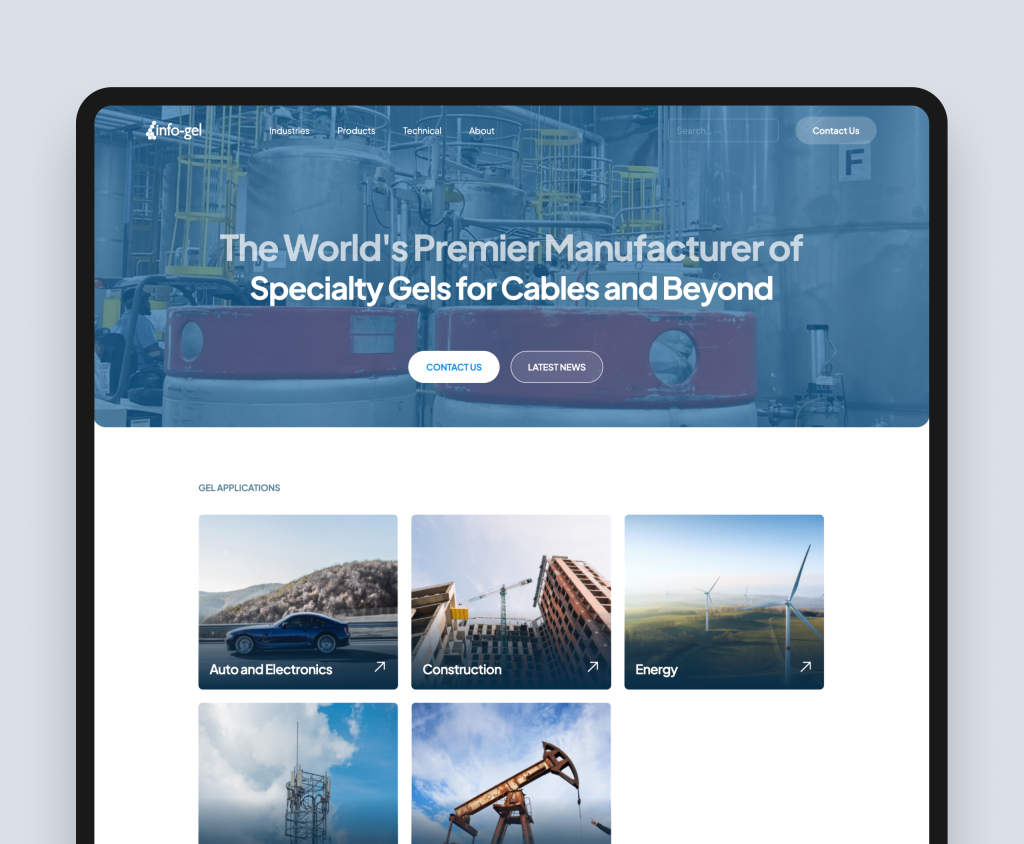
Info-Gel is a manufacturer of specialty gels for cables, producing a range of formulations used in telecommunications, energy, and industrial cable applications. Each product has specific performance characteristics for different cable types, operating environments, and installation conditions. The breadth of the product range and the technical specificity of each product's application created a significant digital communication challenge.
Their existing website lacked a cohesive structure for navigating the product catalogue, making it difficult for specifiers to explore the range and find products relevant to their requirements. More critically, there was no efficient search mechanism for the technical data sheets (TDS) and safety data sheets (SDS) that buyers need to access during the specification and procurement process. A buyer who could not quickly find and download the relevant data sheet for a specific product was forced to contact the company, adding friction to a process that should be self-service.
The approach
Rudo began with a comprehensive sitemap and information architecture that imposed a logical structure on the product range, creating clear navigation paths through the catalogue by product family and application type. Wireframes defined the user flow through the catalogue with particular focus on how buyers would navigate from an initial category or application to a specific product and its associated documentation.
HubSpot CMS was chosen as the platform for its marketing capabilities and its ability to support robust search functionality for product content and documentation. The CMS architecture was designed to allow Info-Gel's team to manage product content and documentation updates independently after launch.
The outcome
The new website provided buyers with a clearly navigable product catalogue and efficient access to technical documentation. The search functionality made data sheets and safety data sheets easy to find by product name, specification, or application context, eliminating the friction that had previously required buyers to contact the company for basic documentation requests. The redesigned platform received positive feedback from both existing clients and potential customers.
Read the full case study: Info-Gel case study.
Takeaway
For manufacturers with large, technically complex product catalogues, the highest commercial priority in website design is making the right product and its documentation findable efficiently. Every barrier between a buyer and the data sheet they need to complete their specification exercise is a risk to the enquiry. Removing those barriers through well-designed catalogue architecture and documentation search is more commercially valuable than any visual design decision.
3. ELTA Automotive: automotive component distribution
The client and the challenge
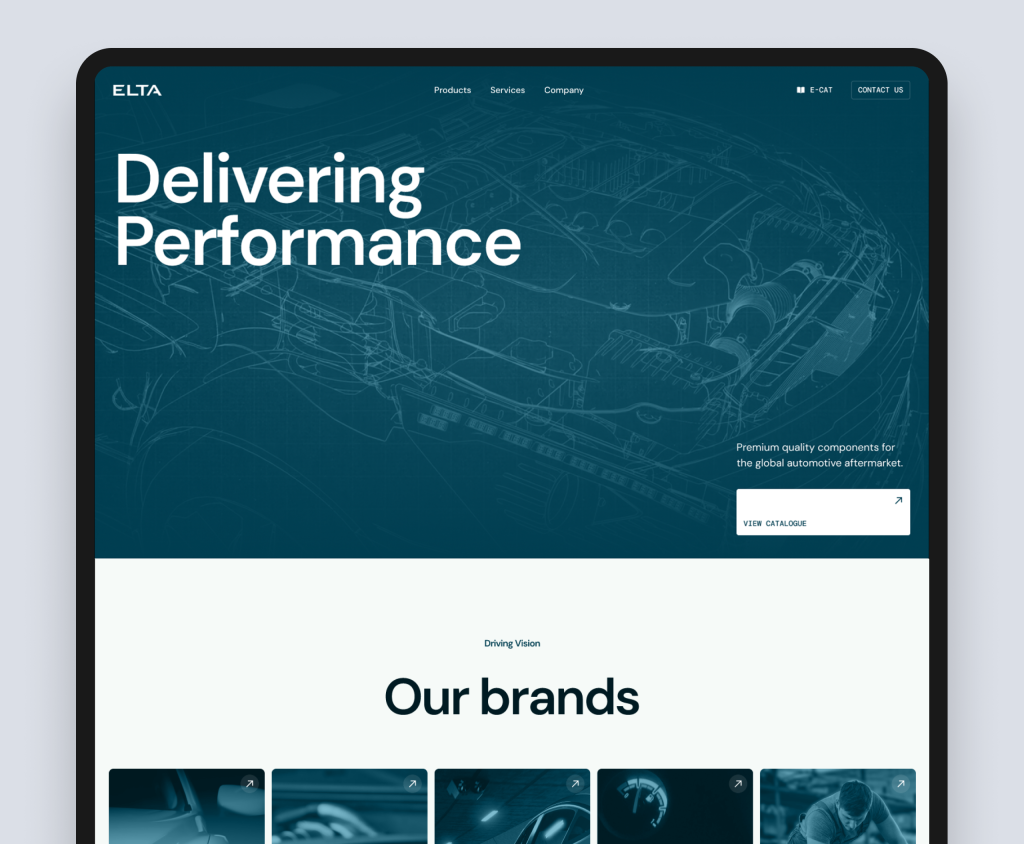
ELTA Automotive is a UK-based, family-owned automotive component distributor established in 1993. Official licensee of the iconic Lucas brand for the UK and Europe, ELTA supplies motor factors and retailers across the globe with automotive bulbs, wiper blades, engine management components, sensors, and ignition parts. Their brand portfolio spans Lucas, VXPRO, VisionPRO, Pride, and Serck Automotive following the recent acquisition of Cooling Components Limited.
ELTA's challenge was communicating the breadth of a growing brand portfolio, the depth of product application data that differentiates them in the aftermarket, and the technical support services that make ELTA a preferred supplier for independent motor factors, to a digitally sophisticated audience of automotive aftermarket buyers.
The approach
The website needed to serve multiple audience types within the automotive aftermarket: motor factor business owners evaluating new supplier relationships, trade counter staff looking up technical specifications and application data, and workshop technicians seeking product and fitment information. Each audience type has different information needs and different content depth requirements.
The design communicated ELTA's three decades of market presence and its commitment to the independent aftermarket, positioning the company as a partner, not just a supplier. The product and brand architecture was structured to give each brand in the portfolio clear positioning while communicating the coherence of ELTA's overall offer. Technical data and application information, a key differentiator for ELTA through their TecDoc-certified data provision, was given prominent architectural placement.
The outcome
The new website communicates ELTA's position as a major player in the UK and European automotive aftermarket, with clear digital representation for each brand in the portfolio and a platform designed to grow with the company's continued strategic expansion.
Takeaway
For distributors and manufacturers with multiple brands or product lines under one parent company, the website architecture needs to balance brand distinctiveness with portfolio coherence. Each brand needs clear positioning; the parent company needs to communicate the strategic advantage of its overall portfolio. This dual-level communication challenge requires deliberate information architecture rather than a simple brand-plus-products structure.
4. Norit: activated carbon manufacturing
The client and the challenge
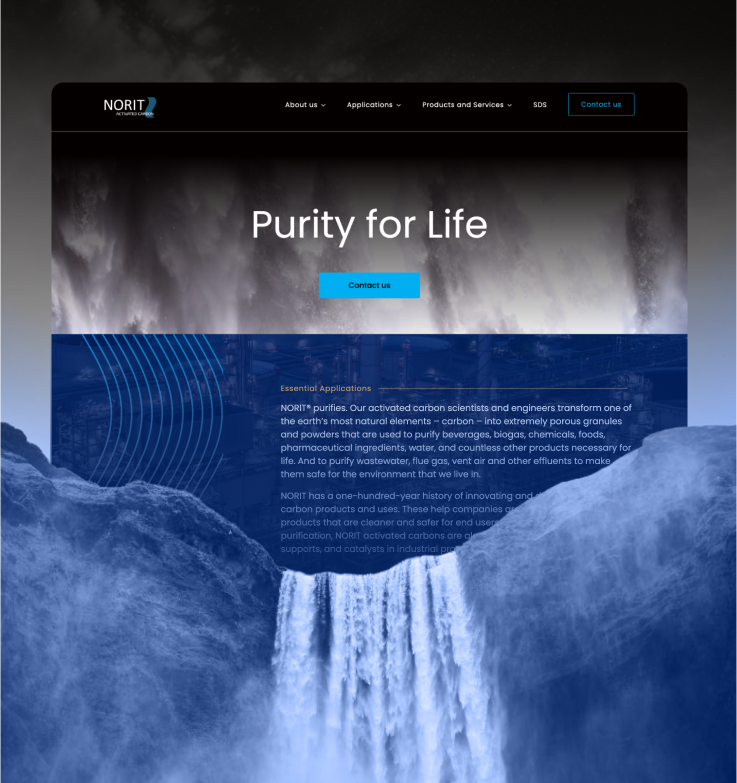
Norit is one of the world's largest producers of activated carbon, with over a century of history in manufacturing and product development. Operating ten plants across seven countries on three continents, Norit produces more than 400 grades of activated carbon used for purification across water, food and beverage, pharmaceutical, chemical, and industrial applications. Their activated carbon solutions are also used as colorants, catalyst supports, and catalysts in industrial processes.
The scale and technical complexity of Norit's offer creates a significant digital communication challenge. With over 400 product grades serving highly technical applications across multiple industries, the website must serve buyers ranging from water treatment engineers selecting a specific grade for a municipal water plant to pharmaceutical procurement specialists sourcing GMP-certified activated carbon for a drug manufacturing process.
The approach
Rudo's work with Norit focused on creating a digital presence that communicates the scale, technical authority, and product breadth of a global manufacturing leader to highly technical buyer audiences across multiple industries and geographies. The information architecture was designed to accommodate Norit's extensive product range while remaining navigable for buyers who are specifying from very different starting points.
The application-based navigation structure allows buyers to enter the product range from their specific industry context: a water treatment buyer navigates through water purification applications; a food and beverage buyer navigates through food-grade purification requirements. The underlying product data serves both audiences; the entry points and content framing are specific to each.
The outcome
The website positions Norit's century of innovation and global manufacturing scale as tangible credibility signals for buyers in regulated industries where supplier qualification is rigorous. The application-led navigation makes the extensive product range accessible to buyers who are specifying for complex, multi-stage purification processes across diverse industrial contexts.
Takeaway
For global manufacturers with very large product ranges serving multiple technically distinct industries, application-led navigation is more commercially effective than product-led navigation for first-time visitors. A buyer who can enter the website from their specific application context and find directly relevant products and grades converts at a higher rate than one who must navigate a large product catalogue from the top level.
5. What the best manufacturing websites have in common
- Real photography, always. Across all three examples, photography of real facilities, real products, and real teams is a commercial differentiator. Buyers who visit dozens of manufacturing websites are adept at recognising stock imagery. Real photography communicates specific capability in a way generic imagery cannot.
- Application context before specification detail. The best manufacturing product pages lead with application context — what this product is used for, in what environments, for what industries — before presenting specification tables. This serves both the buyer who knows what they want and the buyer who is starting from a problem.
- Technical documentation as a conversion tool. Freely accessible, easily downloadable technical data sheets and safety data sheets reduce sales friction and build buyer confidence simultaneously. Every barrier between a buyer and the documentation they need to complete their specification exercise is a cost to the enquiry rate.
- CMS architecture designed for independence. The internal teams at Info-Gel, ELTA, and Norit can manage their product content, update documentation, and add new products without developer involvement. This independence matters: a product catalogue that goes out of date because updates require developer tickets is a commercial liability.
- Conversion architecture suited to long sales cycles. None of these websites treats the contact form as the only conversion point. Multiple lower-commitment options, documentation downloads, application guides, technical enquiry routes, give buyers in different stages of the evaluation process a meaningful next step.
Ready to talk about your manufacturing website?
Rudo designs and builds manufacturing websites that communicate technical credibility, present complex products clearly, and generate qualified enquiries. Book an intro call to discuss what a high-performing website would look like for your manufacturing business.
Find out more about our manufacturing web design service.
Also in this series: manufacturing website design guide, manufacturing product catalogue websites, manufacturing website cost, and SEO for manufacturers.
