Overview
Most manufacturing companies go through the same process when choosing a web design agency: they search Google, request three proposals, compare prices, look at portfolios, and make a decision. The result, more often than not, is a website that looks presentable but fails to serve the commercial reality of a manufacturing business: multiple sophisticated buyer types, complex product information, technical documentation requirements, and a sales process driven by credibility and proven capability.
The problem is not the agencies' ability to design and build websites. It is that most web design agencies do not understand what a manufacturing website actually needs to do. They apply the same process, the same frameworks, and the same thinking they use for e-commerce, professional services, and consumer brands. Manufacturing is different. Getting the agency choice right makes the difference between a website that generates qualified enquiries and one that merely occupies a URL.
In this article:
- Why choosing the right agency matters more in manufacturing than most sectors
- The types of agency manufacturing companies encounter
- What genuine manufacturing web design expertise looks like
- Strategy: the foundation most agencies skip
- Content organisation: the challenge most agencies underestimate
- Trust and credibility: manufacturing's most important design problem
- Proven results: what to ask for and how to evaluate it
- Where Rudo fits and what we bring to manufacturing projects
- Questions to ask any agency before hiring
- Frequently asked questions
This article is part of the complete guide to manufacturing website design.
Find out more about our manufacturing web design service.
1. Why choosing the right agency matters more in manufacturing than most sectors
A poorly chosen agency for a consumer brand produces a website that looks generic and underperforms on conversion. A poorly chosen agency for a manufacturing company produces all of that and more: a product catalogue that technical buyers cannot navigate, credibility signals that are absent or misplaced, technical documentation that is inaccessible, and a site that serves none of the distinct buyer types who need to engage with it.
Manufacturing websites serve genuinely different audiences simultaneously: engineers who need specification depth, procurement managers who need compliance evidence, and business decision-makers who need credibility signals and commercial positioning. Each audience arrives with different questions and needs to find different information efficiently. An agency that does not understand this distinction will design around one audience and neglect the others.
The cost of getting this wrong is also asymmetric in manufacturing. A manufacturing company whose website fails to communicate credibility to a potential OEM customer, or whose product catalogue loses a specifier because they cannot find the data sheet they need, is losing deals at values that can run into hundreds of thousands of pounds. The ROI case for getting the agency choice right is compelling.
| The manufacturing buyer's research process |
| Studies consistently show that B2B buyers in manufacturing complete 60% to 70% of their evaluation process before speaking to a sales representative. Your website is doing active sales work while your commercial team is working on other things. An agency that understands this dynamic builds websites accordingly. One that does not builds something that looks good in a portfolio but generates very little from the buyers who visit it. |
2. The types of agency manufacturing companies encounter
The web design agency market spans a wide range of capability and focus. Understanding the main categories helps manufacturing companies avoid expensive mismatches.
| Agency type | What they do well | Where they fall short for manufacturing |
| General marketing agency | Multi-channel campaign management, brand identity | No depth in product architecture, technical content, or manufacturing buyer psychology |
| E-commerce specialist | Product listing and transactional design | Catalogue thinking built for consumer purchases, not B2B specification and long sales cycles |
| Cheap / fast build shop | Speed and low cost | Template-based output, no strategy, no sector knowledge, often poor performance |
| Technical web developer | Complex custom functionality | Strategy and commercial thinking typically secondary; design often outsourced or weak |
| Generalist B2B agency | B2B structure and conversion thinking | Rarely has specific manufacturing sector depth or product catalogue experience |
| Strategy-led B2B agency with manufacturing experience | Full strategic, design, content and technical capability with proven manufacturing results | Fewer in number; typically higher investment than the alternatives |
The most common mismatch for manufacturing companies is the generalist B2B or marketing agency. They understand B2B better than an e-commerce specialist, but they have not solved the specific problems manufacturing websites face: presenting complex catalogues, layering technical content for multiple audiences, communicating certification and compliance, or building search and filtering for specification-led buyers.
3. What genuine manufacturing web design expertise looks like
Ask any agency whether they have experience in manufacturing and most will say yes. The claim is easy to make. The evidence of genuine expertise is specific and verifiable. Here is what to look for.
Sector-specific portfolio work
Look at actual manufacturing or industrial websites the agency has delivered. Not one or two projects buried in a broad portfolio alongside retail, hospitality, and professional services. Look for depth: multiple manufacturing projects, across different sub-sectors (chemicals, automotive, precision engineering, specialty materials), that demonstrate a pattern of thinking about the sector's specific problems rather than applying a generic template.
Evaluate those sites critically. Do the product pages lead with application context before specification? Is technical documentation accessible from product pages in one click? Does the homepage communicate scale, certifications, and credibility within the first scroll? Is the navigation structured for buyers starting from a problem as well as buyers starting from a known product? These are the details that separate a manufacturing specialist from an agency that has done one manufacturing project.
Understanding of the buying process
An agency with genuine manufacturing expertise will ask commercial questions early in the conversation: who are the different buyer types for this product, how do engineers search for what they need, what certifications matter to procurement, how long is the typical sales cycle. An agency without this knowledge will ask primarily about aesthetics and branding.
Technical documentation experience
The handling of technical data sheets, safety data sheets, application guides, and compliance certificates is a specialist capability. An agency that has done this well understands how to structure a documentation library, how to make data sheets findable by product without requiring form submission, and how to build a CMS architecture that allows non-technical team members to update documentation independently. Ask specifically about this and evaluate the quality of their answer.
For a full framework of what a manufacturing website should do, read our complete guide to manufacturing website design.
4. Strategy: the foundation most agencies skip
The single most important differentiator between agencies that produce commercially effective manufacturing websites and those that produce visually adequate ones is whether strategy precedes design. Most agencies move too quickly from brief to wireframes. The strategic work that should sit between them, and that determines whether the finished site actually serves the business, is either abbreviated or skipped entirely.
What strategy means in a manufacturing context
Strategy in a manufacturing website project is not a brand positioning exercise. It is a disciplined process of understanding the commercial reality of the business before making any design decisions. It includes: who are the distinct buyer types for each major product category, what questions does each buyer type need the website to answer, how do engineers actually search for and specify components (which is often very different from how the internal product team describes them), what competitive context are buyers evaluating the company within, and what commercial outcomes does the website need to drive.
The answers to these questions determine information architecture, not designers' preferences. The navigation structure should reflect how buyers think about the product range, not how the internal organisation is structured. The homepage hero should address the buyer's primary evaluation question, not communicate the mission statement. The product page hierarchy should serve the specification journey, not just list what exists.
What happens without it
Manufacturing websites built without strategic discovery consistently make the same mistakes: navigation structured around internal product codes rather than buyer search behaviour, homepage copy that says nothing specific to a buyer who is evaluating suppliers, product pages that lead with the product name rather than the application context, and a site that serves the marketing director's aesthetic preferences rather than the engineer's information needs.
These mistakes are invisible in a design review because they are not design problems. They look fine. They fail commercially. The only way to catch them is to do the strategic work before design begins.
| A strategy phase is not a luxury for manufacturing websites. It is the difference between a site that looks right and a site that works. The investment in getting it right before design begins is always smaller than the cost of rebuilding after launch when the site fails to generate enquiries. |
5. Content organisation: the challenge most agencies underestimate
The content organisation challenge in manufacturing is genuinely complex. A manufacturer with hundreds of products across multiple grades, applications, and industries needs a content architecture that serves buyers approaching from fundamentally different starting points: some know the product they need and are confirming specification, others know the application and need to discover which product addresses it, and others know neither and are evaluating whether the company can solve their problem.
Three-dimensional content architecture
A well-organised manufacturing website has at least three navigational dimensions operating simultaneously: a product dimension (by product family, grade, and variant), an application dimension (by the problem the product solves or the industry it serves), and a specification dimension (by the technical parameters that determine product suitability). Most manufacturing websites have only the first. The absence of the second and third dimensions means that buyers approaching from application or specification contexts cannot efficiently reach the product they need.
The catalogue as a sales tool
The product catalogue on a manufacturing website is not a digital version of a printed product brochure. It is an active sales tool that should do specific commercial work: surface the right product for the buyer's context, make comparison between grades and variants straightforward, provide the technical documentation needed to progress a specification, and connect the buyer to the next step when they are ready. An agency that treats the catalogue as a content management problem rather than a commercial architecture problem will produce a catalogue that is technically complete and commercially inert.
Technical documentation as content
Data sheets, safety data sheets, application notes, and compliance certificates are not administrative documents. They are content that serves buyers at the most commercially valuable moment of their evaluation: when they are specifying. Making this documentation findable, accessible, and properly connected to the relevant products is one of the highest-value content organisation decisions in a manufacturing website project. An agency that understands this builds documentation access into the CMS architecture from the start; one that does not treats it as a file hosting problem.
For a detailed guide to product catalogue design, read our guide to manufacturing product catalogue websites.
6. Trust and credibility: manufacturing's most important design problem
In most B2B sectors, trust is built over time through a combination of marketing, sales relationships, and delivered performance. In manufacturing, the website has to carry a significant portion of the initial trust-building work because buyers evaluate suppliers extensively online before making contact. A manufacturer that cannot communicate credibility through its digital presence is being removed from shortlists it never knew it was on.
The specific signals manufacturing buyers look for
Manufacturing buyers are not persuaded by generic quality claims. They look for specific, verifiable evidence: the names of clients in recognisable industries, certifications with visible and current documentation, scale indicators (production capacity, number of facilities, years in operation), and case references that demonstrate experience in their specific application or sector. These are not nice-to-haves. They are qualification criteria. A buyer who cannot verify within two minutes that you hold the certifications their quality management process requires will not pursue the relationship.
Real photography as a credibility signal
The choice between real facility photography and stock imagery is one of the most commercially significant design decisions in a manufacturing website project. Buyers who visit dozens of manufacturing websites are adept at recognising generic stock photography, and they discount it. A photograph of your actual cleanroom, your specific precision machining equipment, or your quality inspection process communicates capability in a way that no copy can replicate. An agency with manufacturing experience will insist on real photography and know how to brief it. One without this experience will use stock imagery as a placeholder and call it sufficient.
Certifications as conversion architecture
ISO certifications, sector-specific accreditations, and product approvals belong in the conversion architecture of the website, not buried on an about page. They should appear on the homepage (as immediate credibility signals), on relevant product pages (where procurement managers are evaluating supplier compliance), and as downloadable documents from the company credentials section. The buyer who cannot find your ISO 9001 certificate without contacting the company has found a reason to contact a competitor instead.
7. Proven results: what to ask for and how to evaluate it
Every agency claims to deliver results. The claim is meaningless without specificity. Here is how to evaluate whether an agency's track record is genuine and relevant to a manufacturing project.
Ask for manufacturing-specific results
Generic results claims (increased traffic, improved conversion rate, positive client feedback) tell you very little. Ask specifically: what commercial outcomes have you driven for manufacturing clients, what did enquiry volume look like before and after the project, how did the redesign affect the quality of inbound leads, and can you connect me to a manufacturing client who can speak to the commercial impact of your work.
An agency with genuine manufacturing results will be able to answer these questions with specifics. An agency that applies generic B2B thinking to manufacturing projects will have generic outcomes to report.
Evaluate portfolio depth, not breadth
A portfolio with twenty manufacturing projects tells you more than one with one manufacturing project and nineteen from other sectors. Depth of experience in a sector produces better outcomes because the decisions that determine commercial effectiveness in manufacturing, the ones about buyer psychology, content organisation, and credibility architecture, are not learned in a discovery phase. They are learned across multiple projects.
Look at the work, not just the screenshots
Screenshots in portfolios are always selected to look good. Spend time on the actual websites. Navigate the product catalogue as a buyer would. Try to find a specific grade of a technical product from the homepage. Attempt to access a data sheet. Check the page load speed on mobile. These practical tests reveal the quality of the work in a way that curated screenshots cannot.
8. Where Rudo fits and what we bring to manufacturing projects
Rudo is a strategy-led B2B web design agency with specific, proven experience in manufacturing and industrial sectors. Our manufacturing work spans specialty chemicals, activated carbon production, automotive components, and specialty materials manufacturing — different sub-sectors with different technical communication challenges, all requiring the same core capabilities: strategic discovery, complex content architecture, credibility design, and technical documentation management.
Strategy before design, every time
Every Rudo manufacturing project begins with a discovery phase that includes stakeholder interviews with commercial, technical, and marketing leads; buyer persona development for each distinct audience type the site needs to serve; competitor analysis of the digital positioning of key competitors; and a commercial goal-setting conversation that defines what the website needs to produce twelve months after launch. This work is not a checklist item. It is the foundation that determines every structural and content decision downstream.
The discovery phase for a manufacturing project at Rudo typically reveals a gap between how the internal team describes products and how buyers search for them. Closing this gap, by building content architecture around buyer search behaviour rather than internal taxonomy, is frequently the highest-value outcome of the strategic phase.
Content organisation built for industrial buyers
Our manufacturing builds are structured for buyers approaching from multiple directions simultaneously: product families, applications, industries, and specification parameters. Product pages are designed to serve both the engineer confirming a specification and the buyer discovering whether a product addresses their challenge. Technical documentation is made accessible without friction. The CMS architecture is built so that non-technical team members can update product content, add new grades, and manage documentation independently — because a product catalogue that requires developer involvement for every update will go out of date and become a credibility liability.
Credibility architecture as a primary design consideration
Rudo treats credibility architecture, the placement and presentation of certifications, client references, scale indicators, and facility photography, as a primary design consideration rather than an afterthought. The homepage is designed to answer the trust question within the first scroll: who are you, what do you make, who makes it with you, and can I verify your credentials. Every page where a procurement audience might land has visible certification signals. Technical documentation is downloadable in one click from the relevant product page, dated, and kept current through the CMS.
Proven results in manufacturing
Our manufacturing work produces specific, commercial outcomes.
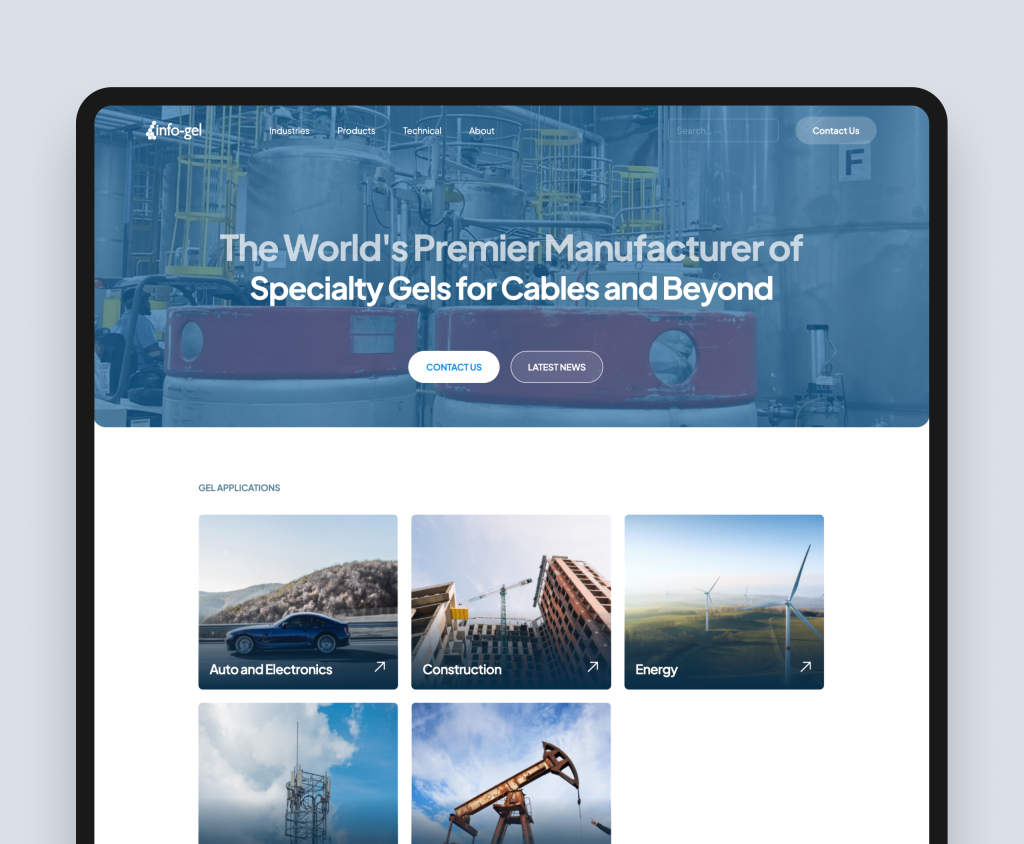
| Case study: Info-Gel (Specialty gels for cables, HubSpot CMS) |
| Info-Gel's previous website had no cohesive structure for navigating a large specialty chemicals product catalogue and no search functionality for the technical data sheets that specifiers need. Rudo redesigned and rebuilt the site with a well-organised product taxonomy, intuitive catalogue navigation, and robust search functionality making TDS and SDS documentation efficiently accessible. The redesigned website received positive feedback from both existing clients and new prospects, with Info-Gel establishing a digital presence that matches the technical quality of the products it represents. Full case study: rudo.co.uk/case-studies/info-gel/ |
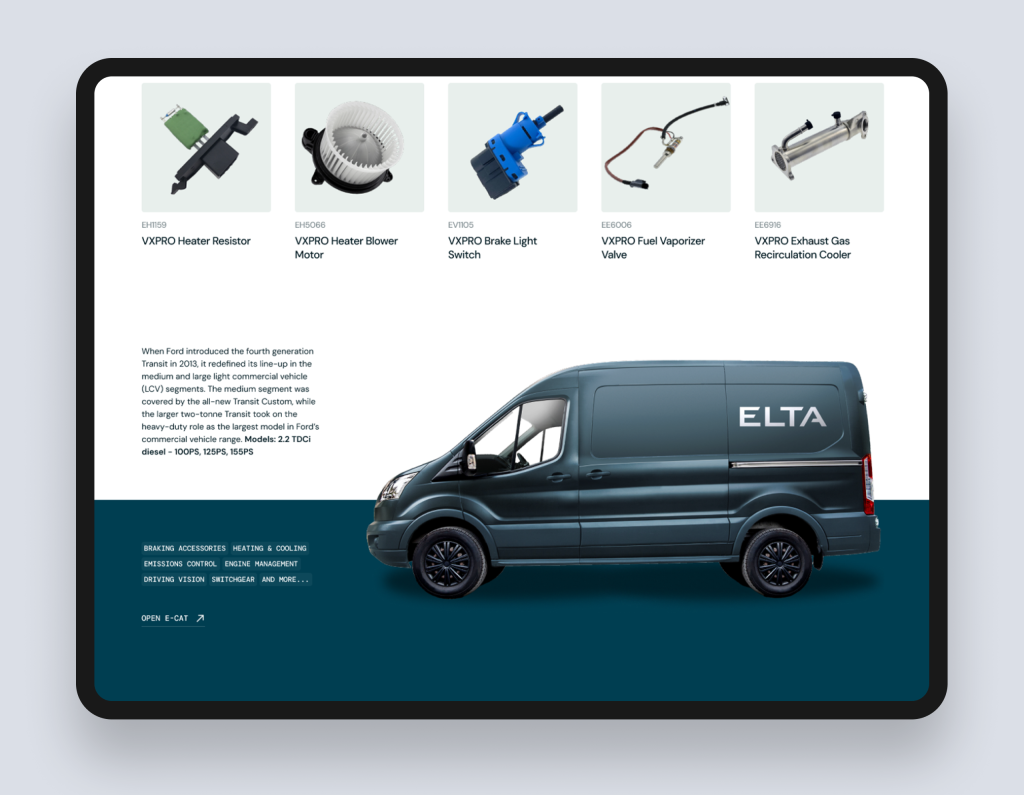
| Case study: ELTA Automotive (Automotive component distribution, UK) |
| ELTA Automotive is a UK-based, family-owned automotive component distributor and manufacturer with 30 years of market presence. Official Lucas brand licensee for the UK and Europe. Rudo built a website that communicates the breadth of ELTA's product portfolio, the depth of their application data capability, and the authority of a three-decade market presence — serving both the trade counter buyer looking up a specific application and the motor factor owner evaluating a supplier relationship. EDITOR NOTE: Case study page pending publication. |
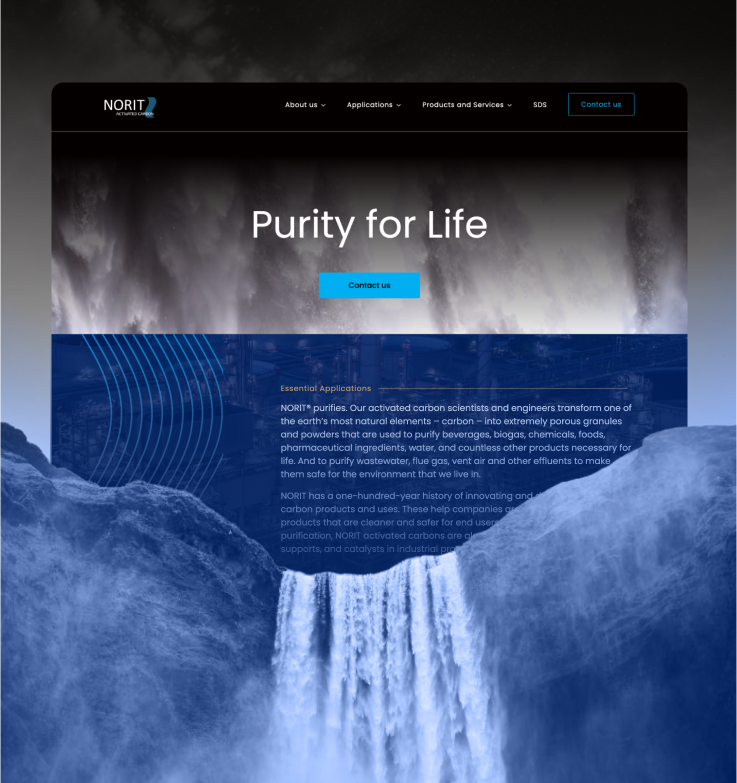
| Case study: Norit (Activated carbon manufacturing, global) |
| Norit is one of the world's largest producers of activated carbon, with 400+ grades serving pharmaceutical, water treatment, food and beverage, and industrial applications across ten plants in seven countries. Rudo's work with Norit focused on creating a digital presence that communicates the scale and technical authority of a global manufacturing leader to highly technical buyer audiences across multiple industries and geographies. EDITOR NOTE: Case study page pending publication. |
Rudo is ranked number one UK web design agency on DesignRush and top ten on Clutch. Find out more about our manufacturing web design service.
9. Questions to ask any agency before hiring
These questions work for any agency you are evaluating for a manufacturing project. The answers will quickly reveal whether the agency has genuine sector depth or generic B2B experience applied to a manufacturing brief.
On sector experience
- Can you show us manufacturing or industrial websites you have delivered, and can we speak to the clients? Portfolio images are curated. Real conversations with real clients reveal what the agency actually delivered and what the commercial impact was.
- How do you approach product catalogue architecture for a manufacturer with complex technical products? Listen for specific thinking about buyer types, specification search, application navigation, and documentation access. Generic answers about 'user-friendly design' indicate shallow experience.
- How have you handled technical documentation in previous manufacturing projects? Look for specific answers about CMS architecture, documentation search, data sheet accessibility, and how non-technical team members manage updates.
On process and approach
- What does your discovery phase involve for a manufacturing project? An agency with genuine depth will describe a process that includes buyer persona work, competitive analysis, and a commercial goal-setting conversation. An agency without it will describe a brief intake and a meeting with the design team.
- How do you handle copywriting? For manufacturing clients, copywriting is not something that can be left to an internal team who are product experts but not commercial communicators. Ask whether copywriting is scoped, planned, and managed as part of the project.
- What happens in the first 30 days after launch? Good agencies have a clear post-launch plan: performance monitoring, CMS training, SEO configuration, and a defined point of handover. Agencies that disappear after launch are not long-term partners.
On commercial accountability
- How do you measure whether a manufacturing website is working? Look for specific commercial metrics: enquiry volume, enquiry quality, organic search visibility for target specification keywords, and time-to-contact for buyers who found the company through the website. Generic answers about traffic and bounce rate indicate a lack of commercial focus.
- What manufacturing clients have seen measurable commercial outcomes from your work? Ask for specifics: which clients, what sector, what changed, and whether you can speak to them directly.
For a checklist of questions covering the broader B2B agency selection process, read how to choose a B2B web design agency.
Work with a manufacturing web design agency that understands your sector.
Rudo has delivered manufacturing websites for specialty chemicals companies, automotive component distributors, and global industrial manufacturers. Book a no-pressure intro call and we will review your current site, discuss your buyers, and tell you honestly what your website needs to do differently.
10. Frequently asked questions
What should a manufacturing web design agency know about my sector?
A genuine manufacturing web design agency should understand: how B2B buyers in manufacturing research and specify suppliers online (and how this differs from consumer and general B2B buying behaviour); the structure of a manufacturing product catalogue and how to make it navigable for both product-led and application-led buyers; the role of certifications and compliance documentation in supplier qualification; how to handle technical data sheets and safety data sheets as commercial content rather than administrative documents; and the specific credibility signals that manufacturing buyers look for when evaluating a new supplier.
How much does a manufacturing website agency charge?
Manufacturing website costs vary significantly based on the complexity of the product catalogue, the number of audience types the site needs to serve, and the depth of strategic and copywriting involvement. A standard mid-market manufacturing website build at Rudo typically costs £12,000 to £25,000. More complex projects involving specification filtering, large catalogue architecture, or ERP integration typically cost £25,000 to £50,000. The investment is consistently justified by the commercial outcomes a properly built manufacturing website generates.
For a detailed breakdown, read our manufacturing website cost guide.
How do I know if a web design agency has genuine manufacturing experience?
Ask to see multiple manufacturing portfolio examples and speak directly to manufacturing clients from their portfolio. Navigate those sites as a technical buyer would: try to find a specific grade of a product, locate a data sheet, check how certifications are presented, and assess whether the site serves an engineer's information needs. Check the page load speed on mobile. These practical tests reveal the actual quality of the work far more reliably than portfolio screenshots.
Does our web design agency need to be based in the UK?
Geographic proximity matters less than sector expertise and commercial alignment. The majority of professional B2B web design projects are delivered remotely through video calls and collaborative tools. A strategy-led agency with deep manufacturing experience based in London will consistently outperform a local generalist agency without sector knowledge. That said, if in-person discovery workshops or site visits to photograph your facility are important to how you work, geography becomes a practical consideration.
What is the most important thing a manufacturing web design agency should do?
Start with strategy before design. The most commercially damaging mistakes in manufacturing website design — navigation built around internal product codes rather than buyer search behaviour, homepage copy that says nothing specific to a prospective buyer, product pages that lead with the product name rather than the application context — are strategy problems, not design problems. They look acceptable in a design review and fail commercially after launch. The only way to prevent them is to do the strategic discovery work before any design begins.
Find out more about our manufacturing web design service.
Also in this series: manufacturing website design guide, manufacturing product catalogue websites, manufacturing website cost, manufacturing website examples, and SEO for manufacturers.

Written by
Rudo Agency
Rudo is a strategy-led web design and development agency specialising in B2B. Based in the UK and working with clients globally, we help ambitious brands turn complex ideas into high-performing websites. Our team combines digital strategy, UX/UI design, custom development, and SEO to deliver results-focused websites that support real business growth.
